
This Still Isn’t Normal
On Sunday, President Donald Trump took to his Truth Social account to announce that he would be reporting NBC News’ Kristen Welker, “the Unpopular ‘Hostess’ of the once great Meet the Press, now considered Meet the Fake Press,” to the Federal Communications Commission “for rebuke or punishment.”
You know, normal president stuff.
Minutes earlier, Trump had posted an all-caps screed claiming that the FCC was going to do something about “the fake polls used by our crooked media.”
I’m already exhausted. And not that it really matters, but let’s look at what Welker actually said. It wasn’t actually part of the Meet the Press broadcast on Sunday, but during a promo for the show on WRC-TV, the NBC-owned station in DC. Welker said this:
He’s going to loom large over these midterms. There’s no doubt about that. He, of course, has endorsed a slate of candidates in the primaries. He’s had some mixed results, but most recently, his pick of Senator Darline Graham, of course, the sister of the late Senator Lindsey Graham, was successful in her primary battle, so now she takes on Dr. Annie Andrews in South Carolina.
Three words set him off: “Some mixed results.” Okay, then. And while I’m wary of even dignifying Trump’s nonsense complaint as worth engaging with, I’d like to note that it’s probably fair to say that there have been “mixed results” when it comes to Trump’s primary endorsements. Like… yes, he has successfully endorsed the winning candidate 96% of the time during the 2026 primaries because he made 313 primary picks, which included a bunch of incumbents who didn’t have a serious primary challenger.
His misses have been pretty rough. Trump’s fourteen misses include the endorsement of Rep. Cory Mills (R-FL) after serious allegations of sexual misconduct and violence arose. Mills lost. Similarly, My Pillow lunatic and election conspiracy theorist Mike Lindell lost his primary for governor in Minnesota. Rep. Andy Ogles (R-TN), who famously posted that “Muslims don’t belong in American society” earlier this year, lost his primary for re-election. The most embarrassing loss for Trump probably has to be Amir Hassan (R-MI)‘s failed attempt to get the nomination as the Republican candidate in Michigan’s 8th district. Hassan’s opponent Thomas Smith suspended his campaign a few weeks before the primary, but somehow came away victorious over Hassan. Add in that his picks for governor in Iowa and Georgia both face planted, and you can see how this might be described as “some mixed results.”
But none of this matters. None of this justifies Trump’s calls to sic the FCC on NBC because he didn’t like something the host of Meet the Press said or for publishing polls that correctly note that he is just… wildly unpopular right now. Even if Trump had a perfect score when it came to endorsements, it’s beyond inappropriate for him to be using the FCC like a weapon the way he’s done throughout his second term.
I really, truly don’t want to have to be writing about this. It’s an extraordinarily dumb story — the president got upset because a local TV promo included language he didn’t like, and demanded that the power of the federal government be used to crush her — but I feel like I have to write it up, because as people have been saying for the past decade or so, this isn’t normal.
Let’s take the post in pieces. I really want it to sink in how unhinged this all is.
“How can anyone be allowed to say this, working for freely given Public Airwaves?”
Allowed. By him, I suppose.
“Because of this purposeful inaccuracy, she will be reported to the FCC for rebuke or punishment. Unfortunately, she is not the only one.”
So who else is on the FCC naughty list for saying things the president doesn’t like?
“In actuality, it is, without question, the strongest Endorsement in the History of Politics. If it were not, I would be the first to admit it.”
Irrelevant, but I do not think he would, in fact, be the first to admit it.
That question about who else is on the list isn’t rhetorical. Before Trump retook office in January 2025, he was already leading a crackdown on free speech. In December 2024, weeks before he was sworn in, he sued a pollster — Ann Selzer, along with the Des Moines Register — over a poll he didn’t like. And as soon as he took office, he started putting the government to work doing the same.
Just two days into the second Trump administration, FCC chairman Brendan Carr revived three complaints — against ABC, CBS, and NBC — that had been dismissed as “at odds with the First Amendment.”
The CBS complaint was about the editing of the infamous 2024 60 Minutes interview they aired with Kamala Harris. In February 2025, the FCC released the raw transcript and pushed on in its investigation. As it became clear that Skydance was going to acquire the network, the company started taking action to please the administration. 60 Minutes producer Bill Owens resigned in April 2025, telling staff that “I would not be allowed to run the show as I have always run it.” The next month, CBS News president Wendy McMahon was out, saying only that she and the company “do not agree on the path forward.”
On July 1, 2025, Paramount agreed to pay Trump $16 million to settle his lawsuit over the 60 Minutes interview. Two weeks later, Stephen Colbert went on the air and called it a “big fat bribe.” Three days after that, CBS canceled The Late Show, a show that had been critical of Trump, with its final episode airing this past May. CBS said the cancellation was “purely a financial decision.” A week after that, the FCC approved Paramount’s merger with Skydance, after the buyer promised to install an ombudsman to field complaints about anti-conservative bias in CBS News coverage and to end the company’s DEI policies.
Notice that the FCC didn’t ever have to actually rule on the complaint in order to get a bunch of concessions for Trump.
In September 2025, Carr went on a right-wing podcast where he threatened ABC over a Jimmy Kimmel Live segment the administration didn’t like. From the audio: “We can do this the easy way or the hard way. These companies can find ways to change conduct, to take action, frankly, on Kimmel, or, you know, there’s going to be additional work for the FCC ahead.” Kimmel was briefly taken off the air, but returned days later.
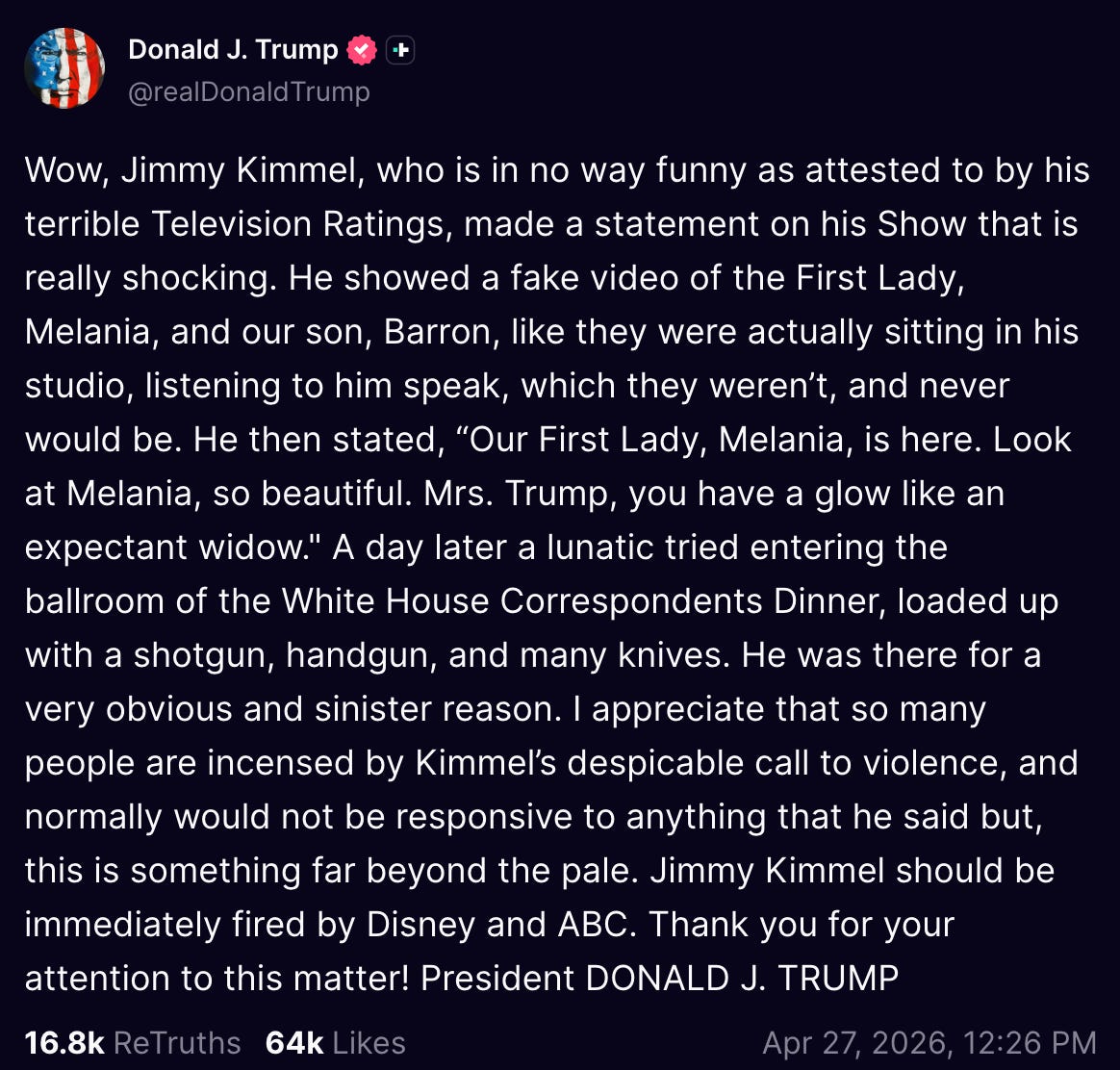
By April 2026, Trump was on Truth Social ranting about Kimmel again, writing that “Jimmy Kimmel should be immediately fired by Disney and ABC” over a joke made at Trump’s expense. The very next day, the FCC ordered all eight ABC-owned stations to file for early license renewal in an attempted shakedown. Disney and ABC are at least pushing back on this, however. Two weeks ago, the company sued the FCC over the license renewal demand, calling it a “retaliatory campaign.” A judge hears arguments in October.
Meanwhile, at NBC, Comcast has been under an FCC investigation since February 2025 over the company’s “invidious forms of DEI“ policies that “do not comply with FCC regulations & civil rights laws.” That one’s still up in the air.
In 19 months, the FCC hasn’t revoked a single broadcast license. And it hasn’t ruled against a single station on a “news distortion” complaint. Why? Because with the exception of ABC and Disney, which seemed to grow a spine after the second time they got targeted by the administration, the FCC hasn’t actually had to. They’ve just gotten whatever they’ve wanted. Anna Gomez, the lone Democrat at the FCC, walked through how it works in a May letter to Disney’s CEO, using the ABC complaint as her example:
In late 2024, a politically motivated outside organization filed a complaint with the FCC alleging that ABC violated the FCC’s news distortion policy in its coverage of the presidential campaign, specifically the presidential debate ABC journalists moderated. Agency staff reviewed that complaint and dismissed it in January 2025, finding it contrary to the First Amendment and that it failed to even assert a set of facts that, if true, would violate FCC rules. This FCC revived it anyway, for reasons that have nothing to do with the merits and everything to do with politics. It is unclear to what degree this FCC has even seriously pursued that complaint, and I suspect there will be no end in sight for that investigation because the process is the punishment and keeping it open serves that goal.
This isn’t just some fringe-left read of what’s happening, either. Even Sen. Ted Cruz (R-TX), who chairs the Senate Commerce Committee, criticized Carr for his “easy way or the hard way” comments about Kimmel, saying that the language was “right out of a mafioso coming into a bar going, nice bar you have here, it’d be a shame if something happened to it.” He called the attitude “dangerous as hell.” In July, 13 former FCC officials of both parties — including Mark Fowler and Dennis Patrick, the two men Ronald Reagan put in charge of the agency — asked the commission to drop the ABC investigation, calling it “an assault on free speech disguised as regulatory process.”
This is not normal. I guess it’s worth saying again.