
A 'D' and a bunch of 'B's — my report card for the media covering Trump's awful speech
You’ve heard of the easy A? Well, in this media report card following Donald Trump’s primetime speech on Thursday night, I’ll hand out this easy D.
The D goes to Fox News, which surprisingly managed not to flunk altogether. While it did air every minute of the predictably lie-filled speech, Fox hosts and others managed to interject some skepticism. Even Sean Hannity, a Trump loyalist if there ever was one, noted that truth might be in short supply in this speech, and another Fox host noted that the network could not verify Trump’s claims. Of course, we know why Fox was more careful than usual, since it paid a huge settlement to a voting machine company for the network’s misleading coverage of Trump’s false claims about a “rigged” 2020 election.
To ABC News and NBC News, a couple of Bs. Kudos for the decision not to broadcast Trump live, which seems completely logical but took some institutional guts. I didn’t think the commentary was all that strong. Both broke in to their regular programming later, post-speech. Also, you could find the full speech streaming on these networks’ streaming news channels, which raises the question: Why is that OK, if broadcasting is not? Is it a way to straddle the line? Trump didn’t see it that way. He harshly criticized the two networks during his speech — “they want to protect the radical left.” Talk about lies and falsehoods.
To CBS News, a C-plus. I give that even though CBS News was the one broadcast network that did make the dubious decision to air most of the speech live, thus handing Trump an undeserved megaphone. BUT, their presentation and commentary was outstanding and helpful. As one veteran broadcaster told me, “Bravo to CBS News for extended analysis and context not matched by ABC or NBC. CBS provided fair and balanced coverage that turned out to be excellent.” Evening News anchor Tony Dokoupil even started out by warning viewers that he expected the speech to offer a lot of falsehoods. “Much of what the president has said on this topic has been untrue,” he began, and acknowledged the (obvious) “argument that it is irresponsible to air the president’s speech tonight. But this speech will be made, it will be news, and it’s our job to cover the news.”
There are clearly still a lot of pros at the beleaguered Tiffany Network, and, in some ways, they managed to hold sway.
To the Washington Post, a somewhat baffled B-minus. To its credit, the Post didn’t air the speech live and, as far as I could see, never even made it the lead story online. Solid call there. Instead, they stuck with their fine exclusive about the damning real reasons for the reflecting pool’s problems. I was turned off, though, by “Brian,” the AI voice that offered a toneless reading of some of the Post’s speech coverage. It’s just so bad, and there’s no reason for it, except to say, “we’re down with AI here.” (Frankly, same with the AI text summaries of reader comments on Post story; I hate this. I want to hear real voices and read real words.) The Post also offered this mealy-mouthed headline online: “Trump’s address stops short of offering evidence of vote tampering.”
To the New York Times, another B-minus, but for different reasons. The Times — which really, really should know better, after last week’s outrageous subpoenas — decided to show Trump’s full speech live as the lead piece on its site. Yes, there was simultaneous analysis in the form of a live blog, which brought context and fact-checking; but taking the whole speech live nevertheless was a bad call.
To make it worse, every time I left the mobile site and came back to look at it, I got an automated suggestion to send the live speech coverage to others as a gift link. The effect of these decisions was to undercut the relatively courageous calls by ABC and NBC. I was heartened, however, to see a headline on the Times site that told the story remarkably straight: “Trump Asserts Outlandish Claims About Election Results in Address.”
But at other times, it was back to normalizing and both-sidesing: “White House Touts Trump speech as Democrats warn of recycled falsehoods.” It’s the “critics say” approach to truth-telling.
In the aftermath, the Times offered strong analytical reporting like a next-day piece headlined “Trump Brings Full Weight of Government to Bolster False Election Claims.” It stated, without attributing this to “critics” or “Democrats,” that the heavily redacted intelligence documents that Trump was touting “did not reveal new weaknesses in the country’s election systems or show that foreign governments had manipulated any votes.” The story is gift-linked above.
I’m hesitant to grade CNN or MS Now, because I didn’t watch either of them for very long in real time, but they both seemed to do well, with a particular nod to CNN’s approach.
As Tom Jones of Poynter summarized it: “CNN did not air the speech. Instead, CNN monitored the speech and then reported on it after it was over.” That’s the way to go, especially with a strong setup in advance. Truth sandwich, anyone? CNN might even deserve an A.
MS Now started to air the speech live but quit about halfway in. Afterwards, panelists for both cable networks did what panelists do — they chewed it over at length.
Some of the most trenchant commentary came not from Big Journalism but from individual commentators such as scholar and political scientist Norman Ornstein, whose X thread identified a story much broader than just another lie-filled speech: “Far too much emphasis has been put on Trump’s call yet again to pass the SAVE Act. That is not what is behind this speech. Trump is trying to lay the groundwork for seizing ballot boxes in key states and congressional districts based on false claims of foreign interference.” He predicts Trump “declaring a national emergency and abusing the emergency powers,” including seizing control of media outlets. It’s very scary stuff, and I think he’s on target, as usual.
Readers, what did you see in your media coverage and how did you react? Please let me know in the comments. And thank you very much for caring about the subject of this newsletter: The need for strong, fact-based, independent and courageous journalism as our democracy teeters.
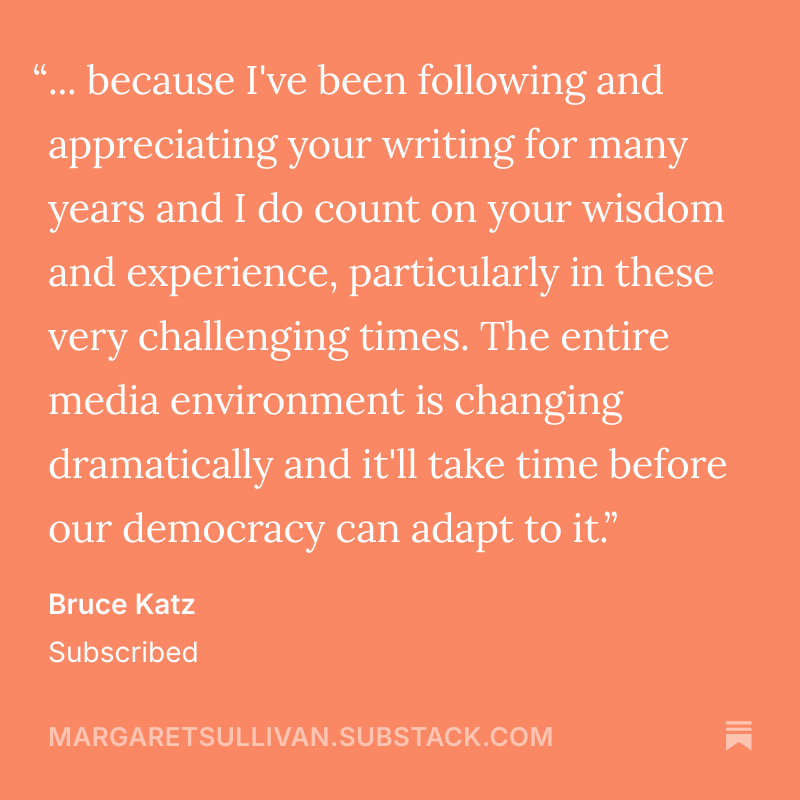
I am glad to have you here in any form, and particularly appreciative if you can swing the $50 a year to become a paid subscriber. Here’s why one reader did so recently:
My background: I am a Lackawanna, NY native who started my career as a summer intern at the Buffalo News, my hometown daily. After years as a reporter and editor, I was named the paper’s first woman editor in chief in 1999, and ran the 200-person newsroom for almost 13 years. Starting in 2012, I served as the first woman “public editor” of the New York Times — an internal media critic and reader representative — and later was the media columnist for the Washington Post. These days, I write here on Substack, as well as for the Guardian US. I’ve also written two books, taught journalism ethics, and won a few awards, including three for defending First Amendment principles.
The purpose of ‘American Crisis’: My aim is to use this newsletter (it started as a podcast in 2023) to push for the kind of journalism we need for our democracy to function — journalism that is accurate, fair, mission-driven and public-spirited. That means that I point out the media’s flaws and failures when necessary.
What I ask of you: Shortly after Trump’s election in November of 2024, I removed the paywall so that everyone could read and comment. I thought it was important in this dire moment and might be helpful. If you are able to subscribe at $50 a year or $8 a month, or upgrade your unpaid subscription, that will help to support this venture — and keep it going for all. Thank you!