
What we need right now is a big, juicy 'truth sandwich'
The concept of the “truth sandwich” is pretty simple. When dealing with political lies and propaganda, the media should not simply put false information out there and then offer some mild fact-checking afterwards.
Instead, provide three distinct layers: Present what we know to be truth. Follow it, if you must, by the politician’s false statements, and then follow that with a detailed fact check.
If you want to read more about this, and where it came from, here’s a gift link to a column I wrote for the Washington Post during the first Trump administration. (I’m told Brian Stelter of CNN coined the term; and the concept is from linguist George Lakoff.)
But that was then. Now we need to be even hungrier for the meal that feeds democracy.
On Thursday night, Donald Trump will blast out his version of what happened in the 2020 presidential election and try to build on the Big Lie that he’s been perpetrating for years — that he, not Joe Biden, should have won. That the election was rigged.
He’s doing this to sow doubt and confusion in the public because he’s terrified about the looming midterm elections. If the Democrats regain the House of Representatives (and even the Senate, too) he will lose the absolute power and the absolute lack of restraint that he so enjoys right now. We might get some semblance of checks and balances back again.
White House officials have already leaked what his big 9 p.m. speech is about — he’ll declare that newly declassified intelligence proves that a foreign government tried to mess with that election, and perhaps even insist that a national emergency must be declared to cede control of the midterms to the federal government.
Because Trump is the president, what he says always creates headlines. News organizations can’t ignore his proclamations. But they can serve the public interest by how they cover him. They can at least try to protect the truth.
Parker Molloy this week made the excellent point that the three major news networks (ABC, NBC and CBS) should not simply air Trump’s speech live and, in effect, hand him a megaphone. As of this writing, they hadn’t decided yet. (Hard to imagine CBS News, in its newly compromised state, not airing it live.)
After all, as Molloy observes, “the question of foreign involvement in the 2020 election was investigated to death, in real time, by Donald Trump’s own government, under rules Donald Trump signed.” That investigation found a clean election, as did another similar one by the Justice Department and the Department of Homeland Security.
I thought Reuters did a good job of laying this out Monday:
“President Donald Trump will give a national address on Thursday night about newly declassified intelligence on investigations into U.S. elections and what the White House says are voting machine vulnerabilities, an administration official said. The Republican president could use his televised speech … to again press his false claim that he lost his 2020 reelection bid to Democrat Joe Biden due to massive fraud.”
The story went on: “Numerous courts, ballot audits and his first-term Justice Department found no evidence of such fraud, including voting-machine rigging. The federal cybersecurity watchdog joined other federal state and local officials in declaring the vote ‘the most secure in American history.’”
(Side note for journo junkies: I loved that one of the three bylines on this solid Reuters story was that of Jonathan Landay, formerly of the Knight-Ridder reporting team which broke from the pack in the run-up to the Iraq War. The pack, led by the New York Times, was largely parroting Bush-friendly reports that Saddam Hussein had weapons of mass destruction. Landay and company reported otherwise, to their eternal credit. The country went to war, a disastrous one, anyway.)
The Reuters headline was okay, too: “Trump to assert voting machine vulnerabilities in Thursday speech.” (I would have liked “claim” more than “assert.”)
It’ll be mighty interesting to see how various media outlets cover this speech. Will headlines merely quote Trump, giving him more credence than he deserves? Will Fox News even nod to reality? Will the biggest “print” outlets — the Times, the Post, the Wall Street Journal and USA Today — avoid both-sidesing this speech? (Here’s how that would look: Trump says this, but critics say he’s wrong, and we really can’t help you figure out who’s right.)
How about the Associated Press, which is famously careful, which reaches far into the nation and world, and which has stood up to Trump in the recent past? How about CNN, which is at risk right now of falling into the same hands as CBS if a planned merger survives the challenges by state attorneys general?
I’ll be tracking this, and I hope you, readers, will let me know what you see in your news sources.
Of course, we also know that people get their information less and less from traditional news sources and increasingly from social media and short-form video such as TikTok. The standards, such as they are, are very different. So because it’s a national address by the president of the United States, Trump’s claims will be heard — and probably believed — far and wide.
Zooming out, let’s not forget what this is really all about: The midterms. The all-important midterms.
Robert Reich nailed it the other day, in a post titled “Trump WILL Try to Steal the Midterms. Here’s how.” The “how” is summarized thus: Eliminate neutral watchdogs. Eliminate all constraints on big money. Intimidate voters. Investigate and arrest alleged leftist “terrorists.” Make it harder to vote and control how ballots are counted. Cast doubt on the outcome of the midterms.
He quotes the former Republican operative Rick Wilson who notes that none of this stuff works if the anti-Trump vote is big enough. “Cheating operations work on the margins. They flip close races. They exploit recounts, certification fights, faithless officials, and friendly courts. What they cannot do, what no operation in American history has ever managed to do, is steal a landslide.”
What happens Thursday night and in its aftermath is part of Trump’s desperate plan to pull out all the stops in every one of the ways that Reich named. The media have a role to play. Reporters and their editors need to be aware of what’s going on and not allow themselves to be manipulated.
Stay tuned. I’ll be tracking it here.
Separately, with the recent Atlantic magazine story, “The Age of Reading Is Over,” I’ve doubled down on mine. Right now, I’m reading poetry (mostly Yeats, Szymborska and Dylan Thomas), novels including “Ghost Eye” by Amitav Ghosh, and non-fiction, including an advance copy of “The Digital Delusion: How Classroom Technology Harms Our Kids’ Learning — and How to Help Them Thrive again” by Jared Cooney Horvath. I also stayed up way too late one night finishing a Scott Turow legal thriller I had missed when it came out many years ago, “Reversible Errors.”
What are you reading, and how else are you resisting the soul-deadening digital and AI tsunami? (Handwritten letters? Real-life meetups with friends? Gardening instead of texting?) Please let me know. Finally, you might enjoy this wonderful piece (gift link here) by Alexandra Jacobs in the New York Times about the 75th anniversary of “The Catcher in the Rye.”
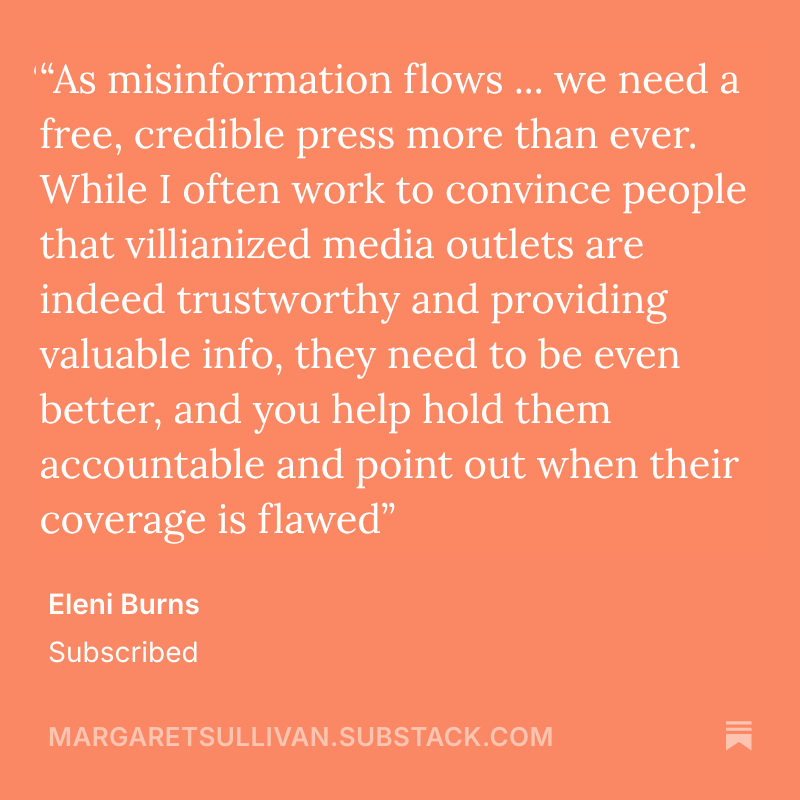
Thanks so much for being here and caring about these issues. Here’s why one reader recently became a paid subscriber. I’d be honored if you’d consider doing the same.
My background: I am a Lackawanna, NY native who started my career as a summer intern at the Buffalo News, my hometown daily. After years as a reporter and editor, I was named the paper’s first woman editor in chief in 1999, and ran the 200-person newsroom for almost 13 years. Starting in 2012, I served as the first woman “public editor” of the New York Times — an internal media critic and reader representative — and later was the media columnist for the Washington Post. These days, I write here on Substack, as well as for the Guardian US. I’ve also written two books, taught journalism ethics, and won a few awards, including three for defending First Amendment principles.
The purpose of ‘American Crisis’: My aim is to use this newsletter (it started as a podcast in 2023) to push for the kind of journalism we need for our democracy to function — journalism that is accurate, fair, mission-driven and public-spirited. That means that I point out the media’s flaws and failures when necessary.
What I ask of you: Shortly after Trump’s election in November of 2024, I removed the paywall so that everyone could read and comment. I thought it was important in this dire moment and might be helpful. If you are able to subscribe at $50 a year or $8 a month, or upgrade your unpaid subscription, that will help to support this venture — and keep it going for all. Thank you!