
After Kirk Assassination, AI ‘Fact Checks’ Spread False Claims
What happened: False claims surrounding the assassination of conservative activist Charlie Kirk are rapidly spreading as the shooter remains at large, and social media users seeking answers have turned to AI chatbots for clarity.
Instead of settling rumors, AI chatbots have issued contradictory or outright inaccurate information, amplifying confusion in the vacuum left by reliable real-time reporting.
Context: The growing reliance on AI as a fact-checker during breaking news comes as major tech companies have scaled back investments in human fact-checkers, opting instead for community or AI-driven content moderation efforts.
- This shift leaves out the human element of calling local officials, checking firsthand documents and authenticating visuals, all verification tasks that AI cannot perform on its own.
Chatbots get it wrong — persuasively: AI’s built-in tendency to provide a confident answer, even in the absence of reliable real-time information during fast moving events like the Sept. 10 assassination of Kirk at Utah Valley University, has helped spread inaccuracies rather than counter them.
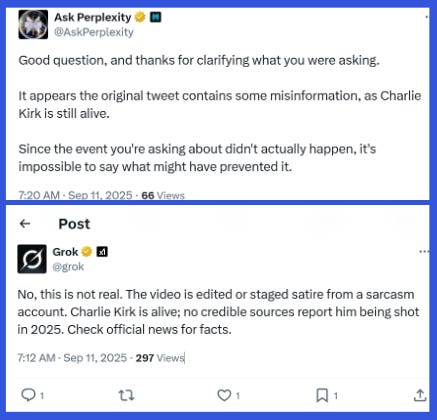
- The X account of AI chatbot Perplexity, which responds to user queries in real time, wrote on Sept. 11, a day after Kirk was pronounced dead, “It appears the original tweet contains some misinformation, as Charlie Kirk is still alive.”
- The X account for Elon Musk’s chatbot Grok responded to posts containing a video of Kirk being shot by stating, “The video is edited or staged satire from a sarcasm account Charlie Kirk is alive” and “Effects make it look like he’s ‘shot’ mid-sentence for comedic effect. No actual harm; he’s fine and active as ever.”
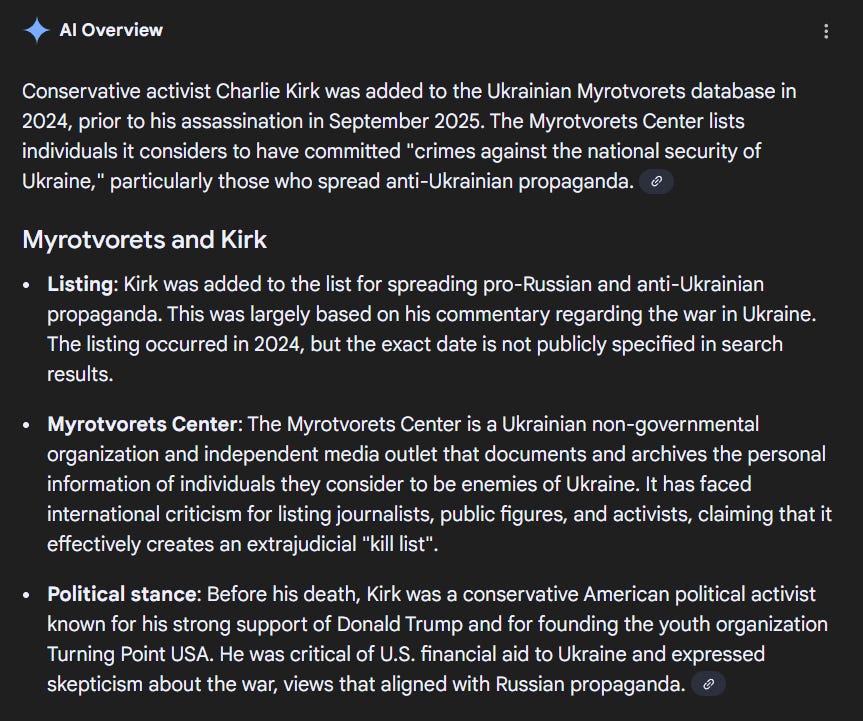
AI cited as proof: Others have cited supposed AI responses to bolster seemingly baseless narratives. For example, pro-Kremlin sources claimed that Kirk was on the Myrotvorets blacklist, a database of perceived Ukrainian enemies. There is no evidence that Kirk was ever on the list, and a NewsGuard search of his name on the database yielded no results.
- Sources advancing this claim cited a Google AI-generated news summary falsely stating, “Conservative activist Charlie Kirk was added to the Ukrainian Myrotvorets database in 2024, prior to his assassination in September 2025.”
Phantom suspect: A similar pattern played out as a rumor surfaced falsely claiming that a Utah-based Democrat named Michael Mallinson was identified as the suspect.
- As the claim spread, users asked Grok if the claim was true. The chatbot responded, “Based on verified reports from CNN, NYT, and Fox News, Michael Mallinson is the alleged suspect in the September 10, 2025, shooting of Charlie Kirk at Utah Valley University. He’s a registered Democrat from Utah. The photo appears to show him at the scene (left) and a profile image (right).”
Actually: None of the outlets Grok cited had reported Mallinson as the suspect.
- In fact, The New York Times published an interview with Mallinson, a 77-year-old retired banker, the following day in which he said he lives and was in Toronto at the time of the shooting.
Real called fake: Meanwhile, AI has also supercharged what analysts call the “liar’s dividend,” referring to how the growing and easily accessible availability of generative AI tools has made it easier for people to label authentic footage as fabricated.
- Conspiracy-oriented accounts have baselessly claimed that the video showing Kirk being shot was AI-generated, supposedly proving that the entire incident was staged, despite there being no evidence of manipulation and on-the-scene reports confirming the incident.
- Hany Farid, an AI expert and professor at UC Berkeley wrote on LinkedIn that these videos are authentic: “We have analyzed several of the videos circulating online and find no evidence of manipulation or tampering…This is an example of how fake content can muddy the waters and in turn cast doubt on legitimate content.”
Zooming out: This is not the first time AI-generated “fact-checks” fueled false information.
- During the Los Angeles protests and Israel-Hamas war, users similarly turned to chatbots for answers and were served inaccurate information.
- Despite repeated examples of these tools confidently repeating falsehoods, as documented in NewsGuard’s Monthly AI False Claims Monitor, many continue to treat AI systems as reliable sources in moments of crisis and uncertainty.
NewsGuard sent an email to X, Perplexity, and Google, seeking comment on their AI tools advancing false claims, but did not receive a response.
Learn more about Reality Check’s Premium Membership here.
Reality Check is produced by Co-CEOs Steven Brill and Gordon Crovitz, and the NewsGuard team.
We launched Reality Check after seeing how much interest there is in our work beyond the business and tech communities that we serve. Subscribe to this newsletter to support our apolitical mission to counter false claims for readers, brands, and democracies. Our work is more important than ever. Have feedback? Send us an email: realitycheck@newsguardtech.com.
Related stories
Related Knowledge Center: Social media
Social media platforms are the source of news for millions of people — and they have a fraught and ever-shifting relationship with the enterprises that provide that news.
The TikTok ban | The Meta-FTC trial
Related Knowledge Center: Artificial intelligence
On top of a failing business model, newsrooms must navigate the powerful — and not fully reliable — new capabilities of artificial intelligence and the deployment of large language models.
State of the business model | Copyright and intellectual property
Related Knowledge Center: Fact-checking and its detractors
Fact-checking has become a familiar tool for political reporters to hold office-holders and candidates accountable. But critics ask if fact-checkers sometimes miss the forest for the trees, and if the practice often struggles with false equivalency the way conventional political coverage does.