
The yin and the yang of the New York Times — again
First off, two things. Then on to the meat of this post.
Thanks to the many new paid subscribers. I’m very touched by the response to my request last week, including so many kind messages. And welcome to all new subscribers!
Second, over the weekend, my editors at the Guardian US asked me to write a column about Donald Trump’s move to ban CNN, Politico and MS Now from the White House. That column will probably be published this afternoon or tomorrow morning, so I won’t write about the subject at length here. I’ll send the Guardian column around on Substack notes and on Bluesky once it launches.
Sneak peek: I will explore the questions, what if there had been true solidarity among the White House press corps all along? What if there hadn’t been so much tolerance of and accommodation for Trump’s bullying? What if principle was as important as access?
Onward, then, to the yin and yang of the New York Times, which is a recurring topic here. By that, I mean, the dark and the light, the good and the bad, the successes and the failures of America’s most important news organization — a place where I once was the inside-the-newsroom watchdog and reader representative, or public editor. Because I held that job (one that, since 2017, no longer exists), I follow what happens at the Times with particular interest. The interest of an insider and an outsider, as I was then, and in some ways, remain.
As with many of you, I find the Times essential, and I know that it sometimes — too often — falls short.
So, this week, the yin and the yang go like this.
The Times celebrated its 175th anniversary with a glitzy party, full of journalism and business luminaries. Publisher AG Sulzberger talked about the importance of a free press, and celebrated the Times’s success and accomplishments.
“The free press needs allies. A confluence of pressures — eroding business models, intellectual property theft by AI companies, worsening attacks on press freedom — has left the press badly diminished, and more vulnerable than at any point in the nation’s 250 years. The press is not perfect. And The Times is not perfect. The first draft of history is by its very nature imperfect. But this labor of learning and sharing is animated by the idealistic belief that the public — all of you — deserves to know the full story as best as we can report it out. That’s what The Times is here to do, without fear or favor.”
Was the whole celebration a trifle too self-congratulatory, too self-important? Maybe so, given the state of American democracy and journalism right now. As you know, I think the Times (and Big Journalism in general) has pulled its punches far too often in normalizing this president and this administration, as I wrote last week.
See what you think; gift link here. Please let me know your thoughts.
Over at Columbia Journalism Review, Bill Grueskin was pulling back the curtain about how things sometimes work at the Times by digging into the paper’s first loss of a defamation case in more than 50 years. A jury awarded $9.25 million to a former University of Alabama basketball player, Kai Spears, because, as Grueskin summarized it, the Times story “mistakenly placed him as a passenger in a car that was at the scene of a tragic shooting death.” (A judge has since slashed the jury’s punitive damages amount.)
A former top Wall Street Journal and Miami Herald editor, Grueskin is a professor at Columbia Journalism School; he’s a perceptive and sharp-eyed observer who brings a lot of reporting to his pieces, in this case examining court briefs, depositions and news coverage.
Here’s part of what he wrote: “At almost every turn, Times journalists misplayed their hand, whether in a brief interview with Spears, or in the seventy-nine days that it took to correct the error,” or in an internal email that became part of the court record. The story was based on an anonymous source and was quickly denied.
The Times calls what happened an honest mistake but it offers insight into how the reporting and editing system can break down, and do harm. Especially when shaky anonymous sources are involved; that was something I railed against during my public-editor stint. Some reforms were put in place while I was there.
Read the CJR story here. And again, please let me know your thoughts.
About the three books. I’m reading Kai Bird’s masterfully reported biography of Roy Cohn, “American Scoundrel.” The through-line to Trump is unmistakable, and Trump himself knew it, given how he once famously demanded, “Where’s my Roy Cohn?” Bird, of course, is the author of the Pulitzer Prize-winning biography, “American Prometheus: The Triumph and Tragedy of J. Robert Oppenheimer.” The new book is co-authored with Bird’s wife, Susan Goldmark.
Also on my reading list is David Corn’s new book, “How Russia Won: Donald Trump, Vladimir Putin, and the Fight for America.” Corn is a longtime investigative reporter for Mother Jones, and calls his book “an attempt to reclaim the Trump-Russia narrative in the face of Trump’s decade-long crusade to brand it a hoax.” You can read an excerpt here. The historian Heather Cox Richardson has called it “a vital step toward a long-overdue national reckoning.”
And one more: “This Cursed, Beautiful Land: A Russian-American Story,” by Evan Gershkovich of the Wall Street Journal who was arrested on false espionage charges in 2023 and spent almost 500 days in the Russian penal system. Evan was my editorial assistant at the Times. I wrote about his imprisonment several times for the Guardian, and I’m overwhelmingly glad that he is free.
Readers, thank you for being here. Thanks for the support and the interest at this critical moment. The high-stakes midterms are now only six weeks away. Please hang in here with me, and tell me your thoughts in the comments.
Also, readers know that I occasionally mention my producer, Abraham Kenmore, who was my teaching assistant at Duke years ago. He is also a freelance reporter and last week published a story about how some people in Durham, North Carolina, are referred to ICE after minor arrests — even when the law does not require it. I know that many of you care deeply about this kind of local reporting, as I do, so I thought you’d like to have a look.
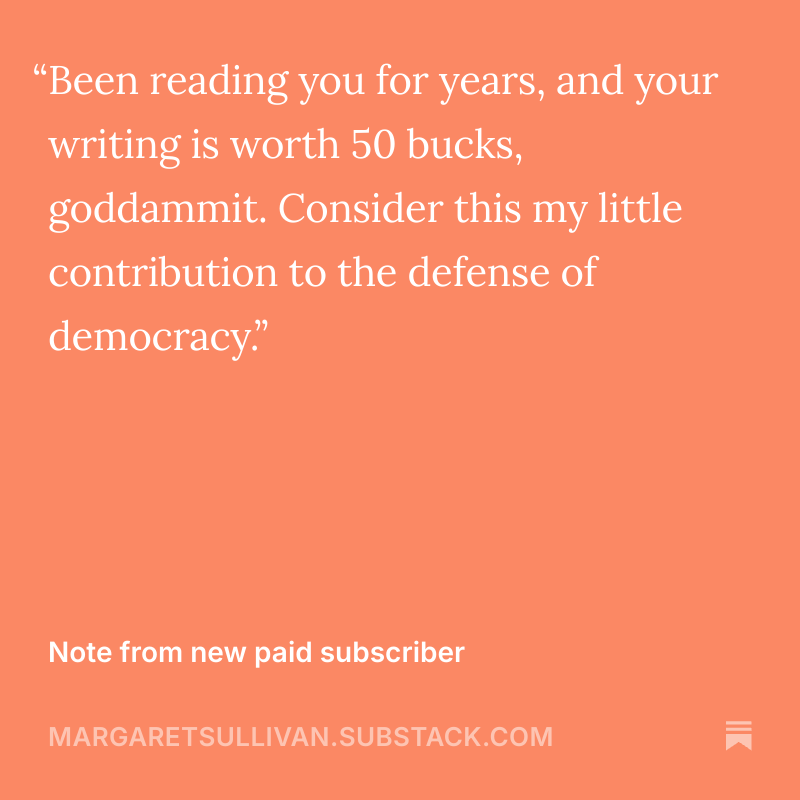
Here’s a message from a new paid subscriber that made me grin. I later found out that he is a longtime Boston sports writer. Which makes perfect sense. Please consider joining him — thank you!
My background: I am a Lackawanna, NY native who started my career as a summer intern at the Buffalo News, my hometown daily. After years as a reporter and editor, I was named the paper’s first woman editor in chief in 1999, and ran the 200-person newsroom for almost 13 years. Starting in 2012, I served as the first woman “public editor” of the New York Times — an internal media critic and reader representative — and later was the media columnist for the Washington Post. These days, I write here on Substack, as well as for the Guardian US. I’ve also written two books, taught journalism ethics, and won a few awards, including three for defending First Amendment principles.
The purpose of ‘American Crisis’: My aim is to use this newsletter (it started as a podcast in 2023) to push for the kind of journalism we need for our democracy to function — journalism that is accurate, fair, mission-driven and public-spirited. That means that I point out the media’s flaws and failures when necessary.
What I ask of you: Shortly after Trump’s election in November of 2024, I removed the paywall so that everyone could read and comment. I thought it was important in this dire moment and might be helpful. If you are able to subscribe at $50 a year or $8 a month, or upgrade your unpaid subscription, that will help to support this venture — and keep it going for all. Thank