
Yes! THIS is how it's done, New York Times
There’s a principle in management known as “catch them doing something right.” The idea is that positive reinforcement, rather than constant criticism, works wonders.
As a frequent critic of the New York Times, and with that principle in mind, I want to spend some time here on how the New York Times handled Donald Trump’s blatant racism, which was on such hideous display last week.
You probably heard about it or saw the disgusting images that the president of the United States shared on his Truth Social platform: Former president Obama and his wife Michelle Obama depicted as apes, and sent around to his millions of followers.
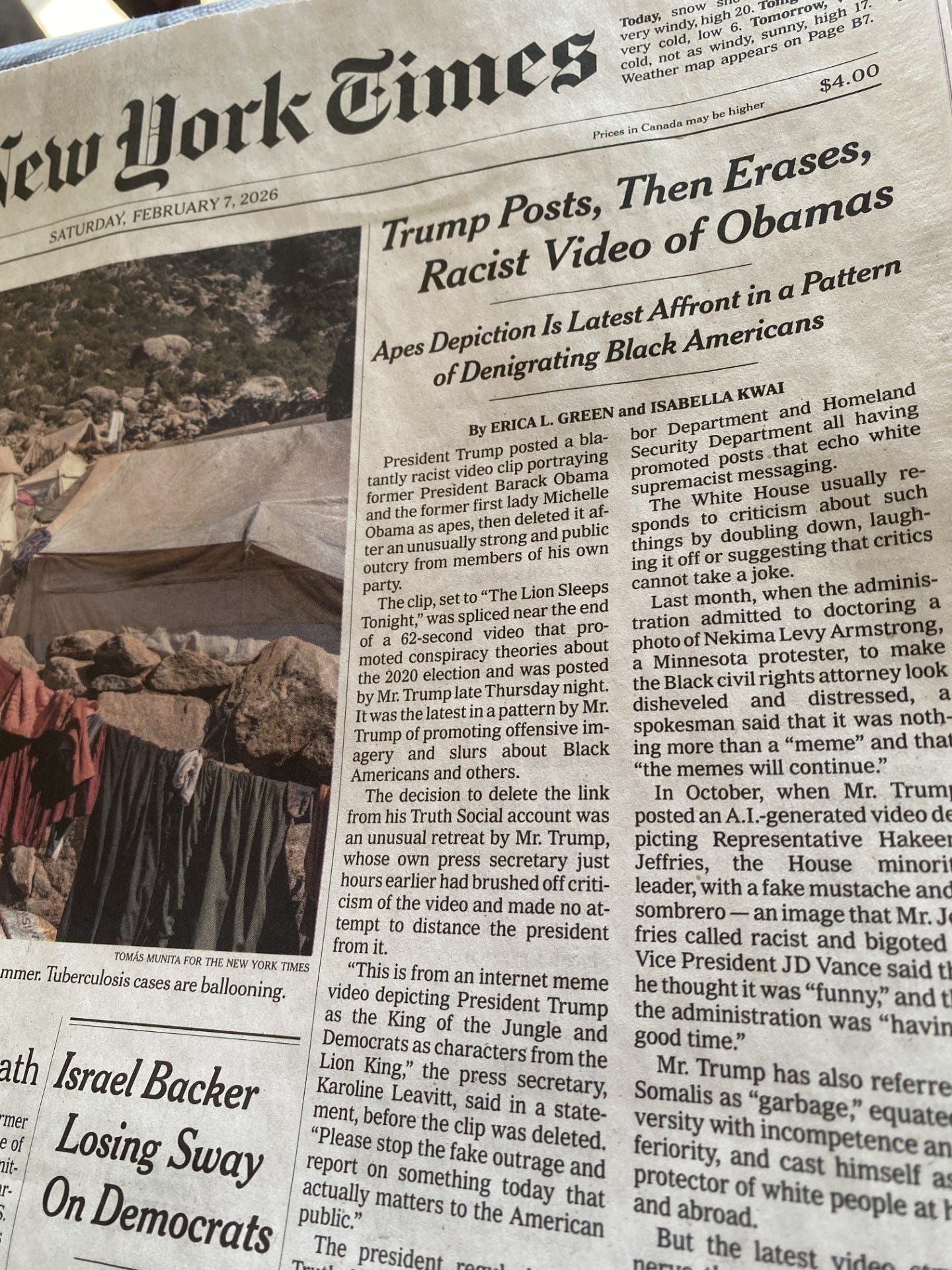
The Times was fast and direct in how its story was reported and displayed. Reporters Erica Green, Isabella Kwai and Zolan Kanno-Youngs wrote a strong story and the Times put it at the top of their website and mobile app. The next day it led the print edition, with this headline: “Trump Posts, Then Erases, Racist Video of Obamas.”
There was no pussyfooting. There was no soft-pedaling. There was no “some critics say” as a way to hint at the ugly truth. There was nothing about “racially tinged.” Racism was called out clearly.
Here was the lede: “President Trump posted a blatantly racist video clip portraying former President Barack Obama and the former first lady Michelle Obama as apes, but he insisted he had nothing to apologize for even after he deleted the video following an outcry.”
And here was a particularly notable paragraph: “The clip was in line with Mr Trump’s history of making degrading remarks about people of color, women, and immigrants, and has for years singled out the Obamas. Across Mr. Trump’s administration, racist images and slogans have become common on government websites and accounts, with the White House, Labor Department and Homeland Security Department all having promoted posts that echo white supremacist messaging.”
It went on: “The depiction of Mr. and Mrs. Obama as apes perpetuates a racist trope, historically used by slave traders and segregationalists to dehumanize Black people and justify lynchings.”
Straightforward, undeniable, and simply true. In contrast, the Washington Post played things more quietly (at least during my initial check, soon after I saw the Times story). It was second, not first, on the mobile app, with a softer headline: “Trump shares video depicting Obamas as apes.”
The Times article — appropriately, it was not billed as an analysis or an opinion piece — was the lead article online, and the next day, it was the most prominent article in the printed newspaper. Front page, top right-hand corner, two-column headline: That’s just about as big as it gets.
A sense of outrage radiated from all of this — headline, lede, placement, language. Kudos.
Why, though, is this so rare? Why, when it comes to other topics, such as vote suppression, or insults to journalists, or threats to longtime allies, does the Times revert to its tendency to pull on its kid gloves and phrase things so deferentially?
Why did it take so long for the media, in general, to say that Trump was lying? Why is he so often given the benefit of the doubt, as well as handed a megaphone to magnify his version of events?
I’ve written about that a lot here. Words like “sane-washing” apply when describing Trump’s unhinged speeches.
The media has been slow — far too slow — and far too cautious. As for the “why,” I believe it comes down to journalists and their corporate bosses not wanting to appear biased, and being defensive about being called liberal. Also, the longstanding respect for the office of president, along with the knowledge that Trump was duly elected twice by American citizens, has played a role. And so, we see these distancing mechanisms, such as “critics say,” or “there is a sense” or “some liberals insist,” etc.
Those didn’t come into use here, and that was heartening. Seeking and stating the truth should be the first mission of serious news organizations, along with holding powerful people and institutions accountable to the public.
With the weakening of the Washington Post, the rightward drift of CBS News and the sharp decline of most regional newspapers across the country, the New York Times is even more influential than ever. When it decides to clearly say “racist,” (or sexist, or fascist, or autocratic), many other news outlets feel it’s safe to do so, too.
And when they all do, the public finally gets the message. It’s no longer about “partisan wrangling,” it’s about the decline of democracy under an autocratic and yes, racist, leader.
More of this fearless straight talk, please.
American Crisis is a community-supported project where I explore how journalism can help save democracy. Please consider joining us!
So many words — many of them eloquent — have been written about the deep staff cuts at the Washington Post over the past week. I’m sure you’ve seen some of them. So I’ll merely offer a couple of quotes that particularly stuck with me in their succinctness.
First, from David Remnick, a former Washington Post reporter himself, and now the longtime editor of the New Yorker, wrote: “It’s truly impossible to keep up, isn’t it?Last week—after the Wall Street Journal broke more news about the Trump family’s dodgy crypto-business dealings and before the President shared a racist video of the Obamas depicted as dancing apes—the Amazon entrepreneur Jeff Bezos decided that one of his smaller properties, the Washington Post, has proved such a drag on his two-hundred-and-thirty-billion-dollar fortune that prudence required that he obliterate much of its newsroom.”
And second from Jim VandeHei, the CEO of Axios, on the firing of Will Lewis, the hand-picked publisher of Bezos who did so much grievous harm in his short term: “Let me get this playbook straight: sully a great institution, hide from staff, float goofy ways to revive it, then retreat, then gut it, then make the editor eat all the shit in public, slink off to the Super Bowl, get spotted and summarily ousted.” Yes, that was the short reign of Will Lewis. His firing — long overdue — was a minor bright spot in this awful tale. But we take our celebratory moments where we can amid this mess.
Well, I can’t resist one more, this from Carol Leonig, a great reporter who was at the Washington Post until she decamped to MSNOW: “Will Lewis showed his horrendous leadership when, at 1st staff meeting, he snapped at my question about his vision for (the Post): ‘Nobody’s reading your stuff.’ … In 18 months, (Jeff Bezos) let him wreck a national treasure.”
If you’ve canceled your Post subscription, I understand. But if you are still a subscriber, know that there are still 400 journalists who are trying to do their jobs there. Most of them are excellent at those jobs, and their work continues to matter. If you feel the need to make a statement, you might consider buying your books from a local bookstore (I did so yesterday from the Strand in New York City) or bookshop.org, instead of Amazon.
I’ll also just note that David Folkenflik of NPR has been on top of the Will Lewis saga since before he arrived at the Post. You can either listen to or read his latest reporting here, and it’s well worth your time.
Finally, here’s a conversation I had with Jennifer Rubin, my former Post colleague, now running the Contrarian. We covered a lot of ground.
Readers, I want to offer particular thanks for your perceptive comments. I learn from them and enjoy them.
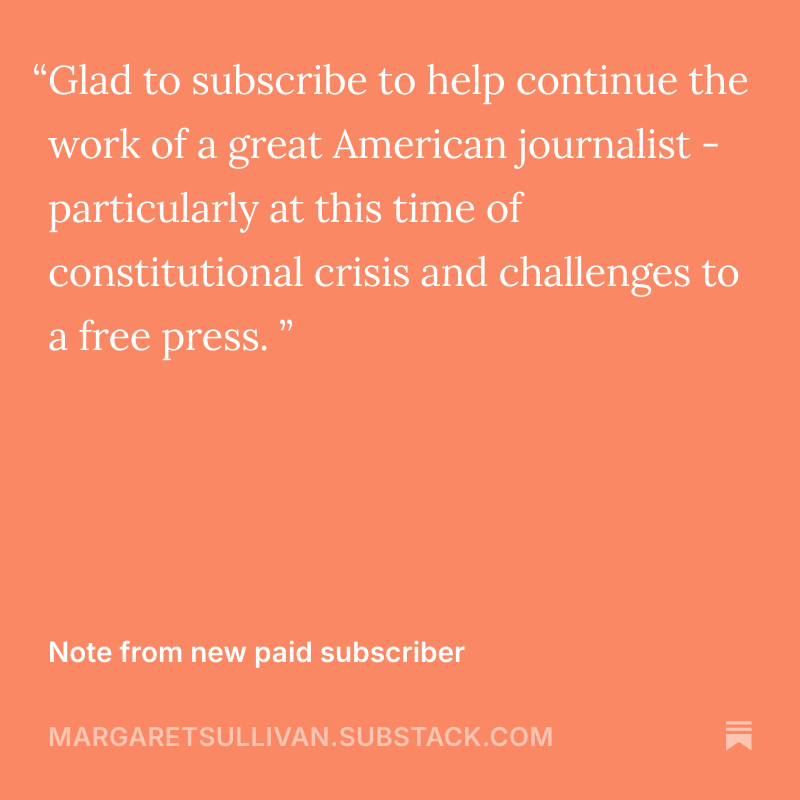
Since this is, overall, a positive post, please tell me what you’ve seen, heard or read in the past few days that has encouraged or inspired you, or that you simply admired. Here’s one from me, a paean to truth in the Guardian by Spanish journalist Carlos Hernández. Thank you for being here, and for caring about these issues. If you’ve decided to become a paid subscriber, I appreciate that very much. Here’s why one very generous reader did so in recent days.
My background: I am a Lackawanna, NY native who started my career as a summer intern at the Buffalo News, my hometown daily. After years as a reporter and editor, I was named the paper’s first woman editor in chief in 1999, and ran the 200-person newsroom for almost 13 years. Starting in 2012, I served as the first woman “public editor” of the New York Times — an internal media critic and reader representative — and later was the media columnist for the Washington Post. These days, I write here on Substack, as well as for the Guardian US. I’ve also written two books, taught journalism ethics, and won a few awards, including three for defending First Amendment principles.
The purpose of ‘American Crisis’: My aim is to use this newsletter (it started as a podcast in 2023) to push for the kind of journalism we need for our democracy to function — journalism that is accurate, fair, mission-driven and public-spirited. That means that I point out the media’s flaws and failures when necessary.
What I ask of you: Shortly after Trump’s election in November of 2024, I removed the paywall so that everyone could read and comment. I thought it was important in this dire moment and might be helpful. If you are able to subscribe at $50 a year or $8 a month, or upgrade your unpaid subscription, that will help to support this venture — and keep it going for all. Thank you!