
Is This The Worst Supreme Court Ever?
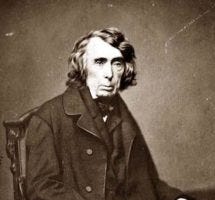
Historians and legal experts are pretty much in agreement that the worst U.S. Supreme Court decision of all time was Dred Scott v. Sandford, issued on March 6, 1857 by a court whose chief justice was Roger B. Taney, whose face always seemed to be melting.
.
Scott is the shameful case that legitimized and institutionalized slavery, declaring that African-Americans, whether free or enslaved, were not U.S. citizens and were “articles of merchandise” who had “no legal rights a white person was bound to respect.”
I think we can stipulate that, as a jurisprudential precedent, this one was spectacularly imprudent. It totters and sways alone in its own stench, like a drunk in the subway who has soiled himself. A more interesting question is”. Which was the worst Supreme Court of all time? Historians tend to give that to Taney’s court, too, on the basis of Scott alone, despite some mitigating factors. I don’t dismiss that argument. John Wilkes Booth is said to have once saved a girl from a runaway horse, but that doesn’t perfume how he is ranked by history.
It’s a little unfair, though, in Taney’s case. At the very least, I think he has new competition for worst. Has anyone actually considered whether the Roberts Court might be earnestly vying for that distinction?
Taney, a lawyer from Maryland, was a noted fulminating racist who was nominated by Andrew Jackson, who was also a noted fulminating racist. And yet…
Taney ran his court from 1836 to 1864, and — until Scott — his stewardship was thought to be remarkably forward-thinking, encouraging corporate competition and technological development over industries controlled by plutocrats with monopolies. His court championed individual rights over government tyranny. He famously challenging Abraham Lincoln’s patently unconstitutional suspension of the writ of habeas corpus during the Civil War. Proving Taney’s point, Lincoln simply ignored that decision, but this is widely seen as Lincoln’s worst move ever, and Taney’s best.
Before Scott, Taney was generally regarded to be a fine chief justice, ably following the greatest of all time, John Marshall.
Now consider the John Roberts court. It is politically fractured. It has dispensed hell from day one, almost unfailingly enforcing a right-wing activist political agenda. It is absurdly partisan and morally corrupt. It has ushered in a nearly constant descent into our darker past.
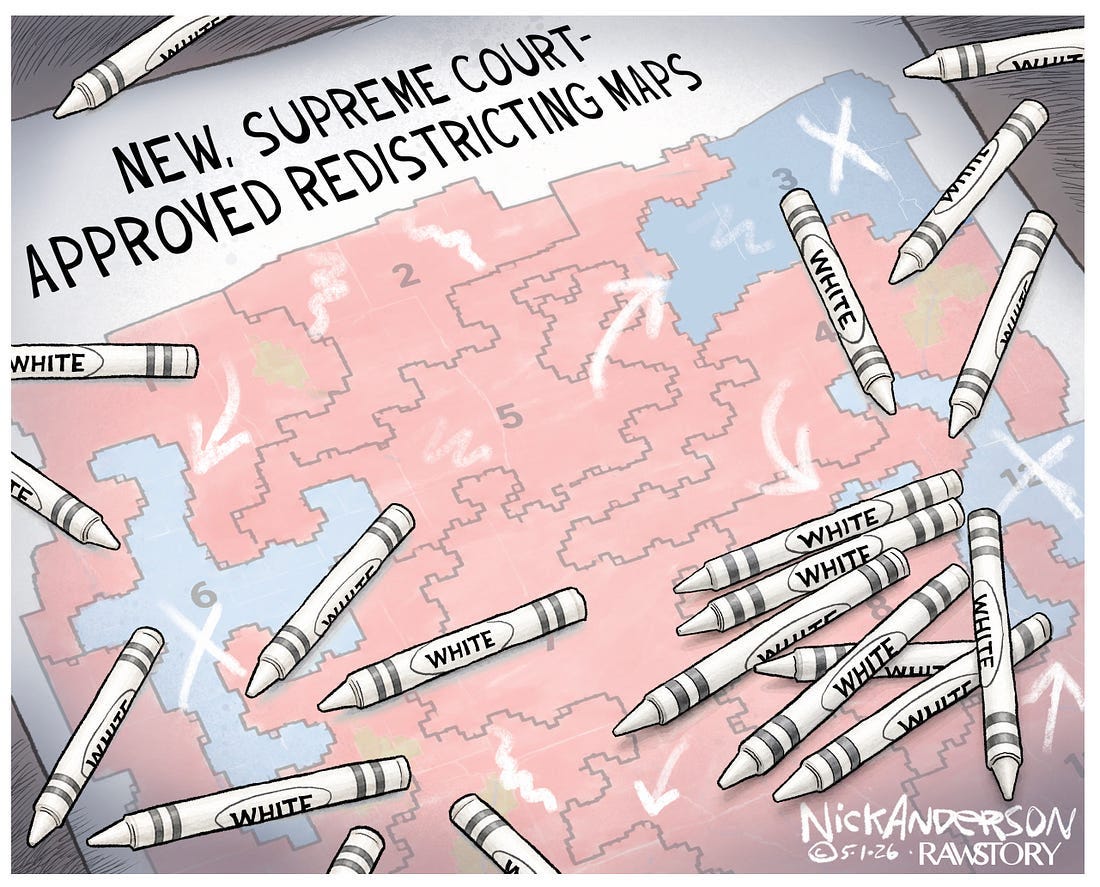
And now, it has given us Louisiana v. Callais, gutting the Voting Rights act, setting the civil rights movement back two generations. It is, fundamentally, a white supremacist decision. It has halted the redrawing of election districts, on the threadbare theory that trying to redress and correct decades of discrimination against Black people … is discrimination against White people.
Unlike the Taney court, this is not an aberration for the Roberts court, which is filled with hidebound reactionary Republican appointees. That is its modus operandi.
Consider:
In Citizens United v. FEC (2010), the court lifted limits on corporate political spending, declaring corporations to be people, with a right to free speech. This enabled the rise of super PACs that have enabled the super rich to be super powerful.
In Dobbs v. Jackson (2022). the court overturned Roe v. Wade, ending constitutional abortion rights, creating chaos in women’s healthcare.
In Trump v. United States (2024, the court affirmed broad immunity for presidential official acts. It persuaded Donald Trump that he could be a king.
In AT&T Mobility v. Conception (2011), the court held that federal law preempts a state’s limits on forced arbitration, making it much harder for consumers to file class action lawsuits against corporations.
In District of Columbia v. Heller (2008), the court declared that the Second Amendment protects an individual right to bear arms, period, prohibiting a beleaguered municipality from limiting violence against its citizens.
Historical note:
In Bush v. Gore (2000), in a purely partisan split, the Supreme Court stunningly ordered the state of Florida to stop re-counting its presidential votes, thus handing the election to George W. Bush, standard-bearer of the party of the court’s majority. Roberts was not on the bench then — but he was heading up the legal team advising Bush in how to press this empty case. Five years later, Bush rewarded him by naming him chief justice, from which all else followed.
Which brings us to … corruption.
No Supreme Court in history has been so blatantly morally compromised — this is the first ones whose actions were stinky enough to lead to Congress creating a code of conduct for them. In effect this is the first time that a Supreme Court — the ultimate authority on what constitutes proper, legal, ethical conduct — required a nanny to police their own selves. Primly, deferentially, the code was declared “voluntary” and “non-binding.”
Much of this court’s corruption involves judges accepting favors and gifts from wealthy benefactors with matters that did — or might — come before them. This is a court that, it would seem, can be bought.
For years, Justice Clarence Thomas took undisclosed gifts of air travel, super-yacht vacations, and tuition payments from conservative donor Harlan Crow. He also accepted “financing” for a $267,000 super-luxury motor coach from a different wealthy friend. A senate inquiry later established that that loan was “forgiven.”
Justice Samuel Alito did not recuse himself from cases related to the 2020 election and the January 6th Capitol attack, despite reports of an inverted flag associated with “Stop the Steal” flying at his home. He also accepted a 2008 luxury fishing trip to Alaska with a hedge fund billionaire who later had cases before the court. He never disclosed this; the media did.
Thomas faced criticism for not recusing himself from cases related to the 2020 election and the January 6 riot, even though his Republican activist wife was actively pushing to overturn the election results.
Justice Sonia Sotomayor’s staff was said to have pressured public institutions to purchase her books. Justice Neil Gorsuch sold real estate to the head of a law firm with cases before the court. Apparently to disguise this transaction, Gorsuch left the buyer’s name blank in federal disclosure forms.
And so forth
—
Other than Taney’s court, the only other Supreme Court that approaches the Roberts level of stench was the court of Melville Fuller (1888-1910), which gave us Plessy v. Ferguson (1896), which said that racial segregation did not violate the Constitution, thereby establishing the racially corrupt concept of “separate but equal” facilities in the schools. It was appalling, and it stood as public policy throughout much of the early civil rights era, until it was upended in Brown v. Board of Education in 1954.
Still, we give Fuller’s court a break. Fuller is credited with being a super-competent administrator, limiting dissents through his force of personality, and establishing unity and comity and collegiality on the court by deploying his “personal charm and humor.” Fuller initiated the corny tradition — still in place — of justices shaking hands before conferences.
And finally, it should be noted that the Roberts court did cough up one truly good, landmark civil rights decision: Obergefell v. Hodges (2015), which extended the right of marriage to same-sex couples. Roberts himself voted against the majority and with the homophobes.
—
Okay. Today’s Gene Pool Gene Poll:
—
The Gene Pool is a reader-supported publication. To receive new posts and support my work, consider becoming a free or paid subscriber.