
Wikipedia is more important, and more vulnerable, than ever
The free online encyclopedia can feel like a relic of the utopian early internet, when it seemed feasible to catalog the entire sum of human knowledge using only volunteer efforts.
But its importance has only grown with time. Because its information is free to use by anyone, it has served as a fact-check on the conspiracy engines of YouTube and Facebook, and, more recently, as a training ground for black-box artificial intelligence engines that are now replacing traditional internet searches.
And all along, it has maintained its integrity. Because it collects almost no user data, no algorithm skews what users see on the site.
Wikipedia may be a throwback, but it still matters.
In a lot of ways, it’s the last bastion of shared reality on the internet.
Yet, on its 25th anniversary, the project is vulnerable, weathering crises both external and internal.
Fighting founders
One of the myriad threats to Wikipedia is from a group of critics who insist that the site has lost its way — that it is no longer the neutral source it claims to be.
Much of that critique comes from the right. Elon Musk has taken to calling the site “Wokipedia.”
One of the sharpest critics is Larry Sanger, a cofounder of Wikipedia. “The Wikipedia editors have declared a favored point of view,” he told Fox News’s Ashley Rindsberg in a recent interview. “It’s definitely no longer a neutral point of view.”
But his nine proposals for reforming Wikipedia would destroy the whole point of the enterprise. One, for instance, would allow competing articles on controversial topics, essentially re-creating the echo chambers that the site aims to puncture.
“It’s not like there’s the liberal version of an article about the president and a conservative version of an article about the president,” says Marshall Miller, the senior director of product at the Wikimedia Foundation, the nonprofit that governs Wikipedia. “There’s meant to be one article about the president that balances the different viewpoints and represents them.”
This is what Wikipedia strives for. And it mostly succeeds.
Jimmy Wales, the other Wikipedia cofounder, who has long battled with Sanger, got it right when he said in a December interview with Ian Bremmer of PBS: “We’ve got this enormous crisis of trust in the world right now. Yet, Wikipedia has gone from being kind of a joke in the early days to one of the few things people trust.”
The secret sauce is the robust debate among the site’s editors — all volunteers — over the most important entries.
In an excellent article in The Verge, writer Josh Dzieza explains just how intensely editors disagree: “By 2005, the pages where editors stipulated policy and debated articles were found to be growing faster than the articles themselves. Today, this administrative backend is at least five times the size of the encyclopedia it supports.”
In theory, anyone can edit at any time, but the rules of conduct are strict, and discussions must be productive and in good faith. The only way to gain the trust of other users, or to be able to join the editing of controversial articles, is to make sensible edits on other articles over a period of time.
The organization’s ethos might be best described as “institutional humility.” After all, the most comprehensive list of hoaxes that have appeared on the site is maintained by Wikipedia itself.
The site’s overview of its institutional biases and blind spots doesn’t pull any punches, either. And it turns out that any bias moves in a direction quite different from the one critics suggest. The data shows that the encyclopedia disproportionately covers topics that appeal to white, Western, and English-speaking audiences and editors.
Wikipedia’s critics seem to voice their complaints everywhere except where it matters: within the discussion, or “Talk,” pages of the articles they disagree with. Why don’t they?
The most obvious answer is that the critics of Wikipedia either can’t be bothered or have beliefs that couldn’t stand up to the scrutiny of its editors.
An emerging problem
In its annual plan, Wikipedia this year identified the organization’s largest challenge: finding quality volunteers.
Even as Wikipedia’s overall users grow, the number of editors is declining. New active editors declined 20 percent between 2019 and 2024.
Even more worrisome, the number of Wikipedia English admins (the name for trusted editors granted extra access) peaked in 2010 at 1,900. As of now, there are barely 1,000 left.
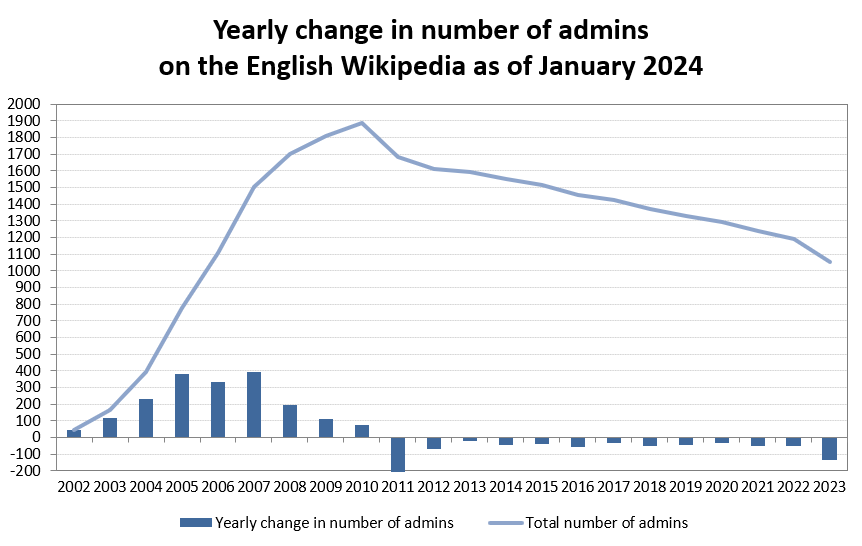
In its most recent annual plan, the Wikimedia Foundation noted that its long-term sustainability largely hinges “on a steady influx of new users who contribute quality content and remain engaged.”
Groups of experts discussing stuff online have moved away from Wikipedia and toward other venues like Discord, Twitch, Reddit, listservs, and even members-only Facebook groups.
Wikipedians are aware that they need more editors. And they are aware that it’s difficult for outsiders to work their way into the group and learn its many norms.
“That is because they’re prickly people involved, but it’s also because of the nature of the work,” says Phoebe Ayers, a Wikipedia editor and librarian at MIT. “People really want to be right. They want their source to be good. Let’s be real: It attracts the pedantic.”
However, new paths and lowered barriers to entry are already being implemented. Editors can make changes on their phones more easily, collaborate with more experienced users, and use AI to help with moderation tasks.
Most people still don’t know that Wikipedia has official social media handles on TikTok, Reels, and YouTube Shorts. These work to entice more young people to get involved in the unglamorous work of editing, sorting, and cleaning up one of the most comprehensive repositories of online human knowledge there is.
As algorithms continually work to build up our echo chambers, fact-checking procedures look increasingly quaint, and AI slop splashes all over the internet, Wikipedia is possibly the only fully unmonetized reality that still exists. There is no algorithm, sycophant AI machine, or advertiser trying to game this place.
That’s why it matters so much.
Rebecca Spiess can be reached at rebecca.spiess@globe.com. Follow her @rebeccaspiessl.