
Why We Shouldn’t Resume Federal Funding of Domestic Public Broadcasting
Welcome to Second Rough Draft, a newsletter about journalism in our time, how it (often its business) is evolving, and the challenges it faces.
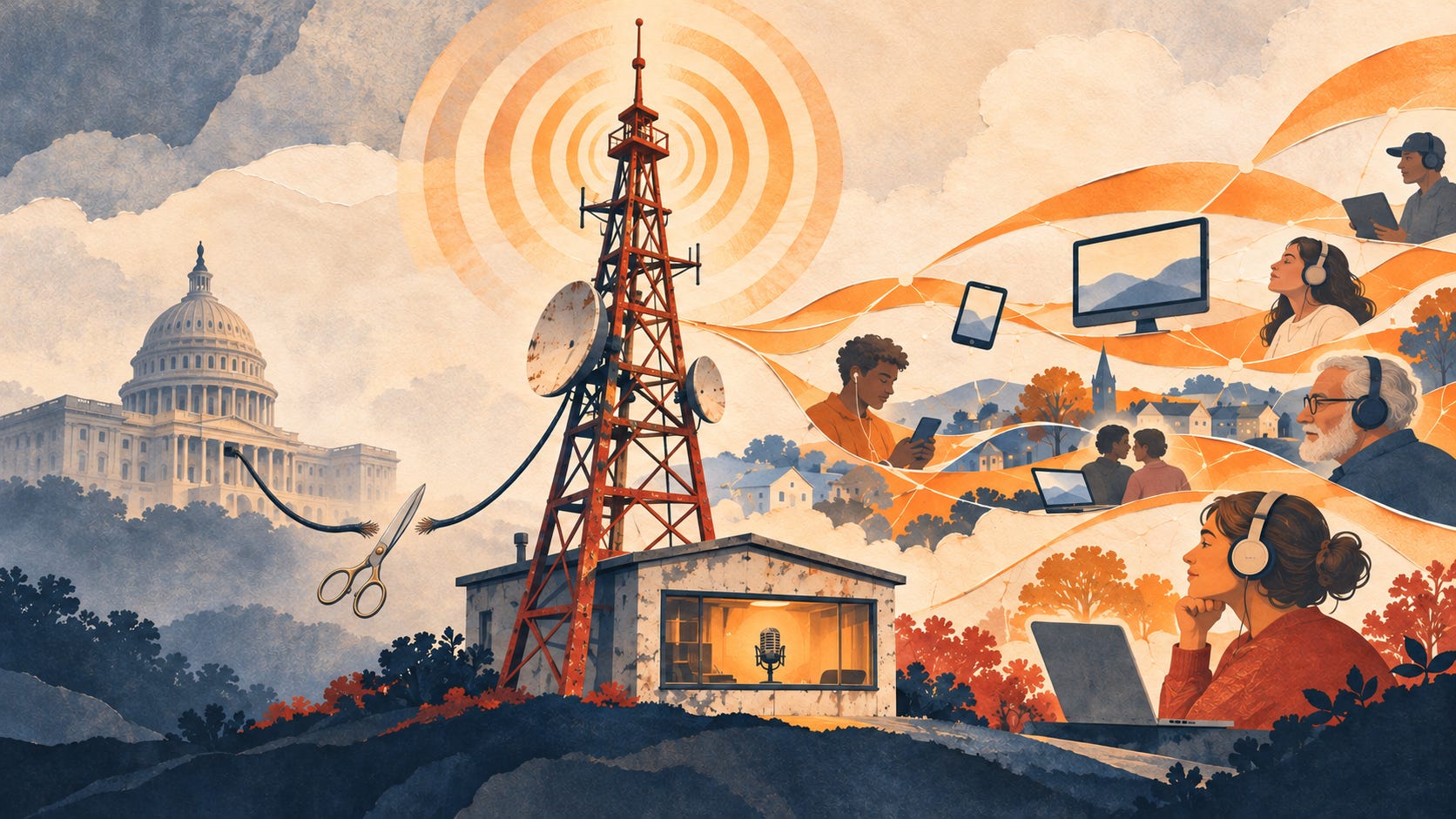
With the large Democratic majorities in both houses of the new Congress, there will be a significant temptation to restore the federal funding of public broadcasting that the Republican Congress eliminated after 58 years in the summer of 2025. This week, I want to explain why I think that temptation should be resisted.
Some will say that it’s not even possible—that Trump would almost certainly veto any such move. But don’t be so sure. Lacking 60 votes in the Senate, Democrats will lean at least as heavily on the congressional reconciliation process that requires a mere Senate majority as the Republicans did in passing their One Big Bill. There will be great pressure to reach an accommodation with Trump on such a bill, and that shouldn’t be ruled out—it will be one of Trump’s only chances to legislate during the remainder of his term, and we know that partisan loyalty runs only one way with him. Spending decisions fit squarely within the reconciliation process, of course, and any funding for public broadcasting—even full restoration— would be such a small part of such a large undertaking that it’s very hard to imagine it becoming the sticking point.
Even if renewed funding is possible, however, I think it would be unwise, for a number of reasons. The most important of these are the need to insulate from rather than embroil public broadcasters in partisan politics, and the pressing need to reinvent the system rather than to restore it.
(Before going further, let me add that US international public broadcasting—Voice of America and other similar assets aimed entirely at audiences outside the country—present a wholly different case. They should be viewed as a critical component of American soft power, even while maintaining their editorial integrity, and the unilateral disarmament Trump has attempted to engineer—a foolish gift to Russia, China and Iran— should be promptly and thoroughly reversed.)
A strictly partisan split
Ending funding for domestic public broadcasting was a strictly partisan move, and reversing that decision on Capitol Hill would almost certainly be as well. Of four House and two Senate Republicans who opposed the recission last year, only Rep. Nicole Malliotakis of New York and Alaska Sen. Lisa Murkowski will serve in the new Congress. (One of the House members retired, while two were defeated, as was the other senator, Susan Collins of Maine.) No Democrats voted in favor of last year’s recission. So Democrats will have the votes in 2027. But if they use them, public funding will likely last only so long as the new congressional majorities. Public broadcasting would be clearly established in Washington as an effective subsidiary of the Democratic Party. That is not a positioning any news organizations should want.
Beyond this, the funding system that existed under the rubric of the now-dissolved Corporation for Public Broadcasting was not strictly content-neutral, as I think all public funding for journalism should be; contrast the recent California news subsidy. Re-funding the federal system would thus pose both practical and philsophical difficulties proponents do not acknowledge.
What needs reinvention
Even more important is the need to reinvent what had been public broadcasting. While many of its components still like to speak of “public media” even in the aftermath of public funding, as I have noted before, that is both a misnomer and a misclassification. Stations and networks today are just additional types of nonprofit news organizations.
Yes, they have a stronger track record than most nonprofits in soliciting small donations, but even here, with the successes of the Guardian, ProPublica and some others, including through NewsMatch, they are not unique. Crucially, the very term “public broadcasters” has also become misleading. The most successful “public” television programs now have much, much larger audiences on private streaming services, especially YouTube, than over linear TV, while the digital audiences for many “public radio” stations have begun to outweigh those reached through terrestrial radio. These trends will not only continue; they need to be cultivated and accelerated as legacy audiences age and consumer preferences continue to evolve.
Nor is the necessary reinvention limited to distribution. Some stations and networks have been well managed, but many, if we are being honest, have not been. In my own home town of New York, for instance, the organization that still calls itself New York Public Radio has had four “permanent” CEOs and four interim leadership arrangements in less than eight years. Its most recent CEO left suddenly after eight months in the role. The previous “permanent” CEO, who had been moved aside in mid-2025 even before his successor had been chosen, is now part of a triumvirate leading the place on an interim basis. This sort of instability can be a signal of much deeper problems. Any notion that we need to “restore” a place with this sort of track record would be misguided.
Beyond adapting to new audiences and inculcating stronger management, stations and networks need, like almost all nonprofit news organizations, to accelerate their adaptation to AI, innovating where possible and accepting efficiencies that don’t compromise quality when available. They also need to refocus their fundraising operations increasingly away from institutional foundations and easy acceptance of program support toward greater outreach to major individual donors and a more pronounced preference for general support.
I know the last two years in domestic public broadcasting have been painful, and that there have been regrettable, even irreparable losses. But it is precisely because these systems have value that they need to modernized, and made truly sustainable, not just in a moment of political flood tide, but across the ebb and flow of our politics. That requires a solution outside of one provided by government.
Second Rough Draft will be off next week. Happy Thanksgiving to you and your loved ones.
Second Rough Draft paid subscribers support nonprofit journnalism. To receive new posts, become a free or paid subscriber.