
Why Starting Long News Stories With Anecdotes May Have Outlived Its Usefulness
Welcome to Second Rough Draft, a newsletter about journalism in our time, how it (often its business) is evolving, and the challenges it faces.
“People like to read about people”—that’s one of the most basic things journalists have been taught for decades, and one of the elemental results has been what reporters and editors call “anecdotal ledes,” pieces (usually longer) that begin with a vignette, a way, ostensibly, to delve into a complicated subject by telling a human story.
When researching the biography of Wall Street Journal pioneer Barney Kilgore I realized that anecdotal ledes in journalism are actually less than a century old, and while I couldn’t quite prove that they numbered among his creations (which included the modern news summary and the summary paragraph high up in stories known as the “nut graf”), Kilgore, in the mid-1930s, was among the first to employ them. Now they are commonplace. On a recent Sunday, I found pieces with anecdotal ledes on the front pages/ home pages of the Atlantic, the New Yorker, the New York Times, Politico Magazine, ProPublica, Kilgore’s Journal and the Washington Post.
For many years, this tactic served us well, and it’s deeply embedded in the toolkits of generations of writers and editors. But I wonder if its time is quickly passing.
Why the tide is turning
A number of factors are conspiring to lead me to this conclusion. First is simply readers’ and listeners’ time (podcasts too love anecdotal ledes). They have less of it to spare, and are hugely impatient. This is the open secret everyone with access to analytic data on news consumption knows: most readers usually bail out of stories after just a few paragraphs, a rate that terrifies editors and depresses writers. In such an environment, the longer you take to say directly what a story is about, what it concludes and why it is important, the fewer people to whom you will find yourself conveying that information.
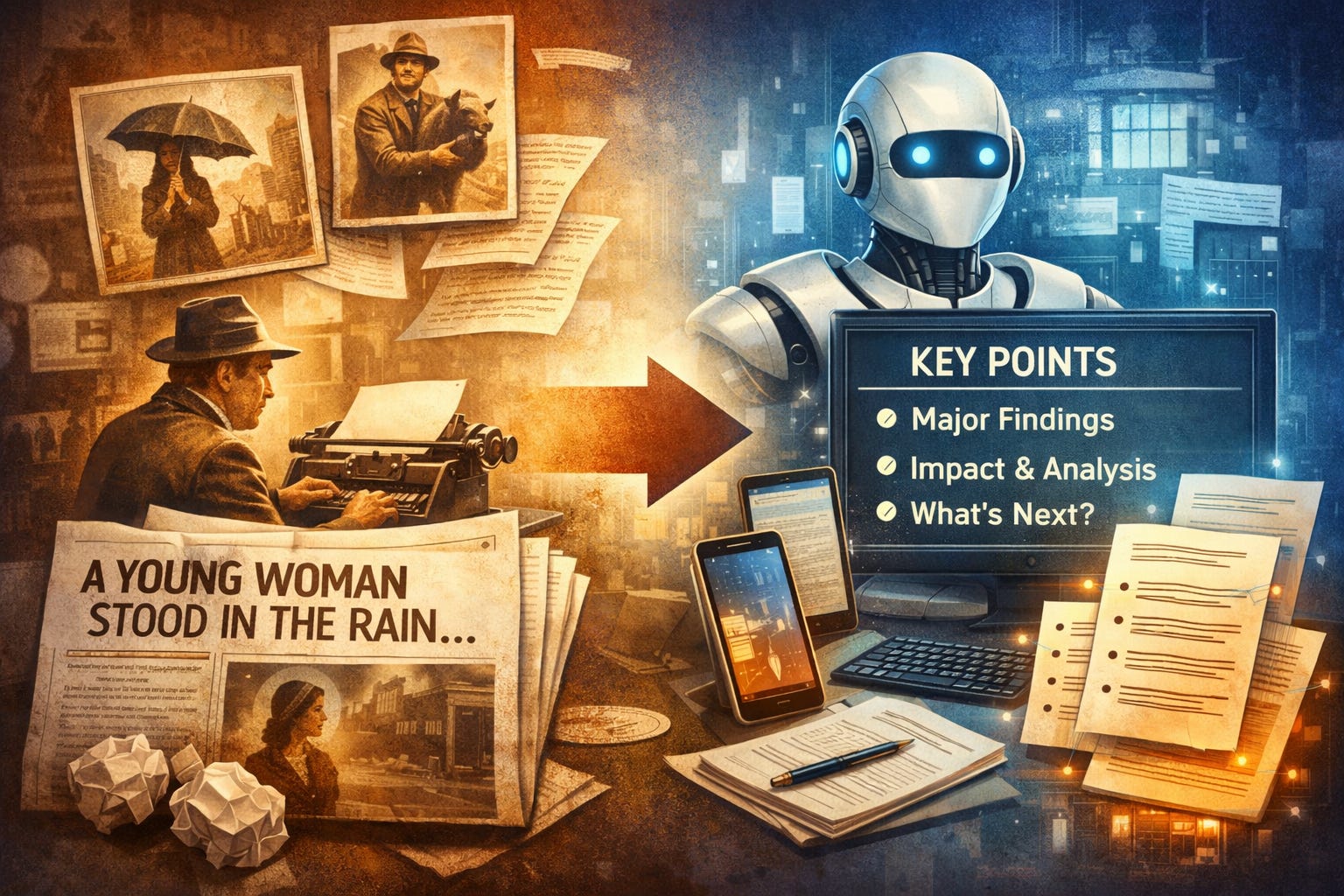
AI is another important factor pushing in the same direction. How much AI is going to take over news delivery is, I think, more of an open question than some techno-enthusiasts believe. But there is no real question that the degree to which content will come to us filtered through AI will grow substantially. And AI is simply going to strip away the grace (and, I am afraid, the power) of anecdotal ledes from those who insist on continuing to employ them. If you are summarizing a story, Kilgore’s nut graf survives—it even floats to the top. But the slow slide into the pool of the anecdotal lede is deemed surplusage.
The riddle of the bullets
You can clearly see this in the ostensibly time-saving bulleted summaries with which an increasing number of newsrooms are topping stories. Whether these summaries are drafted by AI (as they could be) or not, they are literally at war with the device of the anecdotal lede. Yet, on the pages of the news organizations that employ them, such summaries seem to sit above those artful ledes as well.
What are the editors of these publications thinking? Are the summaries an alternative to reading the pieces? If so, that may make sense (but don’t tell advertisers—or writers). If they more nearly fulfill the purpose of a musical overture, accustoming you to what lies ahead, why then double back to an anecdote? And if the bullet points sum up the story, haven’t you almost necessarily robbed the anecdote of its power of intrigue or surprise?
What is to be done
If we should largely forego anecdotal ledes, where does that leave us? People still do want to learn about people, and great narrative writing still does pull readers along. The proof of the point about human stories is everywhere (perhaps most recently in the vogue for vertical video), and proof about the value of strong narrative can be found in the same digital publishing analytics that reveal how quickly most readers abandon most stories. Those same analytics also show that the best writing can leave many thousands of people reading at length. (Relatedly, next time you hear someone say that no one reads books anymore, you might remind them it remains a $25 billion industry in the US—now bigger than newspapers.)
So the best narrative writing should likely still include lots of human drama, and telling anecdotes about individuals and groups of people. Evidence of craftsmanship and creativity, including in writing, may become even more valuable as we are all forced increasingly to interact with machines. But the gateways to stories, the devices we offer to help readers decide whether to invest their time, are changing quickly, and may need to change further. In that process, a second century of prevalent anecdotal ledes seems to me unlikely.
Update: Since launching a paid subscriber option last week that will fuel a fund to contribute to up to four journalism nonprofits nominated by readers before year end, 31 potential recipients have been nominated so far, and more than 145 subscribers have contributed, leaving the available fund already at more than $6200. You can nominate or discuss nominees in the comments here or below. I’ll be soliciting more input later in the year.
After posting every week since the beginning of January, Second Rough Draft will be taking next week off. See you soon.
Second Rough Draft paid subscribers support nonprofit journalism. To receive new posts become a free or paid subscriber.