
Why I’m Changing the Settings on This Newsletter, and How I Hope It Will Do Some Good
Welcome to Second Rough Draft, a newsletter about journalism in our time, how it (often its business) is evolving, and the challenges it faces.
I’ve never charged for Second Rough Draft, never spent a penny marketing it, and don’t want to change that. Reading the newsletter has always been free, and always will be. I’m more interested in a conversation with readers, and, I hope, reaching more of the people who might be interested in what’s discussed here than in making money—and I’m fortunate at this point in my life to be able to do that.
Substack’s quirks
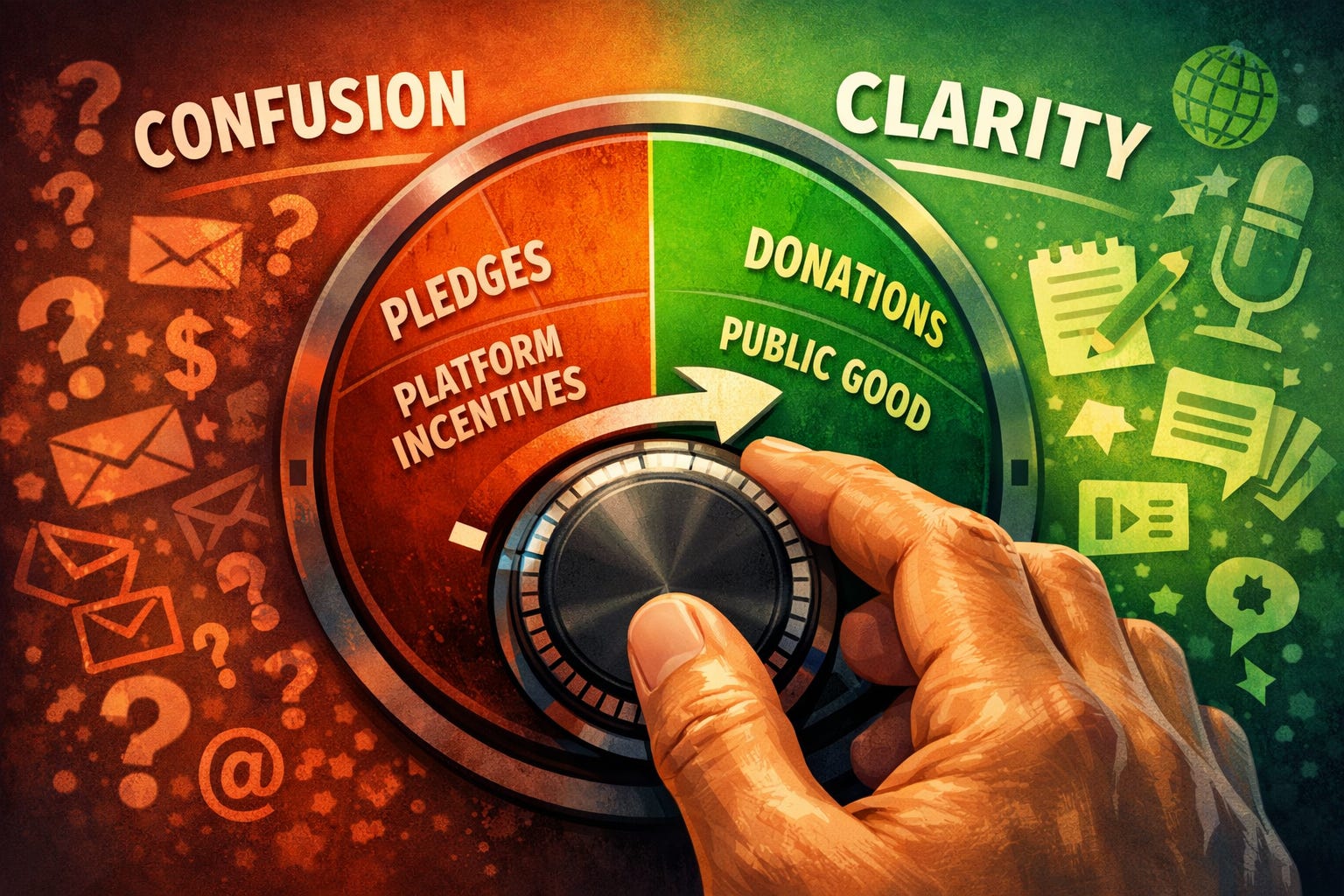
But the model here on Substack—a platform where I’ve generally had a great experience, especially with respect to ease of use and positive network effects—is confusing on the issue of paid subscriptions, even downright weird, and I have concluded I should stop leaning against it, and instead try to convert its weirdness into a way to do some good. This week I want to explain how that will work.
Let’s start with the confusion. Recently I had lunch with a friend who said he had been happy to pay for the newsletter. Which was very nice, except he hadn’t paid, and he was literally about the tenth person to tell me this. The reason: Substack, which makes money (usually 10%) only when people do pay, asks people to pledge to pay later if free newsletters start charging people. As of today, of our more than 7800 subscribers, 181 of you have pledged nearly $17,000 under this system. Thank you—and also sorry you were asked to do this.
I have a couple of times asked top management at Substack to instead offer a donate button option for newsletters, which would be more straightforward. I know they don’t want to do this, presumably because their own key business metric is paid subscribers, and muddying that wouldn’t be good for them. I even (cleverly, I thought) suggested they could take 15-20% of donations to avoid cannibalizing their core business. No dice.
Many Substack newsletter authors I know, facing this same quandary, have opted for a model where “paid” subscribers and free subscribers get all the same content. That is what I am going to do going forward. I have shied away from this in the past because it felt like a bit of a small-time scam, but I have become convinced that the confusion of the current model was too great. Plus, I’m pretty sure Substack will show the column to more potential readers if there’s a paid option.
A better way
More importantly, I think I have come up with a way to do some good while bowing to the realities of this platform. I am going to give away the bulk of the money that comes from subscriptions—and I am asking you to help me do it.
Here’s how it will work, at least for this year. (I might change some of the details for 2027 in light of how it goes in 2026, and will let you know if I do. I remain determined to keep Second Rough Draft free for anyone who wants to read it.)
The plan:
- In a couple of days, I will be turning on the paid functionality for the newsletter, but before doing that I want to give those who made pledges a chance to cancel them. This is one way to notify them; unfortunately, it does not seem possible to email the whole list. According to Substack, to cancel, a pledger can go on the Substack site or app to Settings → Subscriptions → Second Rough Draft, then scroll to Account actions and click “To cancel your pledge, click here.”
- When money is paid for subscriptions I will be donating 90% of the net receipts at year-end to no more than four journalism-related 501(c)(3)s. Readers will help me select the recipients, as described below. The reason for limiting the gifts to no more than four recipients is to practice what I often preach about fewer, larger gifts. The donation won’t be 100% of the money, as unfortunately the US tax code is such that if you have a windfall and donate all of it to charity, you can still be left with a tax bill, which I would like to avoid.
- When I turn on payments, I will be lowering the prices a bit from the defaults suggested by Substack. The “prices” will be five dollars a month, $50 for the year and $100 to be a “supporter.” This means that those whose pledges are redeemed will pay less than they originally pledged, another attempt to avoid unpleasant surprise. If you like this whole idea and want to make a new pledge in the next two days, this is the rate at which pledges will be redeemed.
- To be eligible for one of the year-end donations, a journalism nonprofit will need to be nominated by a reader. (You don’t need to pay to do this.) You can nominate recipients in the comments below, and I will solicit suggestions at least once more later in the year. Recipients of the gifts will be announced before year end, and the gifts will indicate that they are coming from the readers of Second Rough Draft.
- I encourage you to comment on suggestions by others. I ask only three things: 1) please use your own name in making a nomination—anonymous or pseudonymous nominations won’t count; 2) please don’t nominate your own organization and do disclose any ties you have to one you do nominate—but feel free, if your org has been nominated by someone else, to make the case for it in the comments; and 3) as always, keep it civil.
- If I am already a donor to any of the nonprofits selected, I promise that my 2026 donation will be larger by at least the amount of reader contributions than what I gave in 2025. I made cash contributions to 10 journalism-related nonprofits last year.
I hope that this new approach will avoid misunderstanding, perhaps build community a bit as we discuss together where to send limited resources and do some tangible good by supporting a few especially worthy nonprofits. Thanks so much for bearing with me as I have explained the plan. Of course, I welcome your reactions, and suggestions for improvement. Most of all, as always, thanks for your readership and engagement. Back to substance next week.
Thanks for reading Second Rough Draft! Subscribe for free (still).
Related Knowledge Center: Inside the newsroom
As newsrooms struggle with rickety business models and precarious finances — as well as new technologies — they are deploying an array of editorial responses.
The Times and its critics | Washington Post mortem
Related Knowledge Center: State of the business model
The traditional journalism business model has long since collapsed, and news organizations have shrunk or disappeared entirely. While a number of promising experiments are under way, the public has not shown a willingness to buy what news organizations are selling.