
Why ‘False Flag’ Has Become the Internet’s Default, All-Purpose Conspiracy Theory
The recent foiled FlyDubai hijacking has become great new material for conspiracy theorists everywhere, especially those prone to finding a false flag hiding under every rock.
A plane bound for Israel. An Arab co-pilot who allegedly attacked the captain and intended to crash the aircraft into the airport in Tel Aviv. Israeli passengers who intervened and staved off tragedy. Back-up pilots on board. The fact that nobody died. And all of this set against the backdrop of an Israeli government facing widespread criticism and ostracism.
So within hours of the incident, social media users offered a familiar explanation: The attack was obviously a “false flag,” an incident orchestrated by Israel to garner sympathy amid its war with Iran and its proxies.
Of course, no evidence has emerged to support any of this. Authorities in Israel, the United Arab Emirates, and Saudi Arabia are continuing to investigate the incident, but they say that the attack was carried out by an Omani national who had previously been barred from flying by Oman’s national airline due to concerns about his radical Islamic views. An Israeli official told CNN that the alleged hijacker appears to have acted alone.
Nevertheless, this new “false flag” conspiracy is everywhere. On the social media platform X alone, there were 64,500 posts mentioning the words “FlyDubai” and “staged,” “fake,” or “false flag” within the past week, garnering more than 23.8 million views, NewsGuard found.
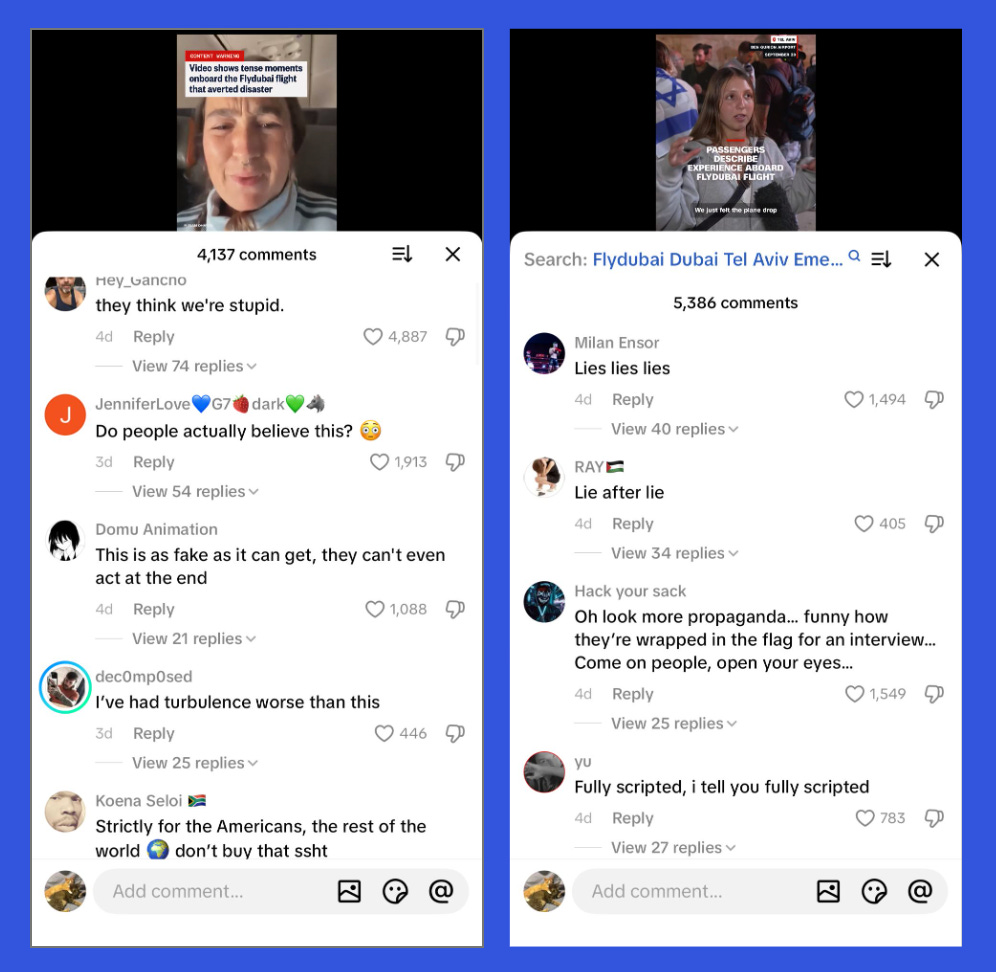
The comment sections are dominated by backers of the “false flag” theory on hundreds of posts on my Instagram and TikTok feeds related to the FlyDubai incident. A user responded to an NBC News TikTok video showing a passenger’s first-person video from the flight by objecting, “They think we’re stupid.” The comment received 4,850 likes. The top comment on a CBS TikTok video featuring Israeli Prime Minister Benjamin Netanyahu was a user stating, “Lies lies lies staged staged staged,” garnering 1,365 likes, followed by another stating, “He [the pilot] was sent by you [Netanyahu],” with 827 likes.
We’ve seen this reaction over and over again. In fact, it is hard to think of any catastrophic event that has not generated some kind of false flag theory. In just the past year, NewsGuard has identified 11 other incidents that were quickly attributed to false flag plots, including the December 2025 Brown University shooting, the May 2026 shooting at a San Diego mosque, and a May 2026 drone attack at a Romanian residential building. Four other shootings were blamed on Israel: an October 2025 U.K. synagogue attack; the December 2025 Hanukkah massacre in Sydney, Australia; a March 2026 Texas bar shooting; and the April 2026 White House Correspondents’ Dinner shooting.
Israel this week is also being pulled into theories about the suspected pneumonic plague outbreak in Russia. My colleague John Gregory, NewsGuard’s health editor, found that conspiracy-minded accounts are noting darkly that Tel Aviv University has developed an mRNA vaccine for a form of the pneumonic plague, potentially laying the groundwork for a baseless narrative that Israel orchestrated the Russian incident. The suggestion is reminiscent of antisemitic claims that spread in the Middle Ages blaming Jews for the Black Death plague in Europe, Gregory notes. But the Middle Ages weren’t subject to the propulsive power of the internet to spread these claims so widely and quickly.
This reflex to cry “false flag” points to a broader phenomenon: “False flag” has become less of a specific allegation than a default response to tragic events — and it’s one that bad actors are happy to exploit. Indeed, Iranian and Russian disinformation campaigns have leaned into the FlyDubai false flag conspiracies to advance their own anti-West agendas. The day after the attack, Iran’s military-affiliated Fars News Agency claimed that Iran obtained intelligence that Israel considered attacking the aircraft intending to blame Iran. And the Russian disinformation campaign Matryoshka fabricated video reports claiming that the U.S. Democratic Party orchestrated the incident.
AN ALTERNATE REALITY
To test how prevalent the “false flag” narrative has become after major incidents, NewsGuard conducted a poll with YouGov in April 2026 that found that one in three Americans believe President Donald Trump “staged” at least one of three attempts on his life.
When the default is to distrust what we see from the government and the media, everything becomes suspicious. Early voids in information — often because reliable information is not immediately available — become proof that authorities are lying. First-hand accounts are picked apart and scrutinized for being either rehearsed or disjointed. Every extraordinary event demands an extraordinary — and hidden — explanation.
Conveniently, the “false flag” reflex makes evidence irrelevant. If an event fits the false-flag narrative, it is proof. If evidence contradicts the narrative, that evidence simply becomes part of the cover-up. This makes a “false flag” an almost impossible theory to disprove — and therefore remarkably durable.
Citizens are not wrong to be skeptical about their governments. Government leaders have lied to citizens about matters big and small.
So yes, skepticism is healthy. It’s smart to be wary of emerging information amid the online cacophony, especially regarding fast-moving stories with more unknowns than knowns. When a big story breaks, we should all ask, “What do we know?” “What don’t we know?” and “What evidence would change our minds?”
The “false flag” reflex skips over all these questions. And that may be the most dangerous conspiracy of all.
Sofia Rubinson is the Senior Editor of Reality Check at NewsGuard.
Become a Reality Check Premium Member and get NewsGuard AI for free. Click here.
Midterms Watch: In Case You Missed It … Is That Election Claim True?
With one month to go until the U.S. midterm elections, false claims about candidates and voting procedures are spreading fast. And sometimes, wild claims turn out to be true.
Our quiz puts eight viral claims to the test, from a Senate candidate supposedly standing in front of a projected image of Adolf Hitler to accusations of, gasp, veganism in Texas. Take the quiz and see if you can separate political fact from political fiction. Your time is recorded, and the highest score in the shortest time wins a much-coveted NewsGuard cap.
This newsletter was edited by Eric Effron.
Reality Check is produced by co-CEOs Steven Brill and Gordon Crovitz, and the NewsGuard team.
We launched Reality Check to shed light on the false claims spreading online, how they spread, and the forces behind them. Each day, we aim to bring you the story behind your news feed and help you stay informed about the false claims circulating in the news. Support our work by becoming a premium member.
Have feedback? Send us an email: realitycheck@newsguardtech.com.
Related Knowledge Center: Fact-checking and its detractors
Fact-checking has become a familiar tool for political reporters to hold office-holders and candidates accountable. But critics ask if fact-checkers sometimes miss the forest for the trees, and if the practice often struggles with false equivalency the way conventional political coverage does.