In the early months of the Pacific War, the Japanese military — then a pariah to the Allied nations and a provocateur to the United States after its surprise attack on Pearl Harbor — captured more than 10,000 Americans across Asia. In places like Japan, Hong Kong, the Philippines, and Singapore, American civilians were interned without due process and forced to endure overcrowding, brutality, malnutrition, and squalor few could imagine.
And U.S. officials were desperate to get them home.
From this confluence emerged a little-known chapter of WWII history, chronicled by the Pulitzer Prize-winning journalist Evelyn Iritani in her latest book, Safe Passage: The Untold Story of Diplomatic Intrigue, Betrayal, and the Exchange of American and Japanese Civilians by Sea During World War II.
At the heart of the story is a secret agreement between the U.S. and Japanese governments to exchange thousands of American and Japanese civilians. The problem was that while Japan had plenty of American prisoners to send, the United States was scrambling to assemble its own list of Japanese civilians for the exchange, even as it was incarcerating Japanese and Japanese Americans at home.
To make the cut, over a dozen Latin American countries agreed to round up more than 2,200 Japanese Latin Americans on behalf of the U.S., who were unjustly imprisoned and ultimately used as bargaining chips in two exchanges that took place in 1942 and 1943.
Learn from top longform journalists and find the best in-depth reporting. Subscribe to Depth Perception:
For Iritani, this dark and complicated chapter of history inspired her to answer a rarely-pondered question about WWII: What was it like for ordinary people caught between two countries and two cultures?
In this dissonance, Iritani had a super power. As a child to a second-generation Japanese American father and a Japanese immigrant mother, she, too, grew up between two cultures. In becoming a journalist, Iritani realized she was most drawn to stories that tried to weave the U.S.-Japan relationship from both sides of the Pacific.
“When I read stories written about these complicated relationships, it often felt like they were … coming from the American perspective or the Japanese perspective,” Iritani tells me. “I wanted to see if I could try to help those two audiences understand each other a little better.”
In this edition of Depth Perception, Iritani talks about the hidden history behind civilian exchanges, the difficult choices made by U.S. and Japanese officials, and what the story reveals about the people caught between them. —Kelly Kimball
In an interview you did with Densho, you “wondered whether people would believe or care” about the stories you uncover in your book, and yet, “we are seeing this history repeated today.” Can you explain some of the parallels you saw between the book you wrote and what we’re seeing these days with immigrants in the United States?
When I first started researching this book more than a decade ago, I was shocked by what I was discovering about what happened on the U.S. side of these civilian exchanges. I had assumed that they were more an exchange of equals, of expats. What I discovered is that many of the people on the North American side of this exchange did not go voluntarily, and in some cases were forced to be part of this exchange.
I started to uncover this disturbing background, such as the U.S. government reaching across its southern border and enlisting its allies there, asking those governments to round up their so-called “dangerous enemy aliens” — Japanese, Germans, and Italians — ship them to the U.S. without any due process, where they were put in prison camps and eventually used in these civilian exchanges. That single thing was one of the most surprising and shocking pieces of this story.
I realized that if you step back and look at what we’ve seen under the current Trump administration, there are a series of things that have disturbing parallels. Such as the use of the Alien Enemies Act of 1798 to round up immigrants based on their skin color or nationality, without due process, to imprison them and separate families, to pressure them to self-deport by threatening to take away everything, or take away their children — and if they don’t agree to that, imprisoning them indefinitely. That was something that was used during World War II to round up Japanese community leaders after Pearl Harbor.
Another example, was this reaching across the southern border, enlisting U.S. allies to do our dirty work. We’re seeing that now. The present administration has signed deals with dozens of countries, many in Latin America, to help our government with its deportation campaigns. This is clearly illegal and unconstitutional, but it happened in World War II, and we are seeing it happen again.
When our government disregarded those laws during World War II, it gave permission to our enemies to do the same, and I fear that we are seeing a repeat of that today, with our government’s decision to step back from its commitment to the rules-based international system that we built after World War II.
“There is this shift towards technology in communication — technology that’s not only shorthand but also can be created to disappear. That change in the way we communicate is going to make it hard for future historians to recreate what happened.” —Evelyn Iritani
You’ve said that some of the most important documents for reconstructing the lives of those in your book were destroyed during the war or confiscated before passengers boarded the exchange ships. When you encountered those gaps in the historical record, what did you find yourself wishing you could know? And did those absences change the way you think about what journalists today need to document for future historians?
I felt I lacked some of the depth I needed on the Japanese side to really help explain why Japanese officials made the decisions they did in these negotiations. One very important one being: How did they choose the passengers that they wanted in these exchanges?
[Because of] the lack of documents, I went to Japan. I brought people in to try to dig up anything about what the Japanese government was thinking. I also interviewed a couple authors who have done books on these exchanges, but there was not much written in Japanese. I felt like that hole became one of those things that I regretted.
It also made me fearful of what I see happening today. There is this shift towards technology in communication — technology that’s not only shorthand but also can be created to disappear. That change in the way we communicate is going to make it hard for future historians to recreate what happened. You also see the present government indicating that it does not want to have as much transparency about what it is doing.
The other thing is, the places where I was able to pull together a richer characterization of the people involved, … [they wrote] about their experiences with letters and scrapbooks. I’m not sure today whether people who are expats or others who are around the world are communicating by letter. I doubt very many people are.
[For example,] there was an amazing scrapbook that I found, where a woman had cut out newspaper stories, recipes, the menus from the exchange ship, that kind of thing. Those are just amazing as a journalist and I worry that we’re not going to have that same record of what’s happening today.
LongShadow nominated for three Signal Awards — vote today!
After 9/11, Congress and the White House consolidated 22 federal agencies under one cabinet-level banner, the Department of Homeland Security, changing the face of immigration in America. In a recent episode of Long Shadow: 9/11’s Lingering Questions, journalist and historian Garrett Graff outlined how the creation of DHS agencies Border Patrol and ICE were byproducts of the terror attacks.
“What we are seeing today is the legacy of that fear Americans experienced in the wake of 9/11,” Graff says in the episode. “Reacting in the middle of one nightmare, we created another — an apparatus that in the wrong hands, has become one of the most authoritarian tools in the history of our country.”
Produced by Long Lead, this special episode been named a finalist for three Signal Awards. Help Long Shadow win by voting today:
Aside from the documents that helped you reconstruct the stories, you tracked down survivors and their families in the U.S., Japan and Peru. What did you come to understand about this history through interviews that you couldn’t have understood solely from printed records?
What I didn’t realize until I started doing this story was that every one of those individuals who were imprisoned had to face a decision: “Do I take my family to Japan, or do I stay behind barbed wire with no certainty about my future?”
As a person who knew something about the Japanese American experience, I knew that some people had gone to Japan. I just didn’t know how those decisions were made and what the impact was for their families and generations to come. And the same thing was true on the American side. I knew very little about the American civilians who were caught on the wrong side of the battlefield after Pearl Harbor.
I didn’t realize until I started this that it wasn’t just journalists and diplomats and a few business people [caught in this story]. There were missionaries and teachers, doctors, who had lived in Asia for decades, sometimes generations, raised their families, and were facing a similar discrimination and prejudice and [perception] that they were the enemy and could no longer be trusted. I didn’t fully appreciate that until I started reading these stories.
How did you decide which stories to write about and which ones you just had to leave on the cutting-room floor?
That was really painful. As a journalist, you always hope that when you start a story, you’re going to find that person who can be the heart of a story, and that it will be someone your readers will care about. I was really fortunate that I found a number of those people, and for me the most important thing [was finding] who can provide me with the full story of their experience.
Emily Hahn, who was The New Yorker’s China correspondent, was one of the few journalists who wrote about her experience on The Gripsholm, as part of the exchanges, but had also written this amazing book, China to Me, about what brought her to China, and what it was like to live in Asia as the war came, and then through the war. She also happens to be extremely talented, irreverent, just the kind of person you want at your dinner table, as long as she doesn’t write about you. She had a deep curiosity in the world and she had this amazing love affair with Charles Boxer, who was Britain’s chief spy in Hong Kong. And so that story alone is going to be one that carries people and makes them care.
Don Hasuike, who is another important character in my book — he’s the 12-year-old Japanese American boy from California whose family gets caught up in these exchanges. His father is one of LA’s most important produce operators. He gets arrested under the Enemy Aliens Act on Pearl Harbor Day, and the family is imprisoned in separate prisons, and he eventually has to make the decision about whether to go to Japan or stay.
The Hasuike family had an unusually large set of documents that they had uncovered through [the Freedom of Information Act] and [with] the help of people in the Japanese American community because they were hoping to file a claim after the war to try to get back some of what they had lost. Those documents — which included an IRS investigation into their family while they were in prison [and] the pleas from Don’s mother to ask that the family be brought together in the same prison so that she could at least talk to her husband about what was happening — were really important.
All of [the characters in my book] were people whose stories really resonated with me. And as far as there were so many that had to be left out, I hope more people write books about this because there are amazing people in them.
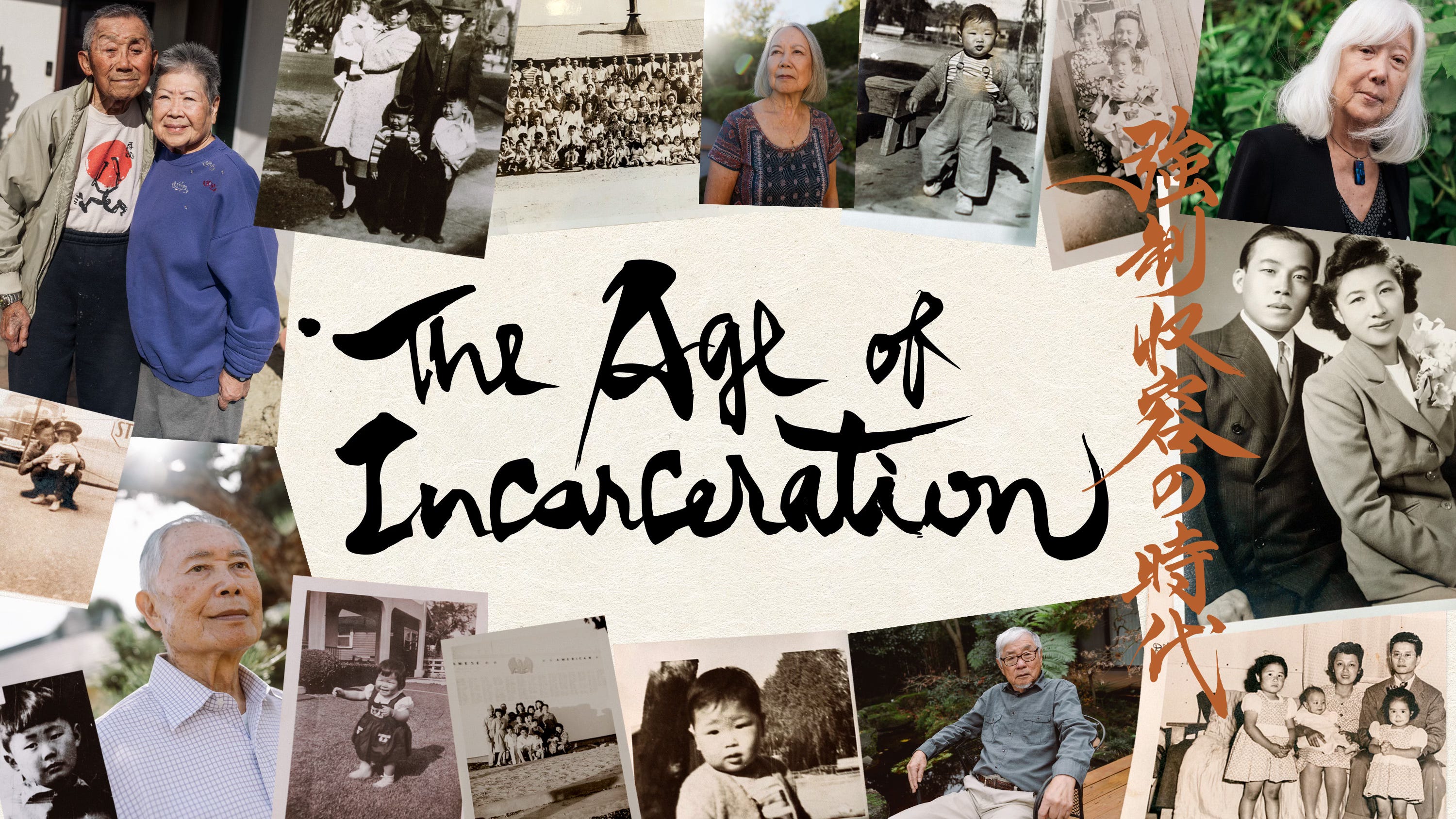
A now-and-then look at people of Japanese descent who were detained in the United States during World War II. Colorphotos by Morgan Lieberman, black-and-white snapshots courtesy of the survivors.
In 1942, under the shadow of World War II, the U.S. government invoked the Alien Enemies Act to justify the forced removal and incarceration of more than 125,000 people of Japanese descent — most of whom were American citizens. The orders from White House uprooted and split families, causing them to abandon their homes, businesses, and communities.
In “The Age of Incarceration,” photojournalist Morgan Lieberman captures the testimony and experiences of nine of the last survivors of Japanese American incarceration, 80 years after the war ended and these people were released. Reflecting on their experience of a childhood spent in detention, this series of portraits and interviews shares stories not just of injustice, but of resilience, documenting what they endured, what they’ve carried with them the rest of their lives, and what about America’s past their country still hasn’t reckoned with. Read it today at age-of-incarceration.longlead.com.
So many of the people in this story were being sent somewhere that was supposed to be “home.” But for some of them, it wasn’t home anymore, and for others, it had never really been home at all. After spending so much time with these stories, what does the word “home” mean to you now?
I think that home is one of those concepts that is so deeply personal. Everyone is probably going to have a different answer to that. But I certainly appreciate having looked at these people who chose to make their lives in another place — how important [it was to be] with your family and community more than even geography.
For the Japanese people of Japanese descent who were in the [U.S. internment] camps, I think the hardest part of that was the separation of family. For many of those families, the men were incarcerated in Department of Justice camps, and the wives and children were in the WRA [War Relocation Authority] camps. That disruption to family structure, and the painful decisions that had to be made without your loved ones, those just reverberate through the generations.
And for the Americans who were based in Asia, I felt that they were there by choice. For example, many of the missionary families would put their children in boarding schools, and then they would go off to these remote parts of China or Southeast Asia. [For the children], boarding schools [became] their families and that was home to them. So when they were sent to America in these exchanges, they might be even going back to a house that their parents had once lived in, but most of them that I spoke to didn’t think of it as going home.
What lessons have you taken away from the book, your research, and the stories that you unearthed?
During World War II, there were very few people who were questioning these government decisions, who were protesting, who opposed them publicly, who challenged them. There were some people within the camps themselves who filed lawsuits and protested and went to prison.
But when I talk about the use of the Alien Enemies Act [in modern day] to round up people from Venezuela to aid in [the U.S.] deportation campaign, you see today resistance to these measures. You see them on the streets. You see them in the courts. Journalists are writing about them. I hope to see more who are pushing back against what are illegal and, in some cases, unconstitutional acts. At least in my belief, that is a difference, and I do believe that’s a lesson we can take from what happened in World War II.
There are many, many lives I’ve discovered. When I go out and talk about the book, often people come up from the audience and say, “I knew my relative had gone to Japan, but I have no idea how it happened or that they were part of these exchanges.”
So the lack of transparency was very painful for people, and I see that happening again today. Lives are being disrupted, and I just hope that we’re able to document this and resist and challenge. It’s an important part of our American tradition, right?
We’ve launched briefing.center with a focus on the press and media.
And we’ve added Citizen Cartwright, a daily quick-read news summary by veteran Washington journalist Linda Cartwright. We’ve also created a new voting rights knowledge center for Citizen Cartwright subscribers. (You can sign up for a dedicated morning email at citizencartwright.com.)
You can sign up here for full access to press and media and Citizen Cartwright on briefing.center.
You can use briefing.center as the center of your information management, or just one of your tools. We’re happy to discuss your information needs.