
Where to Invest in Climate as AI Trade, High Rates Dominate
(Bloomberg) — US solar engineering companies and wildfire-mitigation technologies are emerging as favored climate-related investments ahead of Climate Week in New York City.
According to five managers of environment-focused funds interviewed by Bloomberg News, rooftop solar, battery storage and European utilities are other areas of interest as power demand surges, despite overhanging market concerns about inflation and the future of artificial intelligence. The money managers collectively oversee about $7.5 billion.
“Power has become a major bottleneck, not only for our digital growth, but for the decarbonization of it as well, and so demand for expertise and solutions is also stepping up,” said Katie Self, investment manager at Pictet Asset Management.
Their recommendations come during a turbulent stretch for stock prices. While the S&P Global Clean Energy Transition Index remains about 63% higher than a five-year low set in April 2025, it has lost more than a fifth of its value in the past four months.
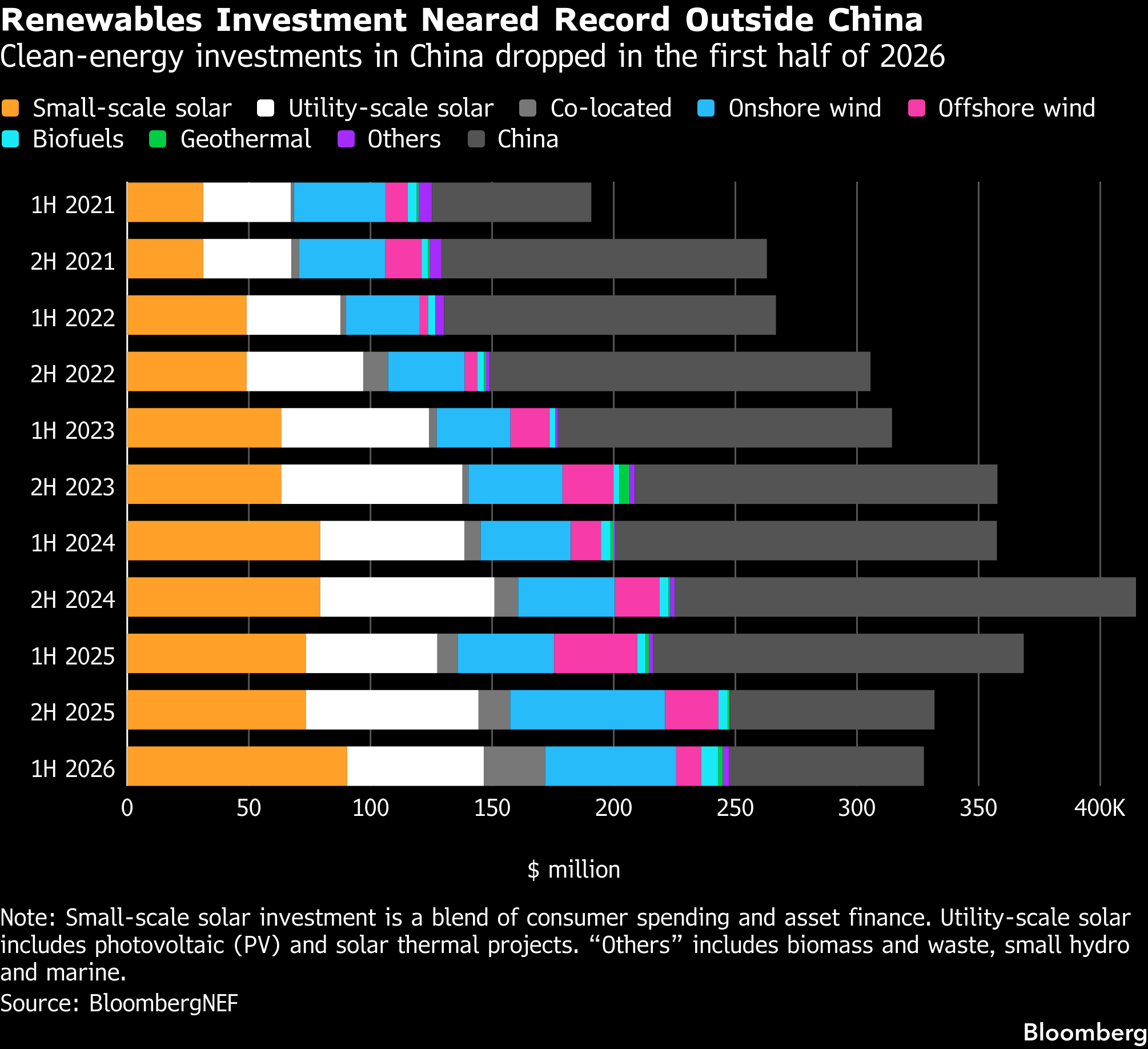
That’s despite renewable-energy investment outside China hitting $247 billion in the first half of 2026, up 15% from a year earlier and just shy of a record, according to BloombergNEF.
The current market weakness is tied to inflationary pressures caused largely by the war in Iran, which led to last week’s decision by the Federal Reserve to raise interest rates for the first time since July 2023. At the same time, AI-related companies are facing greater scrutiny as questions grow about the technology’s potential societal harms.
“The recent selloff in AI-related names has brought down multiples significantly in the clean energy space despite a very strong market for power infrastructure,” said Ulrik Fugmann, portfolio manager at BNP Paribas Asset Management.
Here’s what the fund managers said about what today’s market backdrop means for clean energy stocks, and how investors might find the bright spots in a volatile market environment.
US Solar
Despite President Donald Trump’s pro-fossil fuel agenda, some fund managers remain optimistic about prospects for the solar industry as the US seeks to add new electricity sources to meet the power needs of data centers, and more companies bring manufacturing onshore to avoid Trump’s tariffs.
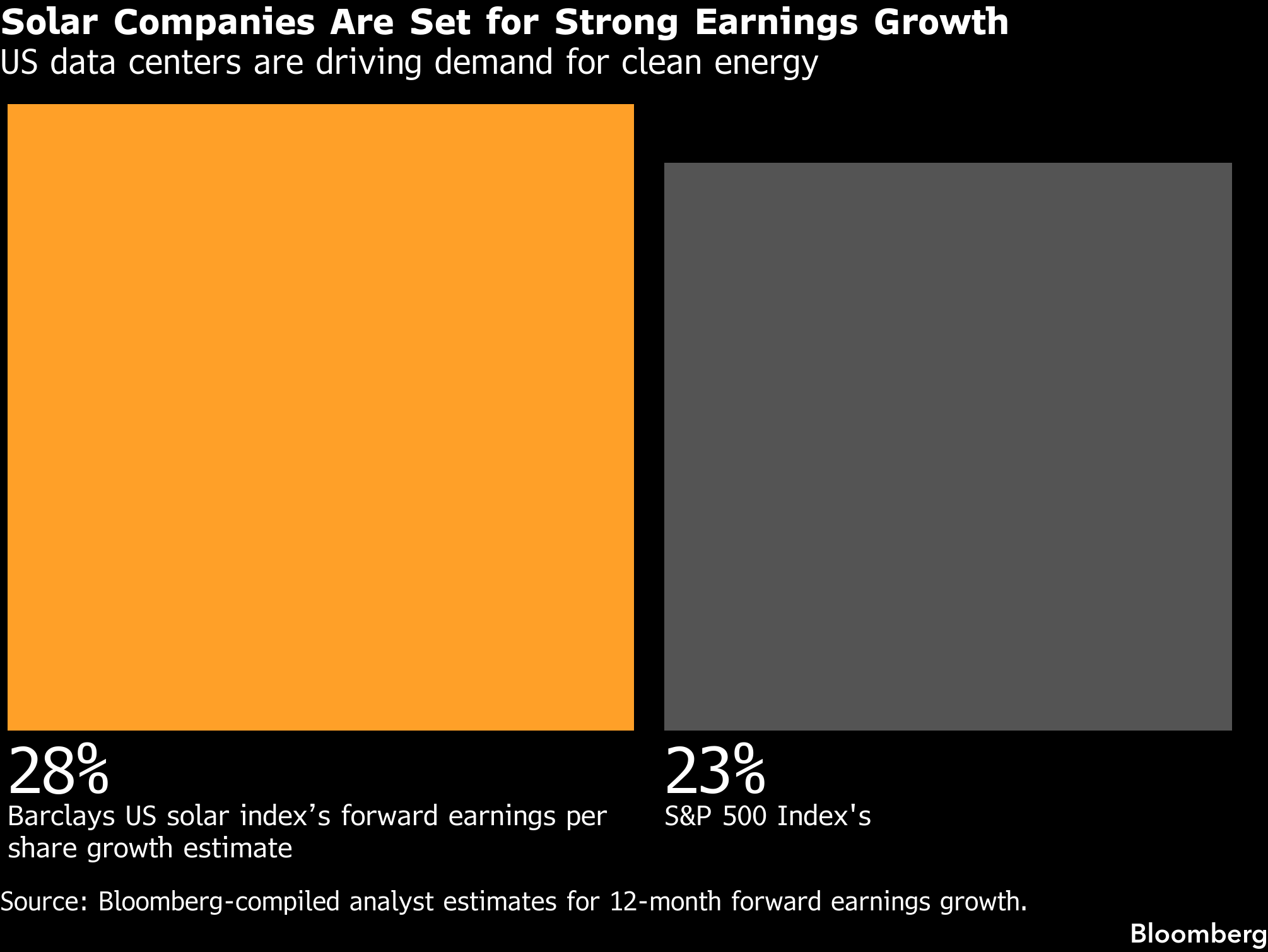
The numbers are on their side, with solar and battery storage representing 70% of all electricity-generating capacity added in the first six months of 2026. Companies in a Barclays Plc gauge of the US solar industry are seen generating earnings growth of 28% over the next 12 months, according to estimates compiled by Bloomberg. Despite statistics like these, the UBS Solar Energy Index has declined about 18% this year.
Seth Kirkham, chief investment officer for global equities at Galvanize, is betting on the sector via the engineering, procurement and construction companies that install solar fields. Solv Energy Inc., which designs utility-scale and battery-storage projects, is among his preferred stocks.“There’s quite significant advancements being made in automation and robotics in the development and deployment of solar fields,” he said. “But in the interim, having the craft skills to build out these large pieces of infrastructure is important.”
For BNP’s Fugmann, the opportunity also extends beyond solar panels themselves. He sees potential in tracking systems and other technologies that can improve project economics by cutting the cost of building and maintaining solar farms. He’s also exploring investments in solar and battery-storage systems designed to power mini data centers for homes and businesses.
Industry leaders in these business areas include companies such as Sunrun Inc. and Array Technologies Inc.
“We’re seeing a very aggressive build-out of solar capacity in the US that is probably going to beat most people’s estimates,” Fugmann said.
Battery Storage
The war in Iran has fast-tracked renewables and battery-storage projects in more than 10 countries, including the Philippines and Thailand, as governments grapple with energy shortages and oil trading close to $100 per barrel.
That has put a renewed focus on energy security. Kirkham said he sees “substantial arrays of batteries adjacent or elsewhere in the grid, which is solving that intermittency problem, allowing countries to — from a security-supply perspective — resolve their reliance on unreliable partners in traditional fossil fuel markets.”
The money manager said Contemporary Amperex Technology Ltd., a leading Chinese battery maker, is “going to become one of the most important companies in the world.” Still, CATL’s stock fell more than 7% in Hong Kong last week amid market speculation about September output cuts and a potential decline in third-quarter unit net profit as more players get drawn to the battery industry.
Despite those competitive pressures, the economics of battery storage are improving. Global adoption is being spurred by lithium-ion prices declining 77% over the last decade, driven by Chinese overproduction, according to BloombergNEF data, while protectionism is aiding US battery manufacturing.
“The shift around battery storage is really gaining traction,” said Pictet’s Self. “The utility-scale solar projects in Europe are adding battery storage as stabilizers at a very, very rapid clip.”
Wildfire Mitigation Tools
Jay Koh, co-founder of Lightsmith Group LLC, which runs a climate-adaptation fund, sees companies that mitigate wildfire risks for power systems as being well-placed to win business.“When we talk to corporates, we’re really looking for where the spending is changing from reactive ex-post disaster spending to ex-ante proactive investment resilience,” he said. “Fire is going to be a big problem everywhere.”
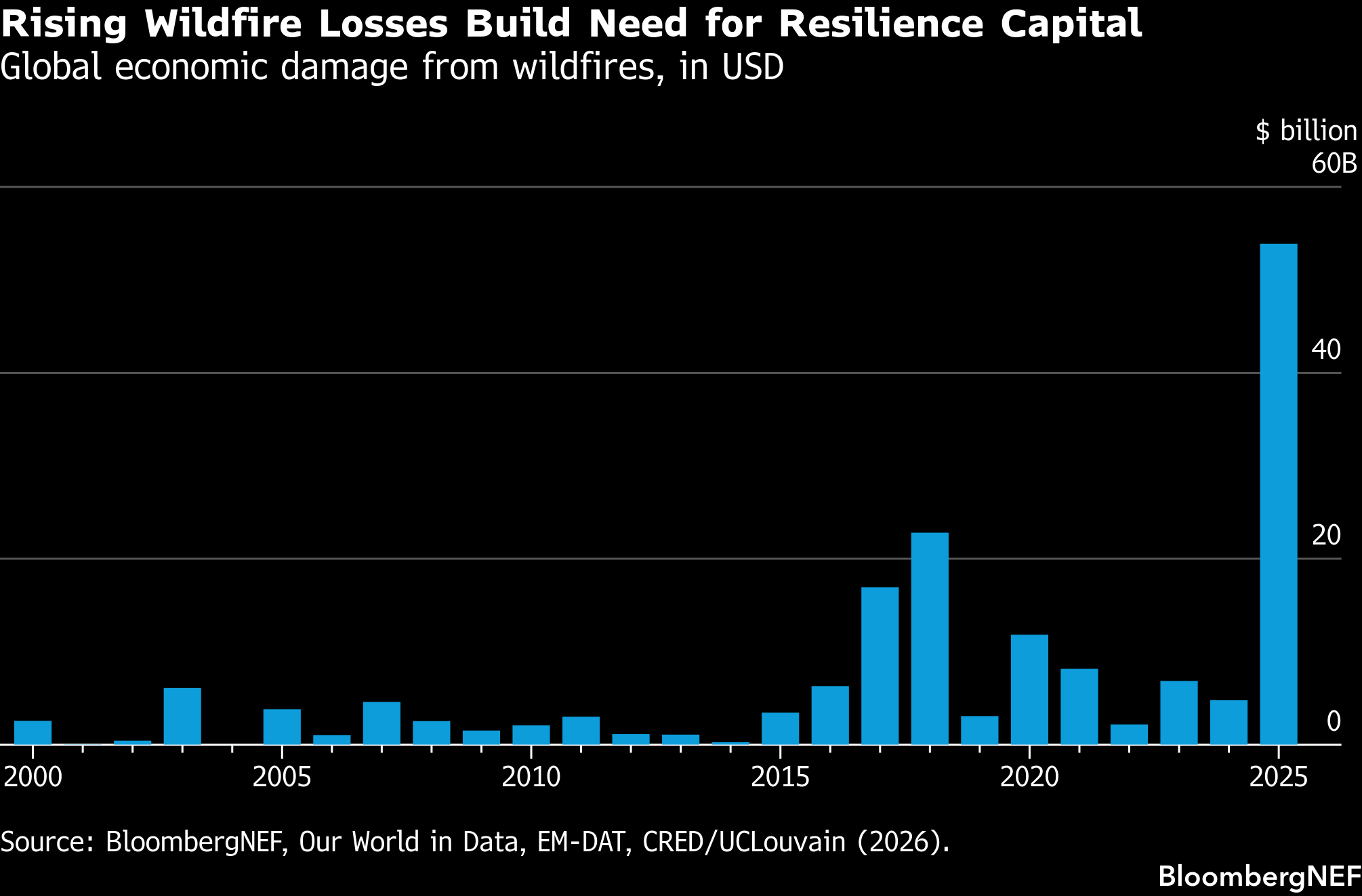
The term “extreme weather” has been mentioned 409 times by the 65 members of an S&P global utilities index in earnings calls, investor presentations and financial and ESG reports this year, according to data compiled by Bloomberg. At the current pace, mentions are on track to surpass the annual peak set in 2021.
Governments in California, southern Europe and Australia — all regions with extreme wildfire exposure — have introduced new financing structures aimed at making utilities more resilient.
Lightsmith has already bet on extreme weather. In 2024, it invested in privately held AiDash Inc., which uses AI and satellite imagery to help utilities manage vegetation risk, storm damage and wildfire threats. Schneider Electric SE agreed earlier this year to buy the company for an enterprise value of $350 million.
The opportunity extends to publicly traded companies, too. Koh sees sensor technologies used across power grids, including transmission and distribution lines, as another potential beneficiary as utilities spend more to make their networks resilient. The equipment is supplied by everyone from startups and growth-stage businesses to established infrastructure providers such as Schneider Electric, ABB Ltd. and Eaton Corp.
Pictet’s Self also highlighted other grid-resilience technologies such as moving power lines underground.
“In the US, there’s a lot of discussion now on the potential to underground power and utility lines,” the investor said. “That’s a very expensive capex project upfront, but you then get the benefit of avoided losses later down the line if there are wildfires and storms.”
The increasing occurrences of extreme heat will only exacerbate the need, Self said.
Utility Laggards
More data centers are popping up across Europe just as regulators estimate the region’s 40-year-old grid system needs €600 billion ($690 billion) of investment through 2030 to modernize and accommodate more renewable energy.
That makes regulated power utilities a top pick for Nishant Gupta, founder of hedge fund manager Kanou Capital LLP, particularly in the UK, where valuations have lagged behind those in the US and elsewhere in Europe.
“Given how tight the power supply-demand [balance] is here, you will see not only utilities, but the whole supply chain do really well,” he said.
Gupta likes UK-based utility SSE Plc as the company plans to make about $40 billion of capital expenditures through 2030. “That’s quite significant for the size of the company and a significant amount of this will go to renewables and grids.” He also likes French company SPIE SA, which helps build transmission grids, as it benefits from the demand for engineers
Tangentially, the hedge fund manager is investing in Wartsila Oyj Abp, a Finnish company that makes medium-sized power plants, on the expectation that the technology will take off as data centers become more commonplace.
“These companies will install many of these small power plants for the next five years,” Gupta said. “And then for the next 20 years, they will get very high-margin service businesses on them.”
(Adds performance of UBS Solar Energy Index in 10th paragraph.)
©2026 Bloomberg L.P.