
When the media covers war, every other topic fades
The media thrives on war, and always has.
Every news organization, for days, has been leading with Trump’s aggressive and impetuous (and illegal) strike on Iran and the killing of its longtime leader. The coverage has blotted out almost everything else. That’s understandable, to some extent. This is a huge story, and the public is hungry for information.
But it means that you’re seeing far less about some of the things Trump wants to blot out from existence. Far less about his appearance in the Epstein files. Far less about the corruption of the Justice Department. Far less about his wildly inappropriate role in the future of CNN and his broader effort to control the news industry. (I wrote about this last week in the Guardian). Far less about the Republican plans to disrupt the midterm elections, which are now only eight months away. Far less about Trump’s dismal approval ratings.
The subjects that were dominating the news last week are brushed aside.
Instead, it’s all war, all the time.
On the NBC News website Monday afternoon, as one example, you had to get past 11 Iran-related stories to reach anything else.
On Monday’s print New York Times front page, a stunning investigative story about Jeffrey Epstein’s use of “elite” medical doctors to treat his young victims got a small presence at the bottom of the page. On the Times mobile app on Monday, I scrolled and scrolled without finding any mention of Epstein at all — much less any further follow-up to NPR’s scoop by Stephen Fowler last week about allegations that Trump had sexually abused a minor: “Justice Department withheld and removed some Epstein files related to Trump.”
And even when it comes to the war itself, there’s far too little about the fact that it is illegal, since the strike lacked Congressional approval. For that, you had to turn to columnists like Will Bunch of the Philadelphia Inquirer who wrote over the weekend that “a mad king’s illegal war on Iran is a cry for regime change … in Washington.” Bunch wrote, “There’s only one thing that truly matters about Donald Trump’s joint war with Israel against Iran … It is blatantly illegal.” Or to a good piece by former Obama deputy national security adviser Ben Rhodes in the Times. “This was a decision made by one man with no legal basis, little public support and no coherent explanation of an endgame.” Or to some of the best commentators on Substack, like Robert Reich, who wrote “Anyone who has doubted Trump’s intention to replace American democracy with a dictatorship should now be fully disabused.”
The Atlantic’s overall coverage has been stellar, and notably has featured many bylines of reporters who decamped from the Washington Post.
You can be sure that this drastic change of subject is all part of Trump’s plan.
So as citizens and news consumers, we need to be hyper-aware of what’s missing.
Take, for example, the front-page analysis piece in Sunday’s Times by David Sanger, “Trump’s War of Choice, With a Key Question: Why Now?” As he searched over many paragraphs for the “why now?” of the strike, Sanger never touched on how deeply Trump wants to change the subject away from those things that are threatening him. True, Sanger is a national security journalist, not a politics guy, but this struck me as a pretty big hole in the analysis.
The other thing that’s missing is much on-the-ground coverage. Iran is notoriously hard to cover from the inside. The Washington Post just dismantled much of its international reporting team. And in general, there are far fewer reporters who even have a chance of covering this war from where it’s actually happening. I was impressed, though, by the Post’s history-rich piece by Greg Miller and Karen DeYoung — two great reporters who remain after the recent deep layoffs: “Trump pursues Iranian decapitation without a plan for what comes next.”
On Fox News, for example, some coverage amounted to straight-up warmongering and cheerleading. Mark Levin, on a radio show, called critics of Trump’s strike “pimps for the enemy.” The Daily Wire host Ben Shapiro gushed that Trump is “the most courageous commander in chief,” and a Fox News guest Julian Epstein bizarrely speculated that the strike could bring Trump a Nobel Peace Prize, which is “very, very long overdue.” But the right-wing voices are split, with Tucker Carlson blasting the aggression as “absolutely disgusting and evil.”
The one constant is that war is the topic. Everywhere. And no surprise that Trump was calling up prominent national reporters to offer them “exclusive” interviews as he tries to build support for what he has wrought. These include ABC’s Jonathan Karl, Michael Scherer at the Atlantic, Jake Tapper at CNN, and quite a few more. As Mark Jacob noted on Bluesky, “the key to getting mainstream media on board with an illegal war is making them feel like an important part of it.” And Oliver Willis of Daily Kos nailed it: “When he wants to sell a war, suddenly they’re not ‘fake news’ anymore.”
It’s hard not to think of the movie “Wag the Dog,” in which a manufactured war was dreamed up to distract from encroaching political disaster.
And, on the subject of how news media loves a war, one recalls the (possibly apocryphal) story about newspaper publisher William Randolph Hearst who said to a correspondent dispatched to Cuba to report on a war with Spain but who reported that all was quiet. “Please remain. You furnish the pictures. I’ll furnish the war.”
As this war continues to be a huge story, I’ll be paying attention to what is getting short shrift as a result. Readers, please let me know where you are finding the best coverage and where — if anywhere —the other important stories are still managing to get some time and space. More broadly, what is your opinion of this war and its implications for the future?
On the topic of the news media and a different war, I want to mention the valid criticism made by American Crisis subscriber Brendan Martin of something in my post from last week. He noted an important omission (my “amnesia,” in his terms) when I wrote about how the New York Times reacted to 9/11 by venturing outside “business as usual” coverage. I was suggesting that, in our current moment, news organizations need to rise to the occasion. When The Times misled its readers with gullible stories about Iraq’s supposed development of weapons of mass destruction, the coverage (Martin called it “ghastly war propaganda”) helped pave the way for the war in Iraq.
American Crisis is a community-supported project where I explore how journalism can help save democracy. Please consider joining us!
Separately, I want to shout out two local news organizations for exemplary work over the past few days.
Investigative Post, a nonprofit news organization in my hometown of Buffalo, broke a story that soon went global about a mostly blind Rohingya refugee who was found dead after being released from jail into the custody of U.S. Border Patrol. Governor Kathy Hochul called for an investigation Monday, blasting “federal agents acting out of control.” Editor Jim Heaney takes readers behind the scenes in this explanatory story.
The Salt Lake Tribune’s editor, Lauren Gustus, wrote a column this week about how her paper — with the cooperation and financial support of several national news organizations — is fighting to inform the public about the Tyler Robinson trial; Robinson is accused of killing Charlie Kirk. Robinson’s defense has tried to close the courtroom multiple times and restrict information in other ways.
Finally, a heads up that Slate is making its first move onto Substack with a legal newsletter called Executive Dysfunction. One of its first topics was a deep dive about Trump-appointed judge Aileen Cannon’s blocking of Jack Smith’s special counsel report, seen as part of Cannon’s campaign for a seat on the Supreme Court. Hat tip to the great Dahlia Lithwick for this news.
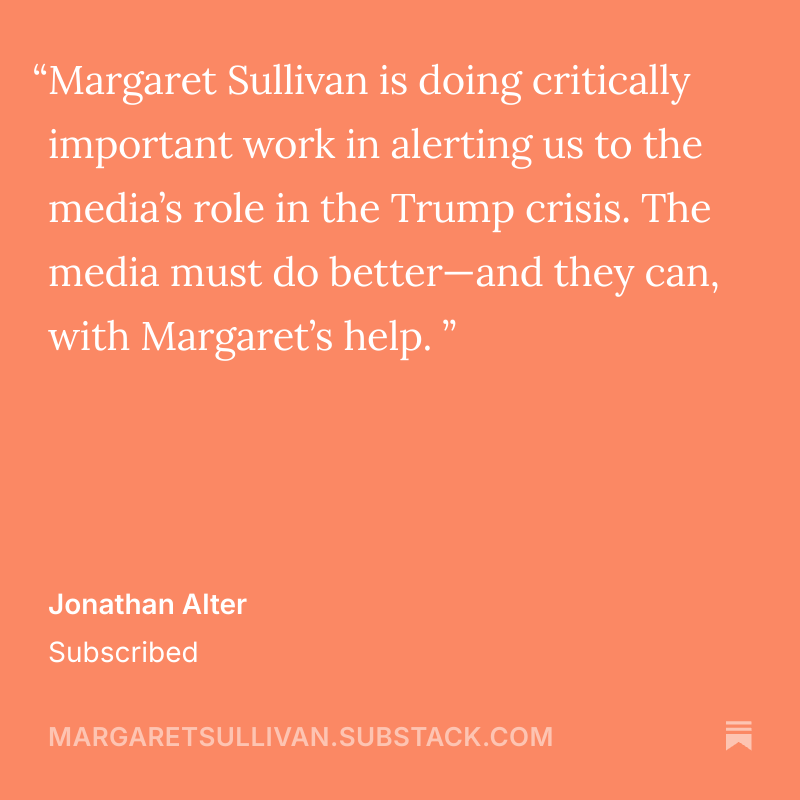
Thanks to all of you for being here, and for caring about the crucial relationship between journalism and democracy. I appreciate your subscriptions and your comments, which I read with great interest. Here’s why one reader (you may recognize him as a prominent journalist and author) signed up. And beneath that, some information for newcomers about me and what I am trying to do here.
My background: I am a Lackawanna, NY native who started my career as a summer intern at the Buffalo News, my hometown daily. After years as a reporter and editor, I was named the paper’s first woman editor in chief in 1999, and ran the 200-person newsroom for almost 13 years. Starting in 2012, I served as the first woman “public editor” of the New York Times — an internal media critic and reader representative — and later was the media columnist for the Washington Post. These days, I write here on Substack, as well as for the Guardian US. I’ve also written two books, taught journalism ethics, and won a few awards, including three for defending First Amendment principles.
The purpose of ‘American Crisis’: My aim is to use this newsletter (it started as a podcast in 2023) to push for the kind of journalism we need for our democracy to function — journalism that is accurate, fair, mission-driven and public-spirited. That means that I point out the media’s flaws and failures when necessary.
What I ask of you: Shortly after Trump’s election in November of 2024, I removed the paywall so that everyone could read and comment. I thought it was important in this dire moment and might be helpful. If you are able to subscribe at $50 a year or $8 a month, or upgrade your unpaid subscription, that will help to support this venture — and keep it going for all. Thank you!