
What The Next Journalism Should Be
Welcome to Second Rough Draft, a newsletter about journalism in our time, how it (often its business) is evolving, and the challenges it faces.
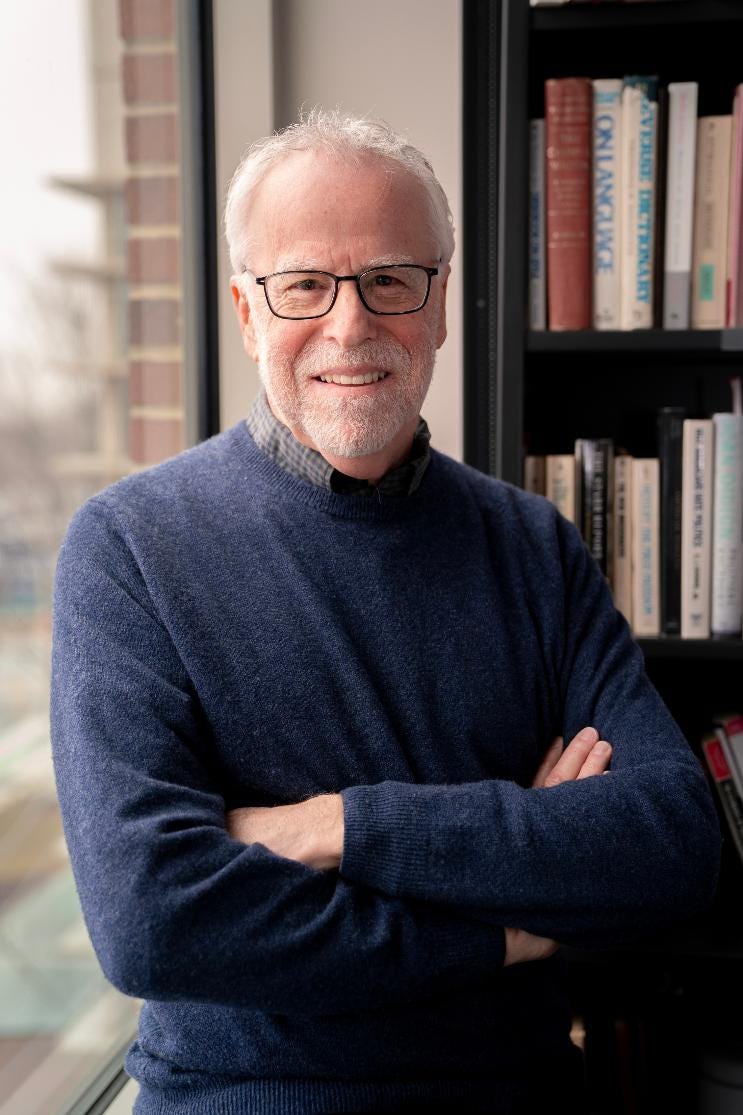
Tom Rosenstiel has been one of the nation’s leading thinkers about journalism for decades. He is the co-author of The Elements of Journalism (with Bill Kovach), now in its fourth edition. Rosenstiel founded and for 16 years led the Project for Excellence in Journalism at the Pew Research Centers, and then ran the American Press Institute for nine years. These days he is professor of the practice and the Eleanor Merrill Scholar on the Future of Journalism at the University of Maryland’s Philip Merrill College of Journalism as well as a senior fellow at NORC at the University of Chicago. Much of his time as a working journalist came at the Los Angeles Times and at Newsweek.
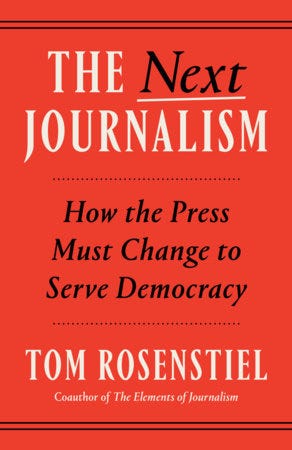
Tom’s new book, The Next Journalism: How The Press Must Change to Serve Democracy, was published Tuesday. I strongly recommend it, even as I’m skeptical about some aspects, as you will see below. Our conversation about the book took place in late July, and has been edited for length and clarity.
RT: Tom, thanks for doing this. Let’s start with the basics. What’s the central premise of the book?
TR: I think the central premise is that the model that we’ve operated by, and that a lot of our routines were built around, was an advertising model in which we got people’s attention, and then we rented that attention to advertisers. We can no longer primarily build this business on advertising, so we have to find another way. We have to find a way of creating a journalism that has so much value that people will pay for the journalism.
And one of the problems that we have in making this shift is that so much of what was indispensable for people in the 20th Century wasn’t our journalism. It was the things that surrounded it. You couldn’t buy a house, or sell a bike, or know what was on TV, or what was at the movies, or get the coupons, without the classified and the listings in the paper, which weren’t the journalistic output.
People now get almost all of that elsewhere. Meanwhile, we as journalists did not think about how to make our journalism indispensable. We even denigrated some of that work as “service journalism” or “puff pieces.”
How can we make journalism have such value that people recognize ‘this is helping me live my life’? That’s what the book is about. It essentially identifies places where that is beginning to happen, and people who are exploring that technique— journalism as a service— and it explores in particular a concept from Clayton Christiansen called the Job to Be Done, which is understanding at a deeper level than we ever had to before how people use our product, why they use it. I mean at the story level, what job is this particular story actually doing for people?
RT: You seem to me pretty disillusioned with investigative journalism, at least as it is often practiced in the U.S., describing it as typically “alarmist.” Is that right?
TR: Well, investigative journalism is a large bucket. Exposés are a category of stories that expose wrongdoing or hidden things. Outside of a handful of publications, there isn’t as much of that as journalists would like to think. But the work that’s done there, I think, is usually pretty good. In fact, some of it is spectacularly good. Much of what we know about things that, for instance, the President of the United States and his family are trying are trying to hide, both personally and within the administration, falls under that category.
Where accountability journalism falls short
TR: The broader category of accountability journalism, where we monitor the powerful, is where our work is often not nearly as good as we think it is. That is often a place where we lean toward “let’s pick out the things that are weird” or things that are extreme or things that we think are “newsworthy.” A lot of it amplifies establishment voices or extreme voices. There’s lots of academic research that shows that we over-index extreme voices in our coverage. That’s where my skepticism is.
There’s another category of reporting, which is to answer fundamental questions: Is childhood poverty increasing or decreasing? Is crime rising or falling? I might put that into a category that Bill Kovach and I once called interpretive investigative reporting, where you’re going through data and then doing assessments of it.
The Pentagon Papers was a classic example of interpretive investigative reporting. They got the Pentagon Papers, but they didn’t just put them in the newspaper the next day. It took weeks of interpreting and analyzing what those documents meant before you could write a story about it. I don’t think we have as much interpretive investigative reporting as we probably need. Is the mayor doing a good job? Are our roads safe relative to similar cities? What would be ways of fixing our healthcare system?
The amount of that is pretty marginal for good reason. It’s expensive. James Hamilton wrote a great book called Democracy’s Detectives where he talked about the average cost of a serious investigation. But he also established that it probably pays for itself in terms of reader value and subscriptions.
RT: So, this leads me into my next question. In reconstructing how news stories are structured, you advocate shifting, I think, from what has often been called a “nut graf” to what I would call a “nut query,” a question the story seeks to answer, which is what you were just talking about. Can you describe how that would work as a technique and why you think it would be an improvement.
TR: I’m glad you asked that. First of all, when we go out to report stories as journalists, there’s always a hypothesis that we’re trying to find out. It could be as simple as, there was a fire at that warehouse. What happened? How many people died? But often the hypothesis is why did this happen? How much trouble is Trump in at this moment with the conduct of the Iran War?, or What is the capability now of Ukraine to sustain that war? Some of these questions are hard to answer. They may be speculative, but there’s always a hypothesis.
I think being more transparent with our audiences about what the hypothesis is, and why we think the hypothesis is important, is a really important step for several reasons.
What objectivity was supposed to mean
TR: One is a deeper understanding of what some people— but not me—like to call objectivity. That really has to do with process: What reporting process did you follow to do your story? Is it a process that I can trust? When the concept of objectivity migrated out of social science into journalism, that’s what people had in mind. It wasn’t objectivity of consciousness. It was objectivity of method.
We have a very hard time explaining that to audiences, and even have a hard time inside the field. People confuse objectivity with neutrality, or objectivity of consciousness, with objectivity of process, or objectivity of presentation.
I think starting with the hypothesis that you are trying to pursue opens up several new ways of storytelling. One is that if there is a journalistic method, we can reveal what that method is to audiences. That’s what they do in natural science and social science. Instead we simply write our conclusions in lecture form and offer some evidence, but we don’t say much about how we arrived at that, or even why we asked that question in the first place, or why it’s an important question. It may be the most important step that we could take in journalism to try to rebuild trust with skeptical audiences.
One of the chapters in the book is all about what we can learn from psychology. People are puzzlers. That’s one of the key lessons of psychology. People want to see the evidence for themselves, especially if they’re suspicious or skeptical of the answer.
Empathy and it limits
RT: You end the book with a strong call for greater empathy with a wider range of readers. Are there limits to this? How do we empathize with people whose views are bigoted or who refuse to accept basic facts?
TR: We need more empathy. What do I mean by that? We assume as journalists that people kind of view the world as we do. They think that people should be watched, that power is corrupt, that we should give voice to the less powerful in society. When we’re accused of bias, we often say, “no, I’m just doing my job.” Here’s some wrongdoing that you should know about, or here’s something really weird. Inside newsrooms; those frames are so familiar, they are ingrained assumptions about what will make people interested and what will seem credible.
But if you look more closely, and particularly if you look at things like moral foundational instinct theory, people do not necessarily share these sort of instincts and values that journalists have and that get ingrained in newsrooms.
Instead, we could think how would I write this story for somebody who is very respectful of authority— which is one of the moral instincts that conservatives tend to lean toward— or somebody who believes strongly in loyalty, another moral instinct that conservatives lean toward. Is there another way to frame the same story other than “here’s the stupid government; you can never trust them”?
When I was at the American Press Institute, and we did experiments writing stories with slightly different frames but the same facts, we discovered that those stories were credible to a wider range of people, but also more credible to people who were in sympathy with journalistic instincts. Now, are there limits to that? Which is the question that you asked. I think there are. In the book, I say, and I’m mirroring something that Marty Baron said, that 20% of people believe in witches. There’s some number of people who are not going to be reachable by fact-based journalism for various different reasons.
But 80% of the American public is a much bigger number than fact-based journalism is reaching now There is a tendency in the press to be more declarative, to call a lie a lie and a liar a liar, and to speak our personal truth more, to bring more voice. Human psychology research suggests that will alienate more people because it will sound more like we’re preaching. That our fact-based journalism will be tilting more toward opinion journalism. That doesn’t mean that we should be doing a neutral both-sided thing, but it does mean that if you’re going to say this is a lie, you offer the proof. You don’t just offer the declaration.
RT: One of the things you advocate is what you call a civic internet employing AI. Can you briefly just describe what that is? But then the real question I want to ask you is, what’s the business model for it?
TR: The civic internet is an idea that has been floating around in my head for a long time, which is that there’s a lot of data about our communities, everything that states and the federal government collect and often try and hide, to some simple information: How many people are coming to the airport? How many car accidents are happening in cities, and at what locations? This data is the Internet of Civic Life. I think that journalists should see it as an enormous opportunity, and in the public interest.
We often use that data very episodically to do one story, one investigation. We collect it, organize it, try and understand it, do a story, and then we move on. The more that we can see the Internet of Civic Life as a public resource, collate it, collect it, make it understandable, and do so on an ongoing basis, make that data available to people, the more that inclines us toward journalism as a continuing service and conversation with the public. We can lean into that and do stories every month. Here’s the 12 indicators of civic health of our community, and each month we’re going to explore one of them, and also provide you with a database so you can explore them. AI makes the management of that data much easier.
Monetization and audience
TR: How can you monetize it? One of the reasons I think this is an opportunity is that, for the last couple of decades, other people have been monetizing it instead of journalism. Lots of people have gotten rich on this, and these are things that we’ve let slip through our hands.
RT: But why should we think that publishers are going to be able to compete, for instance, with real estate sellers in real estate information, or with
health benefit providers about pharmacy information, or with any other industry about information related to that industry?
TR: I think there are areas that have not been developed. I think our ability to synthesize across categories and create higher level understanding of some things like a civic health index, or for education is an example. Our ability to synthesize data and then publicize that we have it actually exceeds some company that is new to the marketplace and is trying to get awareness for what it’s doing. In my imagining, this is both a B2C business in the sense that we’re providing this to customers, it’s part of a subscription. But there may be a B2B opportunity as well. It supports our fundamental business, which is B2C. It may create, in addition to that, some B2B businesses that we don’t have.
RT: We could talk about this all day, and I really appreciate it. But I’ve got one more question. You talk in the book about getting beyond storytelling, and you provide a number of anecdotal accounts of how this can work. My question is: Is there evidence that these techniques actually yield larger audiences?
TR: There’s evidence when stories are told more effectively, more visually. The New York Times this week did a story about where Trump has increased his wealth, and they did it graphically. It’s so much more effective as a way of narratively conveying that information than words would be. We know from data that it is also more persuasive. People believe information that’s conveyed visually.
There’s also evidence that these stories are way more evergreen, which bring them larger audiences over time. Today, our archives are enormously important and valuable to us because people become interested in something that we have done when it enters their life in some new way. I never read that story about Alzheimer’s until my mother had Alzheimer’s, or I didn’t care about that article on how to stay fit at 55 until I became 55. Now I want to hear about it.
RT: Tom, I really appreciate you taking the time. Good luck with the book.
TR: Thank you.
Second Rough Draft paid subscribers support nonprofit journalism. To receive new posts become a free or paid subscriber.