
📅💡🧪 What if you had three months to test your best idea?
Read the Nieman Lab article announcing our partnership with Chicago Public Media to bring Roundabout to Chicago!
Big things are happening around here. Public Spaces Incubator, our partnership with public service media organizations, is reaching new levels of collaboration and implementation. Meanwhile, Roundabout, our local community app, just announced a huge project with Chicago Public Media — one of the largest public media institutions in the US.
This has us looking ahead to the future. What’s the next Roundabout or PSI?
New_ Public Managing Director Angelica Quicksey helped launch both of them. Now she’s kicking off a new initiative: a virtual residency for prosocial builders called Entrepreneur in Residence.
We’re seeking two amazing residents. Applications are currently open for the pilot program, just for the U.S. and Canada for now. The deadline is September 9 at 11:59pm PT. Below, Angelica shares why we’re motivated to support founders, why now is the perfect moment for this, and who should apply.
–Josh Kramer, Head of Editorial, New_ Public
Why AI makes us want to invest in humans:
Think back: what if New_ Public had existed twenty years ago when Facebook or Twitter started? What if we had people thinking and talking about where our technology should go and they didn’t allow it to take over our lives, communities, and communication infrastructure in the way that it did?
There was a moment where our Co-Director, Eli Pariser, was warning about filter bubbles in 2011, but nothing changed. We still ended up with the social media that we have now. It’s atomizing us. It’s pulling us apart. There’s misinformation. There’s conflict.
This new residency is very much tied to AI and our new research on After the Feed. Right now, we’re at this inflection point with AI, and there are a lot of ways that we could, as a society, shape where AI goes.
We don’t want AI to go the way of social media. We want it to power an information ecosystem and a technology of connection that serves our needs. Not one that manipulates us in ways that benefit the builders of these products at everyone else’s expense.
Why New_ Public wants to support entrepreneurs:
We believe that a healthier social fabric is made up of many different kinds of digital public spaces, and that requires many different people building those public spaces.
So for the last five years, we’ve done research on what works. We’ve built things ourselves, and we’ve brought on a Founder in Residence to launch a new platform for local communities. We want to keep doing that. We want to support folks who are building the next generation of social technologies.
We have always believed that people should have many alternatives. Now we’re trying to support the people who are building those alternatives, and building them in healthy ways.
The big opportunity of this moment:
AI-powered coding tools are dramatically lowering the cost of building software, let alone social software. A single product builder or a small team can build something now in a way that they couldn’t before. We think this is a really big change that enables entrepreneurship.
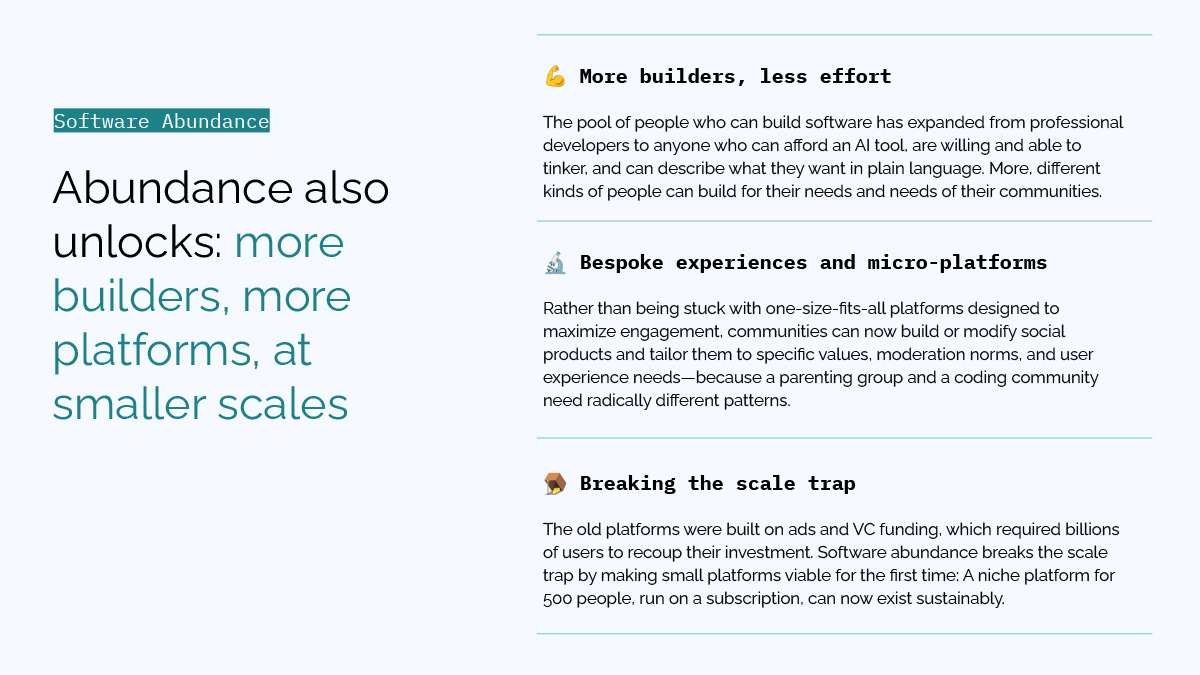
Consumer preferences are changing too. As our tech is transforming, people are seeking alternatives to social media feeds. They are rejecting “the algorithm.” They’re retreating to these smaller, trusted spaces like group chats. They’re experimenting with AI products that give them information that’s uniquely relevant to them. Or they’re going offline entirely and rejecting online life.
So as people’s preferences change, and what’s possible with technology changes too, this feels like a really important moment to enable entrepreneurs to seize that opportunity.
I’m also convinced that decentralized protocols like AT Protocol and ActivityPub make it possible to build social technology that’s different down to its bones.
That’s exciting, because between the AI coding tools and these decentralized protocols, entrepreneurship can look a little bit different. For example, the folks who won our Open Social Awards are building in different ways and creating different kinds of applications. It shows that we can have new ideas and new products in this moment.
The ideal builders for this new virtual residency pilot:
Our prospective EIR could be a developer who can build something quickly with their own technical talent and experience. But there’s also the non-technical founder who can build and test in a way that wasn’t possible before these AI coding tools.
One thing that distinguishes this program from others is that it’s for folks going from -1 to 0. The person exploring at this stage could be someone that has experience working in tech. Maybe they’ve founded something before and they’re ready to build their next thing, and they need a home to do that exploration.
Mostly, we’re looking for people who are very product-oriented. People who can see software-shaped problems, and also see users’ needs. They can marry those to build something that’s really compelling and that people want to use.
They must be able to relentlessly test their assumptions, including getting something in front of potential users and working through the ambiguity of all of these changes in technology and consumer preferences.
They can use this time to pinpoint the one thing they want to build that’s going to be useful to people: a new platform or application that’s prosocial, healthy, and supports human flourishing.
Going from hunch to plan:
This program is for someone who’s coming to us with a hunch, an idea, or an area of exploration. They will leave with a strong conviction about what to build.
When we started the project that became Roundabout, we started with more of a hunch that there was an unmet need in local communities and how people connect locally, but we weren’t sure what the need was.
We spent nine months doing R&D around that. We ran some experiments and we came to the end of that process with a clear conclusion that a new platform was needed. Then we formed the team and built Roundabout. This is more condensed than that. It’s three months of exploration to come to a conclusion about what the shape of your idea should be.
This is about finding a product opportunity and building confidence around that opportunity. This isn’t about writing a white paper or doing an academic exercise.
You’re not going to build a full-stack application during this three-month virtual residency. But ideally you are going to build multiple prototypes, test those prototypes, and get to something that you feel confident about by the end. You’ll have a clear picture of where your product idea stands — what’s working, what’s not, what it would take to get to the next stage. Then, we’ll work with you to identify the next steps.
The focus areas for the virtual residency:
One is humans connecting to humans, and the other is local and civic information environments. These build on areas where New_ Public has a ton of expertise.
We’re interested in social products that bring people into real, meaningful contact with one another. These can be AI-native products, but at the end of the day, we care about humans connecting to humans, not bots.
The other piece is local and civic information environments. What we care about here is that the old distribution channels are changing — they’re weakening. Local news outlets are shutting down. People are turning to other places to get information. They’re increasingly turning to social media and content creators. But people still socialize to make sense of the world around them and internalize information. So what else could that look like?
If you have a wild idea that looks nothing like what’s come before, but is still about humans connecting to humans or local and civic information environments, that’s awesome. If you’re trying to reimagine how people communicate with one another using technology, great! Everything shouldn’t be Facebook-shaped.
What this virtual residency provides:
For three months, residents will get a stipend. This is intended to support builders who might not normally have the opportunity or space for this kind of exploration.
We will bring in external experts throughout the residency around specific topics — everything from thinking about public space and the philosophical roots of this work, to much more hands-on conversations around go-to-market and concept testing.
Residents will also have access to our research. We have five years of research that’s directly applicable to founders building in this space, as well as a massive network, including product teams at major platforms and researchers at leading universities. We want to make introductions to support residents’ work.
You will kick off your three months with us at our in-person team retreat in Philadelphia in October. Throughout the virtual residency you’ll have regular programming, access to office hours with our team, connection time with the other resident, and time and space to build and explore.
This is also a pilot for us, so we’re looking for this first cohort of two people to also help us build the program. Your experience is going to directly shape how this Entrepreneur in Residence program works going forward. We’ll be adjusting in real time, so it’s not going to feel as polished as it will for future cohorts, and we want folks who are going to be comfortable with that.
The long-term vision:
It would be really disappointing if in ten years we’re continuing on the trajectory that social media has put us on: being less social, people trusting each other even less, and basically renting our technology from a couple of large platforms.
The long-term goal of this program is to support many people building things that have a real shot at being successful. I just don’t believe that today’s social media platforms are the only version of social technology that is possible.
At New_ Public, we know that we’re not the only people with great ideas. While we’ve done a ton of work and uncovered a lot of insights, there are so many people with exceptional talent and big ideas out there. We want to support those people.
Thanks Angelica!
Looking forward to cooler fall weather,
–Josh