
What Does California Need to Stabilize the State’s Oil Supply?
California Governor Gavin Newsom signed legislation in September that fast tracks the approval of 2,000 new wells per year over the next 10 years in Kern County, a significant oil-producing region.
“Translation: I, Gavin C. Newsom, am slightly reversing course on my own policies because they suck and would have driven gas and electricity prices even higher,” Assembly Republican leader James Gallagher posted on X. “Nonetheless I am not lowering any of those costs. Good luck to you California. I’m busy running for President.”
Gallagher nailed Gov. Newsom’s motive.
California Democrats’ war on the oil and gas industry is working, but not for the people, or the oil and gas industry. Governor Gavin Newsom in April directed state officials to increase efforts to guarantee reliable fuel supplies for the nation’s biggest auto market, prompting oil companies to blame state policies for difficult business conditions and high pump prices.
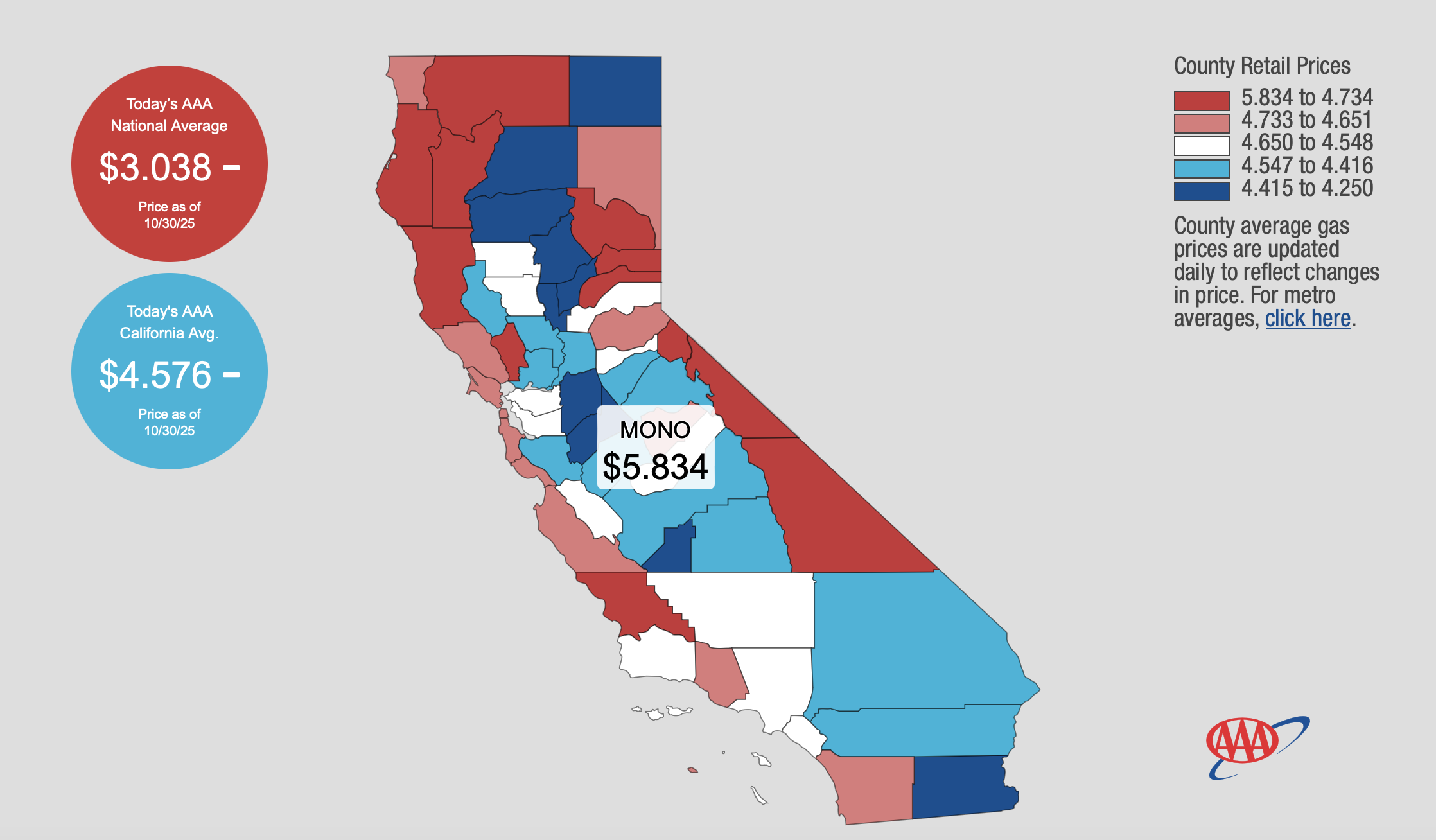
But California’s gas prices have remained the highest in the country. Today AAA reports the national average cost of a gallon of gas at $3.04, and California’s average is at $4.58 per gallon – California’s average is $1.54 higher than the national average. The highest in California is in Mono County at $5.83 per gallon.
Only now does Governor Gavin Newsom make a serious move to address the oil and gas industry in California. While it is something and a positive move, it’s nowhere near what the state need to provide Californians the oil, gas and fuel the state needs.
A Policy Brief on Stabilizing California’s Oil Supply Under SB 237, by Joseph B. Silvi of UC Berkeley, James W. Rector of UC Berkeley, and Michael A. Mische of USC, examines the ability of Senate Bill 237 to stabilize California’s energy infrastructure and supply, maintain refinery and pipeline operations, and ensure energy security amid refinery closures and increasing foreign dependence.
The professors note in the first paragraph:
“California’s in-state oil production has declined by approximately 65% since 2001, while its dependency on foreign imports has risen by nearly 70%. At the same time, refinery capacity has fallen 21% since 2023 and gasoline demand remains largely unchanged at roughly 36–40 million gallons per day. SB 237, designed to permit up to 2,000 new wells annually in Kern County, will add some production but not enough to offset the overall statewide decline and will not adequately stabilize the state’s petroleum infrastructure.”
As the Globe just reported this week, California’s self-inflicted gas crisis is a direct threat to U.S. military force readiness on the West Coast. This in-state oil production crisis is as serious as it gets for the Golden State.
As Silvi, Rector and Mische say in their brief, “California refinery capacity will decline 21% by 2026, eliminating 6.2 million gallons/day of in-state gasoline production. Only 7 refineries will remain capable of producing California-compliant fuels by 2026.”
They offer background:
At one time, California was the leading producer of crude oil in the world, yet today, the Golden State is facing a potential gasoline supply crisis. Long-standing policies and an adverse political and regulatory attitude have resulted in a steady reduction in both California’s in-state oil production and refinery capacity, leading to increased dependency on oil and, potentially, more gasoline from foreign sources, such as Iraq, Ecuador, Brazil, and, at times, Russia, Iran, and Venezuela. Already saddled with the highest regulatory costs and taxes in the nation, retail gasoline prices in California are over 50% higher than the U.S. average.1 2 With the imminent closure of two refineries and the loss of at least 20% of its in-state refinery capacity to produce gasoline, or around 6.5 million gallons a day, as well as the potential loss of California’s largest inland pipeline which supplies crude oil to Northern California, California could be confronting double-digit gasoline price increases, and worse, gasoline shortages and lines at the pump.
In response to the growing potential crisis, Governor Newsom and the California Legislature reversed years of anti-oil policy and passed SB 237. In a stunning contradiction to the stated viewpoint that “increasing CA oil production will not change gasoline production capacity and may only marginally change production costs,”3 SB 237 was enacted and signed by the Governor with the intent of allowing up to 2,000 new oil drilling permits annually within Kern County as the means to increase California’s oil production and stabilize its pipeline and refining infrastructure. However, while this policy change is well-intentioned, it is likely not sufficient to stabilize the state’s pipeline and refining infrastructure.
In September, State Senator Shannon Grove (R-Bakersfield) announced that Senate Bill 237 was signed by Governor Newsom to certify the Kern County Environmental Impact Report (EIR), enabling streamlined permitting to expand oil and gas production while maintaining environmental protections. “SB 237 addresses California’s critical decline in domestic oil production, which has forced the state to import nearly 80% of its oil to meet consumer demand,” Grove said in a press statement.”
“Under SB 237, Kern County will now be able to approve up to 2,000 new well drilling permits per year for the next 10 years. This long-term certainty strengthens Kern County’s position as the Energy Capital of California, stabilizes the supply chain, and helps protect Californians from painful swings in fuel prices at the pump. By comparison, the state approved only 84 new well permits last year and just a handful so far this year.”
Also notable was Western States Petroleum Association (WSPA) President and CEO Jodie Muller’s statement following Gov. Gavin Newsom’s signature on a package of energy legislation, including SB 237:
“Today Governor Newsom signed SB 237, increasing crude production in Kern County under the most stringent regulatory framework in the country.”
“…under the most stringent regulatory framework in the country.” Notably, that stringent regulatory framework remains.
Rock Zierman, CEO of the California Independent Petroleum Association said, “Every barrel of oil produced in-state means fewer foreign tankers idling off California’s coast, lower gasoline prices, and more money staying in local communities to fund schools, first responders, and healthcare.”
As Silvi, Rector and Mische say in their brief, “However, while this policy change is well-intentioned, it is likely not sufficient to stabilize the state’s pipeline and refining infrastructure.”
“Moreover, while SB 237 attempts to address production and supply concerns, California’s energy policy must also consider climate impacts, environmental protection, and social justice. Producing crude oil in-state must meet the most rigorous environmental standards in the world and is subject to emissions mitigation programs, reducing methane, volatile organic compounds (VOCs), and other pollutants compared with production in countries with weaker oversight.”
Their conclusion pulls no punches:
“The additional wells allowed under SB 237 will not stabilize in-state production, and as a result, in-state production will continue to decline as it is more than likely that producers will not drill 2,000 wells annually.”
“Furthermore, due to the imminent loss of two and potentially up to four refineries, California will be increasingly dependent on foreign sourced gasoline from suppliers such as India, South Korea, Saudi Arabia, Singapore, and, perhaps, China. India receives 40% of its crude oil from Russia, while China receives a significant portion of its crude stock for gasoline from Iran, Russia, and Venezuela.”
Read the entire report by Berkeley and USC Professors Silvi, Rector and Mische to understand California’s future with refineries closing, and California’s declining in-state oil production. They deliver the facts, the data, the graphs, consumption and California’s astounding history of oil production… until recently.
A Study of SB 237 to Stabilize Oil Production in California — Definitive