
The Week Ahead
The Supreme Court
Can we think about anything other than the election at this point? It’s a tall order.
But even as we are voting, the Supreme Court will hear oral argument in a number of cases this week. On Election Day, the Justices take up St. Mary Catholic Parish v. Roy, a case about whether a state can deny public funding to religious schools that do not follow state anti-discrimination rules. Two Catholic preschools want to be able to receive public money while refusing to admit LGBTQ+ children or children with same-sex parents in the programs, in accordance with church teachings.
These cases always seem to come out of Colorado: Masterpiece Cakeshop, the baker who didn’t want to do wedding cakes for gay couples; 303 Creative LLC v. Elenis, the Christian wedding website designer who didn’t want to have to do designs for gay couples; and last term’s Chiles v. Salazar, where a Christian counselor used the First Amendment to successfully challenge a state ban on conversion therapy. With this Court, when religious rights bump into other people’s rights, especially those of LGBTQ+ people, religious liberty claims seem to win. We may get some sense of whether this case will continue that trend during the argument.
Quit Threatening Election Workers
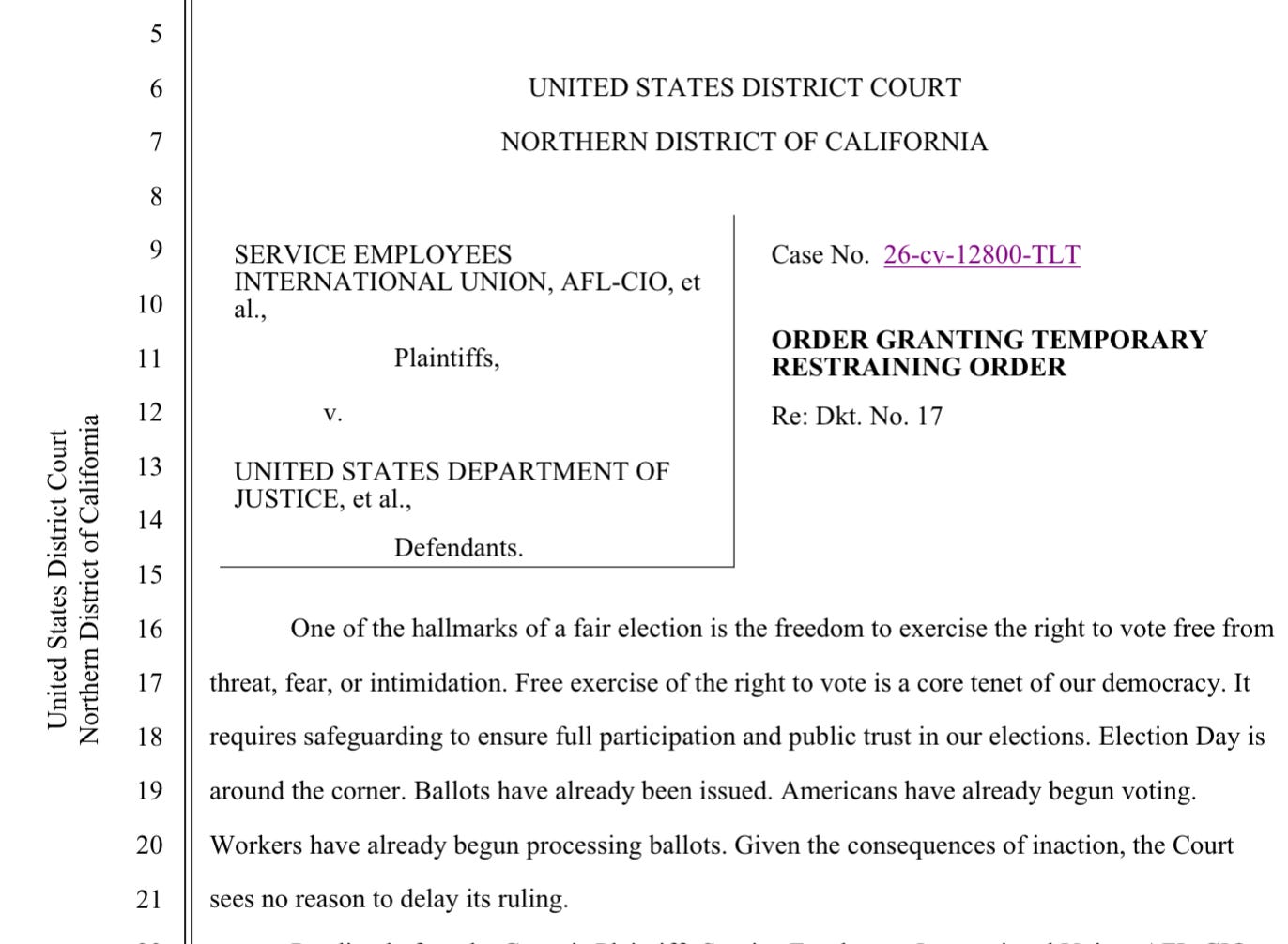
Friday, a federal judge in the Northern District of California entered a remarkable order. She ordered the Justice Department to stop threatening election officials with criminal prosecution. She ordered the government to stop demanding state officials remove registered voters from the rolls or refuse to give them ballots. She also directed the Justice Department to report pending search warrant applications and grand jury subpoenas related to allegations that noncitizens were voting. “Given the consequences of inaction,” Judge Trina Thompson wrote, “the Court sees no reason to delay its ruling.”
Thursday, DOJ sent letters to elections officials in all 50 states, suggesting, none too subtly, that they could be prosecuted if they didn’t preserve election records—which they’re already required to do.
The coalition of unions, voting, civil rights, and immigrants’ rights groups that sued DOJ and DHS wants to put a stop to the administration’s escalating efforts to intimidate election workers and interfere with state administration of the upcoming midterm elections. One focus of the lawsuit is the administration’s efforts to “intimidate, coerce, or threaten” election workers, which violates federal law.
The injunction issued by Judge Thompson orders DOJ and DHS to stop:
Threatening, intimidating, or coercing state or local elections officials or workers by demanding that they set aside ballots because they were voted by someone on the Trump Administration’s list.
Demanding that any state or local election official remove specific registered voters from their statewide voter registration lists or refuse to issue ballots to specific registered voters.
Threatening state or local election officials and workers with criminal prosecution for failure to comply with such demands.
Threatening state or local election officials and workers with criminal prosecution for processing or counting ballots in the 2026 election in compliance with state and federal laws.
Get ready for the appeal. The administration has already taken it to the Ninth Circuit Court of Appeals, asking for an immediate stay of Judge Thompson’s order. The court has given the plaintiffs until 9:00 p.m. ET to respond. We do not yet know who the panel judges are.
In a separate case filed in the Western District of Washington, Marc Elias called on the courts to put a stop to DOJ’s demand that the state set aside ballots there. Elias put it like this: “Defendants’ list is not evidence of anything.” Elias has another case in the District of Columbia, before Judge James Boasberg, where he is asking for an injunction to protect states from the onslaught of DOJ demands that they remove voters or set aside ballots.
The California Ballots Case
Speaking of appeals, we haven’t yet seen one to the Supreme Court in the California case filed by DOJ to challenge 20,000 voters’ citizenship. The Ninth Circuit ruled against the Justice Department on Friday, for the second time. Judges Bennett and Sanchez (who were the judges in the 2-1 majority over the weekend when DOJ tried to take a premature appeal) held that “As the district court found—and we discern no clear error—there is no feasible way to identify and segregate the ballots of specific individuals without potentially catastrophic effects on the entire system.” If DOJ was serious about its concerns, it could have filed this lawsuit months ago. It chose not to.
An analysis by two UCLA data analysts found that 40% of the people on DOJ’s list weren’t even in California’s voter files. Nearly 7,500 are naturalized citizens, “highly likely” to have been flagged by mistake. Their work confirms Judge Carter’s concern that the list’s methodology was wildly off base.
Marc Elias’ Democracy Docket explained what’s at stake here: “California law requires voters to attest to their citizenship under penalty of perjury when registering to vote, which is all that is required under federal election law. The state also provides a process to challenge a voter’s registration. California has more than 23 million registered voters, and the list of alleged noncitizen voters the federal government flagged represents an infinitesimal percentage.” 20,000 out of 23 million is approximately 0.087%.
I was one of a group of bipartisan former DOJ officials who filed an amicus brief with the Ninth Circuit, explaining: “Attorneys of the Department of Justice have long recognized that public confidence in our democracy depends on the integrity of our elections. To maintain public trust in elections, DOJ traditionally followed policies to ensure its attorneys avoid even the appearance of interference in electoral processes, which are administered by the States. This lawsuit is one of many recent executive actions that cast aside traditional DOJ restraint and replace it with demands to overhaul state election procedure while an election is ongoing.”
The case now moves to the Supreme Court as the government tries a last-ditch effort to interfere in the election. It will be up to the Court to decide whether to hear the appeal. But unless it wants to abandon the Purcell principle, it’s too late for the government to prevail. The Supreme Court used that rule, which says that “lower federal courts should ordinarily not alter the election rules on the eve of an election,” just a few weeks ago to permit a New Hampshire provision that bans the use of student IDs as a means of voter ID to stay in place for this election.
Misplaced Indignation Over Peltola
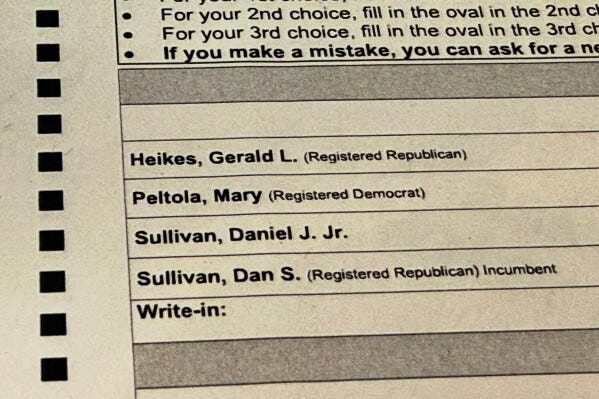
The district judge dismissed DOJ’s lawsuit against Alaska, asking the court to prevent certification of the results unless the Republican candidate for the Senate won. As we discussed, the state’s courts decided this one months ago. The federal government had no jurisdiction to interfere. But now, at least everyone knows there are two guys named Dan Sullivan on the ballot and the one clearly marked as the incumbent Republican is the GOP nominee. The ballot made it difficult to confuse the two, but DOJ has, if nothing else this election cycle, educated the public in Alaska.
DOJ has already appealed.
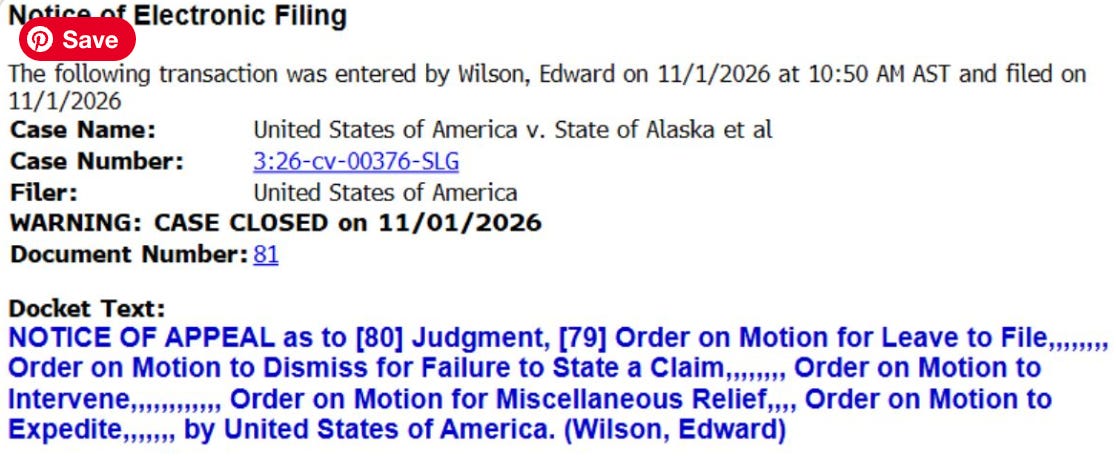
This case has been roundly criticized by legal experts as one of the least meritorious cases they’ve ever seen, a clear attempt to interfere in the state of Alaska’s constitutionally defined role. We’ll find out if the Ninth Circuit agrees.
CNN reported that Republicans have engaged in the same sort of “ballot stacking” exercises DOJ complained about in its lawsuit. In 2024, a Republican activist paid not one but two additional Bob Fergusons to run against Washington’s Democratic attorney general in the gubernatorial primary. And this sort of what I’d call “awful but lawful” conduct has also been aimed at Mary Peltola, the Democratic Senate nominee in Alaska this cycle. A group heavily funded by the top GOP Senate super PAC spent more than $800,000 attacking her during the primaries and promoting a lesser-known Democrat and a Green candidate.
If you really want dirty tricks this cycle, though, you’ll need to look at Alabama, where gubernatorial candidate Doug Jones was targeted by a mailer full of fake, AI-generated content. It was so bad that the mailer included a warning—I am not making this up—that said: “This media has been manipulated by technical means and depicts speech or conduct that did not occur.” The next day, Lagniappe Daily investigative reporter Scott Johnson broke a story about texts many people in Alabama received about a Pride rally Jones was supposedly involved with. “The political text campaign last night promoting a nonexistent Doug Jones Pride rally appears to have been commissioned by a PAC with ties to Tommy Tuberville,” he wrote.
One thing that’s certain is that even with Election Day less than 48 hours away, we haven’t seen the last of the dirty tricks.
The Lawsuit to Stop Trump’s Arch
I had all but decided to save cases that aren’t directly related to the election, like the new prosecution against Jim Comey’s and the Potomac Park case, for Monday evening (if the election litigation gods will play along). But then the AGs for the District of Columbia and the Commonwealth of Virginia sued Trump over his plans to build an arch, and I couldn’t leave that out.
The Washington Post captured this exchange during Friday’s hearing on a lawsuit filed by three veterans to stop Trump from building his stupid arch: “‘What is the harm of waiting?’ U.S. District Judge Tanya S. Chutkan asked Assistant Attorney General Robert Stander, musing about delaying the project for several months. ‘What is the rush to put this arch up?’” The attorneys general apparently shared Judge Chutkan’s concern about the rush. They filed a separate lawsuit seeking to halt the project.
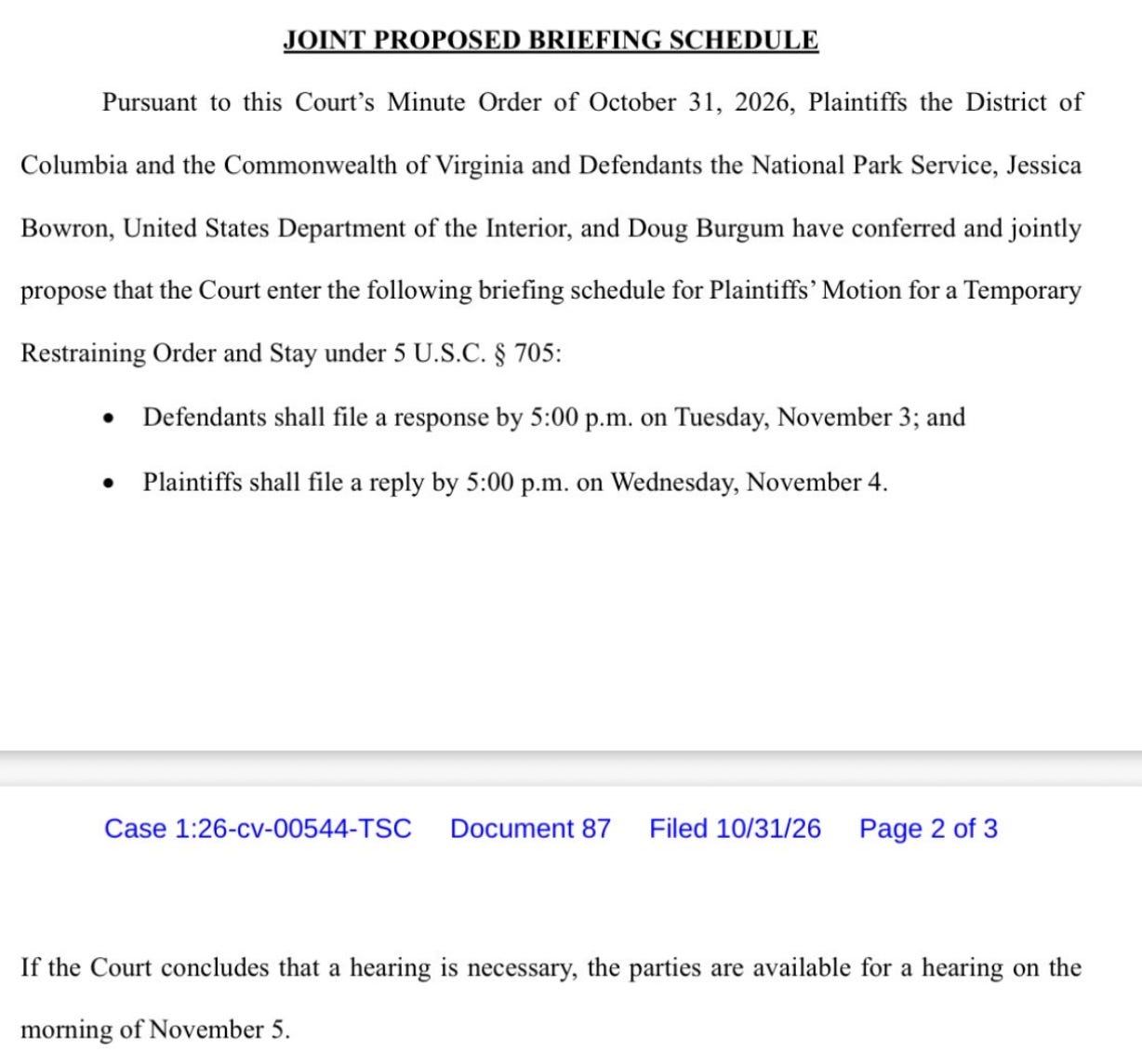
The AGs could be in court as early as Thursday to argue their request for a TRO. They told the court they consulted with the Department of the Interior and the National Park Service, and all parties agreed that a Tuesday/Wednesday briefing schedule and a hearing, if needed for the judge to decide the matter on Thursday, would work for the parties.
Elon Musk Weighs In
Elon Musk and his money are back for this election cycle—he has spent almost half a billion dollars to try and influence the elections. He tweeted this.
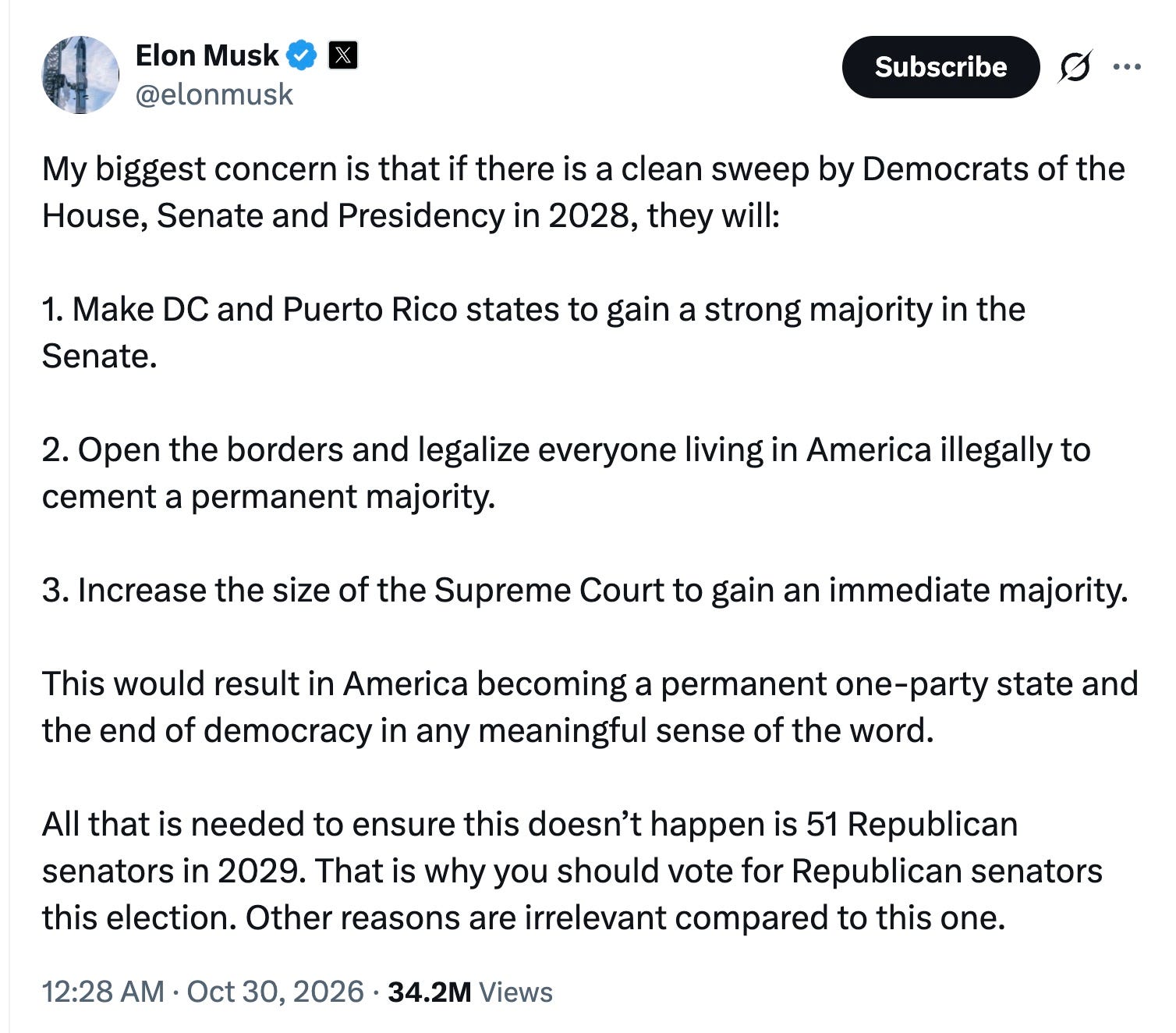
If you needed any more reason to vote, there it is.
There’s a lot left to happen between now and Election Day. There will be still more once the vote counts are underway. I’ll keep following the litigation and explaining what is happening and why it matters. This is the kind of week Civil Discourse was built for. If you find it useful, I hope you’ll consider becoming a paid subscriber. Your support makes this work possible.
We’re in this together,
Joyce