
The Week Ahead
Sending this one out a little earlier because it keeps getting longer. Read it in sections if that makes it easier, but there is a lot that’s important happening all at once right now.
A new Washington Ipsos poll, covering the period from October 9–13, shows Trump’s approval rating at just 33% among U.S. adults, a new record low. Sixty-six percent of Americans disapprove of the president’s performance, and 52% of them disapprove strongly. And two in three Americans believe Trump is using the presidency to enrich himself. That’s an increase from previous polling, and it’s largely driven by Republicans, only 22% of whom answered that question yes just over a year ago, versus 34% today.
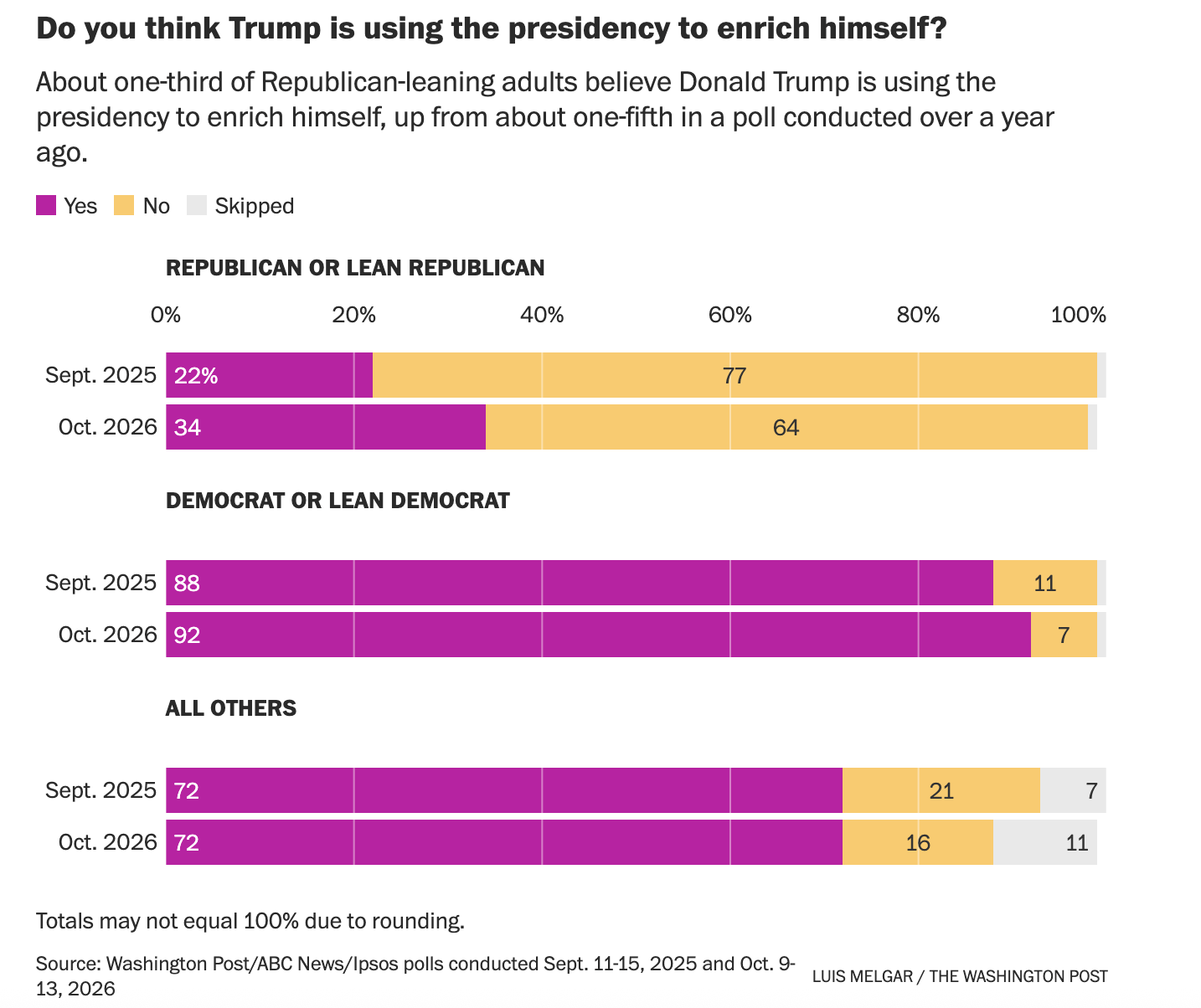
Trump declined to comment on the poll. According to The Washington Post, “Trump’s aides have said his financial situation has worsened since he has been in office, and Trump told reporters that his financial gains in a summer financial disclosure reflected an improved stock market.” But other reporting contradicts that. In July, after Trump released his annual disclosures, CNN characterized it like this, “Trump’s personal wealth has ballooned in office unlike any other president.” Some of the specifics in CNN’s report include:
$1.4 billion in income from his cryptocurrency ventures, including the $TRUMP memecoin and World Liberty Financial, a company co-founded by Trump’s sons. “Trump reported almost three times as much in crypto income last year as he made from his empire of golf clubs, hotels and resorts.”
Increased income from Trump’s Florida properties. He took in almost $77.5 million from Mar-a-Lago, more than 50% over prior year earnings and three times the amount he earned from the resort in 2020. He made $121.9 million from another Florida resort, the Doral, which brought in about $75 million per year during Trump’s first term in office.
Trump made $93.6 million from “real estate.” There was an additional $60 million in income from licensing deals with foreign real estate firms who will use the Trump name for hotels, golf courses, towers and other real estate developments in countries including Vietnam and India. He also licensed the Trump name to properties in Saudi Arabia and Qatar. The New York Times reported that “Those two deals alone generated more than $14 million for Mr. Trump last year, the filing shows.”
Trump’s fourth largest source of income was “legal payouts” at 86.5 million.
Trump’s own reports show total Trump revenue in 2025 of at least $2.2 billion, as opposed to $622 million in 2024. These numbers are not new news—they are based on last year’s annual reports. But they do seem to have hit the mark with Americans in Trump’s own party. The numbers themselves are so large that, as everyday Americans struggle with the price of gas, medical care, housing, and food, they are difficult to comprehend, particularly since the presidency is a job that should occupy all of the incumbent’s time and energy.
The intermingling of the presidency and private business is deeply troubling. Companies with business before the federal government have used Trump venues to host events. The New York Times reported that “One of his [Trump’s] biggest hauls in 2025 came when an investment firm tied to the United Arab Emirates bought nearly half of the Trump family’s main crypto company, World Liberty Financial, a transaction that blurred the line between foreign policy and private enterprise.” As for Trump’s claim that his gains reflect movement in the market, The Times reporting explained that “the stock market’s movements do not explain the bulk of his financial haul in 2025, including the U.A.E. investment in World Liberty Financial or the licensing deals.”
The Times report captured another blind spot in Trump’s annual report, noting that it “also offers little clarity on the president’s net worth, much of which is tied to estimated property values and the fluctuating paper worth of crypto assets and his stock portfolio.” This is because the reports public officials file don’t ask for precise numbers and valuations, but rather permit filers to report ranges they fall within. The Times concluded, “For his largest assets, including cryptocurrency and real estate, Mr. Trump reported a minimum valuation of $50 million with no upper limit.”
Follow the money. One hopes voters will, as they evaluate the choices ahead of them in the next few years. There is plenty for them to look at, like the newly filed lawsuit alleging Trump’s son-in-law, Jared Kushner, is unlawfully exercising significant government power by acting as one of the administration’s “go-to foreign policy negotiators” without Senate confirmation or compliance with federal ethics rules. All of this while making his own business deals along the way. The complaint begins with the words of Supreme Court Justice Felix Frankfurter, “Government officials wield substantial powers. But they must do so responsibly—for the benefit of the American people and not themselves.”
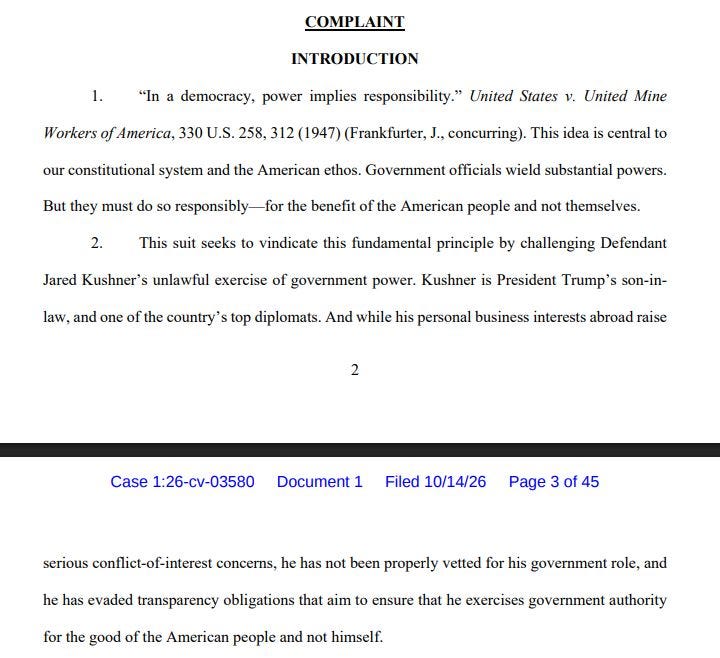
The case was filed in the District of Columbia last Thursday by CREW, a bipartisan group that advocates for ethics in government. The lawsuit asks the court to stop Kushner from playing the role of a government employee without going through the process to get there—and in the absence of financial and ethics requirements that actual government employees are bound by.
Kushner has worked with White House special envoy Steve Witkoff on important foreign policy negotiations, notably helping to negotiate the ceasefire agreement between Israel and Hamas. He has also “participated in diplomatic efforts involving Russia, Ukraine and Iran, meeting directly with foreign leaders on the administration’s behalf.”
In the complaint, CREW argues that Kushner’s personal financial interests overlap with the “volunteer” diplomatic work he is doing for Trump, and alleges that raises the possibility of precisely the types of conflicts of interest federal disclosure lawyers have been put in place to expose. But because of his special status, Kushner does not have to make any of those filings. But his investment firm, Affinity Partners, manages more than $6 billion in assets, 99% of which are owned by foreign investors, according to CREW. Those investors include sovereign wealth funds from Saudi Arabia, Qatar and the United Arab Emirates, while the firm also holds investments in Israel.
Kushner’s lawyers have said his arrangements are legitimate and have been reviewed by outside ethics counsel and government ethics attorneys.
CREW is asking the court to enjoin Kushner from continuing to act in this role, which means we can expect to see further proceedings in court this week. Specifically, the complaint asks the court to:
Count One: “declare that Kushner is unlawfully serving as an officer in violation of the Appointments Clause, enjoin him from exercising the powers of his office, and enjoin the other Defendants from facilitating or supporting his exercise of these powers.”
Count Two: If the court does not believe Kushner’s service violates the Appointments Clause, “it should declare that Kushner is a government official who is required to file financial disclosures under the Ethics Act and order him to comply with these obligations.”
Count Three: “the Court [should] issue a writ of mandamus pursuant to 28 U.S.C. §§ 1361 and 1651 under its equitable authority to compel Kushner to comply with his non-discretionary duty to file financial disclosures under the Ethics Act.”
Count Four: “to the extent the Court finds that Kushner is merely a private citizen, it should declare that Kushner is exercising executive authority in violation of the private nondelegation doctrine, enjoin him from exercising such authority as a private citizen, and enjoin the other Defendants from facilitating or supporting his exercise of this authority.”
CREW has identified the possibilities. If Kushner is serving in violation of the Appointments Clause of the Constitution, he must be stopped from continuing in the role he has been playing. If he has been properly appointed, he must file the disclosure forms he has been skirting. And if he is “merely” a private citizen, he should be permanently enjoined from exercising government authority.
White House spokesperson Anna Kelly: “CREW is an unserious, Trump-deranged organization that has been attacking President Trump, his family, and his administration since the first term. Jared Kushner is a proven dealmaker.” She said that his record of success “more than speaks for itself” and that “His personal business activities have nothing to do with his diplomatic engagements, which he conducts on a volunteer basis at the President’s request and while paying his own expenses.”
In other events we can expect this week, there will be more in the East Potomac Golf Course case, which is set to continue Monday with additional testimony from key government officials, as Judge Ana Reyes considers whether to enter a preliminary injunction. The Trump administration has gone on the attack against the Judge, filing a motion to disqualify her, which was signed by Associate Attorney General Stanley Woodward, the third-highest-ranking official at DOJ.
The motion asks Judge Reyes to disqualify herself from the golf course case: “No reasonable observer could consider Judge Reyes sufficiently impartial to adjudicate this case.” It cites “a few examples of bias,” including that “Judge Reyes has unfairly questioned Trump Administration attorneys’ intelligence, allowed her disdain for the Trump Administration to influence how hearings unfold, and systematically disregarded basic separation of powers principles and Article III constraints on judicial authority.” It’s an odd tactic, given that the Judge bent over backward for the administration early on in the case, rejecting the plaintiffs’ suggestion that the government might act precipitously and saying she trusted it to follow the law. The Judge only became angry after the government violated her trust.
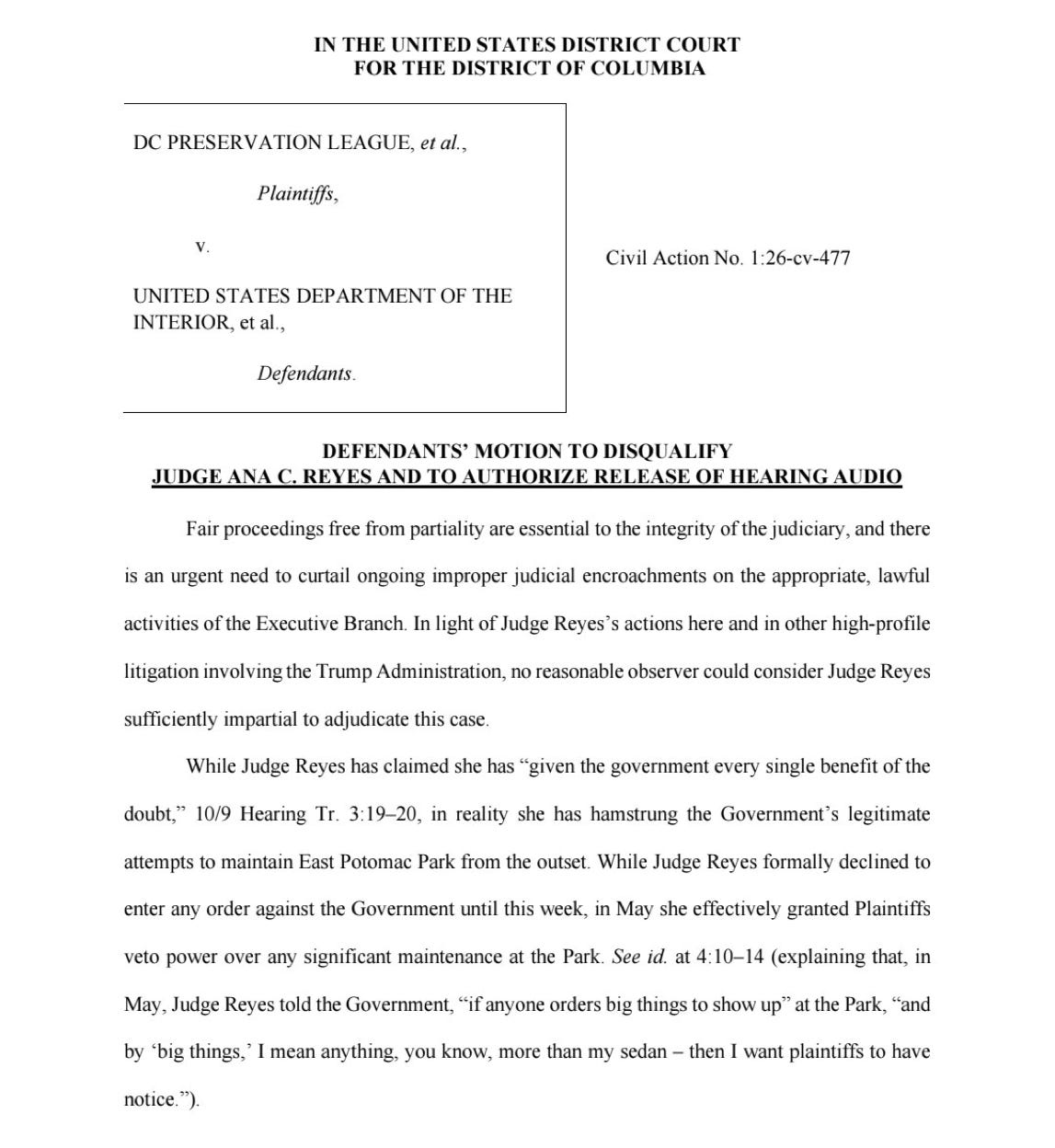
The motion urges disqualification because “Judge Reyes’s histrionics in prior hearings have clearly demonstrated she is no longer impartial. In addition, to allow the American people to fully appreciate Judge Reyes’s animosity for the Trump Administration (beyond just what is revealed in a cold transcript) the Court should release the October 12, 2026, hearing audio.”
The president was busy on Truth Social Sunday morning, explaining that he had a plan for the course: “Doug Burgum, and the United States Department of the Interior, is very excited about the new Development of a Great Golf Course at the site of the old East Potomac Golf Links. We would like to thank Tom Fazio for his initial conceptual design and ideas, coupled with those of others from within the Golf World and the Department of the Interior. Any variance or changes will be made, depending on site conditions, by the Experts in Parks and Recreation, whose experience and knowledge in Seawalls, Landscaping, and Design are second to none. President DONALD J. TRUMP.”
In another post, Trump noted, “Restoration work will begin on the Fazio Design on November 15th, when the old Course will be closed to play. The new Course will be opened in approximately 15 months.” The posts seem to suggest Trump will not be following court orders, but instead, acting on the advice of his chosen “experts.” (We can only hope they’re better at this than the Reflecting Pool people.)
Both the motion and Trump’s posts seemed designed to taunt the Judge. Sunday afternoon, she ordered the government to explain whether it has changed its position by 8 p.m. that evening and ordered Associate AG Stan Woodward to be in court tomorrow.
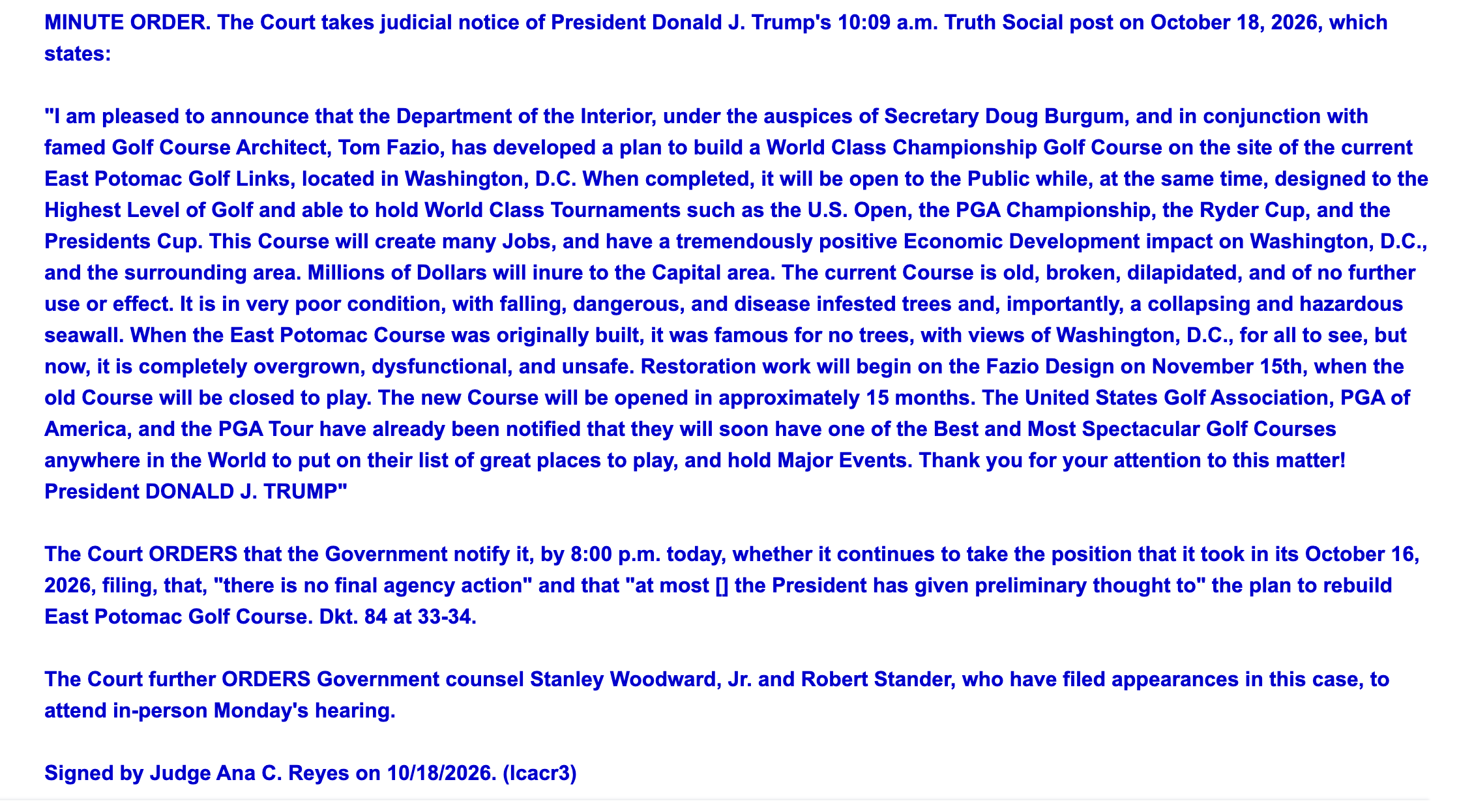
Monday’s hearing should be interesting.
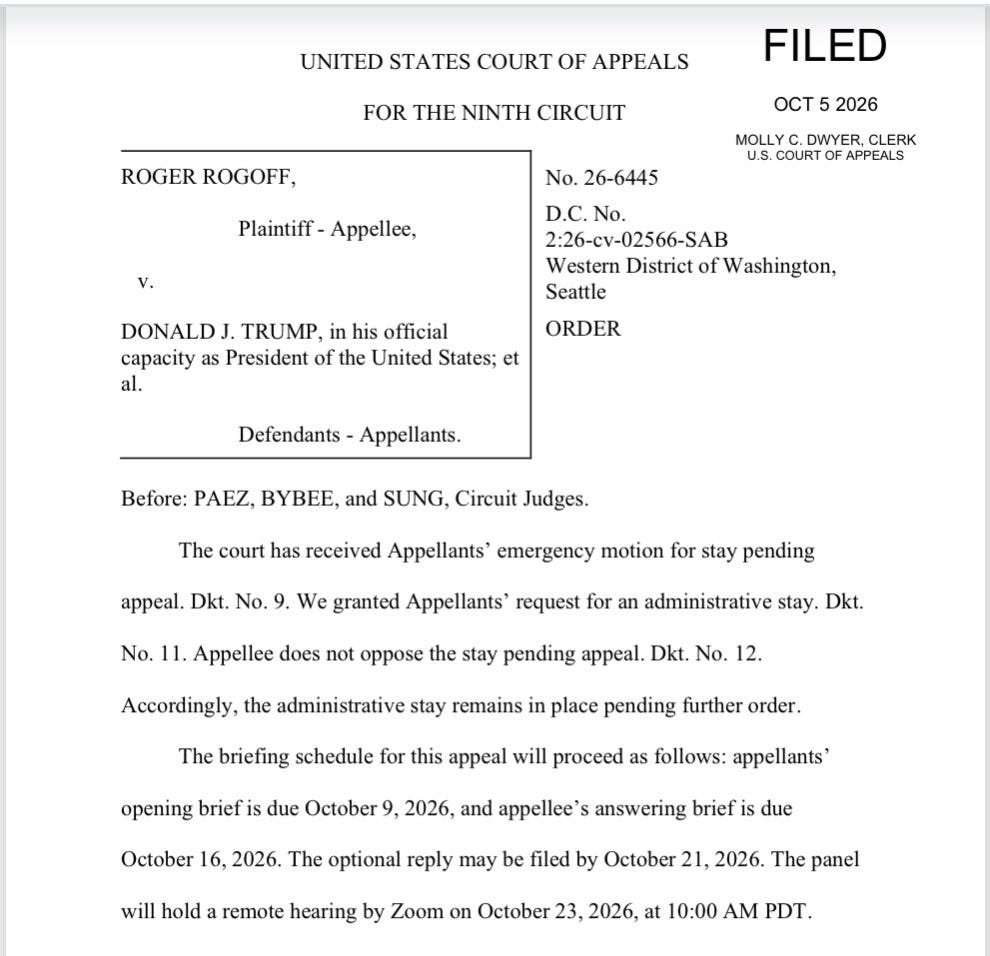
There will also be more this week, as the Trump administration continues to try and justify its stance on appointing U.S. Attorneys. Its view is that despite the Constitutional requirement that U.S. Attorneys be Senate confirmed and longstanding laws that permit the courts to appoint a replacement if the president fails to do so within 180 days, the president can keep a temporary appointee in place for as long as he likes. Trump fired the court appointed U.S. Attorney in Seattle, Roger Rogoff, as soon as he was put in place. Rogoff sued and won in the district court.
A very fast briefing schedule in the Ninth Circuit has put the case on the calendar for oral argument this Friday.
As the election draws closer, there will be more action there this week, too. The California case we discussed last night will move forward. Get ready for another fast one.
If Civil Discourse has become part of how you make sense of what’s happening, I hope you’ll consider becoming a paid subscriber and helping me keep it available to everyone.
We’re in this together,
Joyce