
The Washington Post shamelessly defends Trump's odious ballroom
Over the last few months, the Washington Post opinion section has lost a lot — columnists Eugene Robinson, Catherine Rampell, Jennifer Rubin and Perry Bacon; political cartoonist Ann Telnaes, editors David Shipley, Karen Attiah and Ruth Marcus. It also lost many other outstanding journalists, like Erik Wemple, who either left the Post of their own accord or got the clear message that their work no longer “aligned” with the section’s new mission under a new editor.
That’s not all the Post has lost.
In an editorial published over the weekend, the Post’s editorial board made it clear it has also lost its way — continuing a downward trajectory you can trace back to owner Jeff Bezos’s decision last fall to yank an already drafted endorsement of Kamala Harris.
“In defense of the White House ballroom,” read the headline. Here’s a gift link to the editorial, which pays tribute to Trump’s appeal to his followers after briefly nodding to those who are disgusted by the destruction of the East Wing to build a ballroom funded by mega-rich donors to the tune of $350 million. To his fans, though, he is “a lifelong builder boldly pursuing a grand vision, a change agent unafraid to decisively take on the status quo and a developer slashing through red tape that would stymie any normal politician.”
Are you surprised that Post owner Jeff Bezos’s Amazon is among the donors? I’m certainly not. But I still remember enough of an earlier version of Bezos — just a few years ago when he was a stalwart defender of the Post’s independence — to find this editorial both sad and shameful. (As you know, an editorial written by the Editorial Board is not supposed to be one person’s point of view, like a columnist’s, but rather to reflect the views of the paper as an institution.)
As readers of American Crisis know, I’m a fan of reader comments (including yours in this very newsletter), so I turned to the comments on this editorial with a certain amount of anticipation. I wasn’t disappointed.
“This editorial is a measure of how low the WaPo’s billionaire owner will go to ingratiate himself with Donald Trump,” read one comment. Another was even more direct: “What a joke the post has become.”
I remain a subscriber to the Post, and I admire its news-side coverage. The top editor Matt Murray (who is not involved in editorials or opinion columnists’ work) is a very solid newsman of integrity, and the big, talented staff breaks a lot of stories. The news side also employs the likes of star non-fiction book critic Becca Rothfeld who memorably skewered the new memoir (“dated before it arrived at the printers”) by Biden press secretary Karine Jean-Pierre. Here’s a gift link.
But the Post’s opinion section, which owners traditionally consider their very own plaything, is a lost cause, at least for now. No further evidence is needed.
American Crisis is a community-supported project where I explore how journalism can help save democracy. Please consider joining us!
Separately, I complained here last week that the New York Times had given short shrift to the Saturday No Kings protests, which attracted about six million people in some 2,500 gatherings around the country. Columbia Journalism School professor Bill Grueskin — who also found the coverage underplayed — reached out to the Times for an explanation on behalf of Columbia Journalism Review. He published the response in total, and I’m sharing his piece here. But be forewarned; it may make your blood boil.
You can read it in full here, but here’s the part of the explanation that addresses why the story was not on the paper’s front page: “On Sundays, we tend to showcase reporting that readers can only find at The Times, in this case, the results of a monthslong investigation into how member of a murderous regime have escaped justice.” The response mentioned other stories that did make the cut, including “President Trump’s approach to the shutdown/governing and whether the Democratic Party can regain power in Washington. We covered the “No Kings” protest in June on the front page; we covered the July protests as well.”
The response also took issue with using the Sunday print front page as an accurate measurement, calling that an “outdated assessment.” That might come as an unpleasant surprise to those who buy the Sunday paper in print, and think the biggest news of the previous day ought to be represented in a news story on its front page. (There were two small photos below the fold.) My own feeling on that, and Grueskin has said as much, is that even in our digital age, the front page of the New York Times does remain some sort of measurement of how top editors regard a story’s importance.
By the way, here’s the conclusion about the size of the protests from one well-regarded expert in counting crowds, G. Elliott Morris, who calls it “the largest single-day political protest ever,” with an asterisk for Earth Day 1970, which isn’t fully comparable. Sure seems like a front-page story to me!
Somewhat separately, here’s my Guardian US column from Sunday in which I express a mix of sorrow, pessimism and hope about the radical change in America since one year ago — before November’s presidential election.
And here’s a brief podcast I did with Columbia Journalism Review about whether traditional journalism ethics need to be rethought in the age of AI in newsrooms, and of democracy-trashing politicians who lie with abandon.
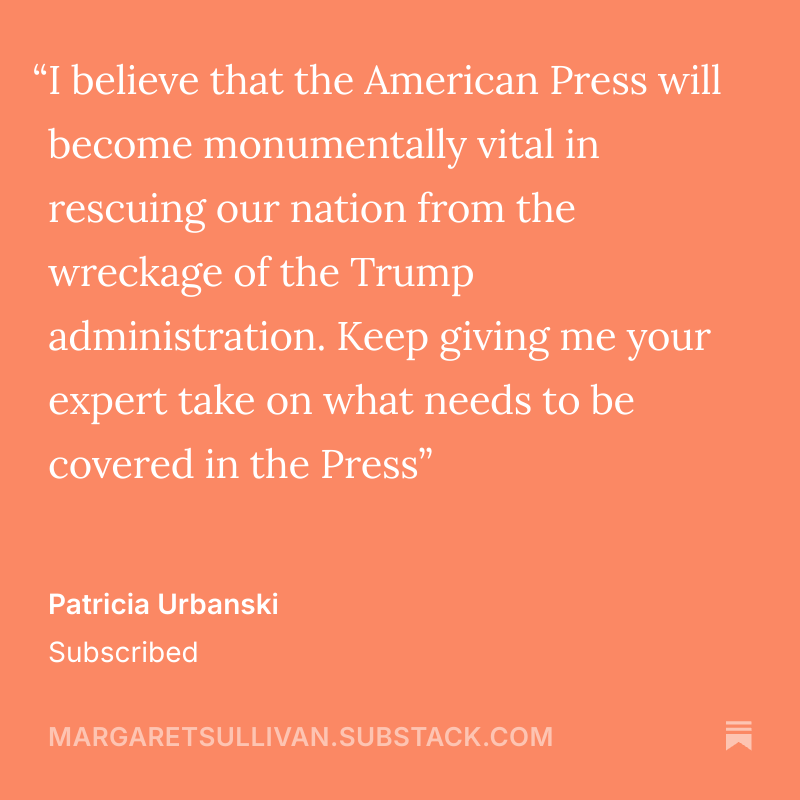
Readers, I deeply appreciate your interest, your comments and your support for this media/democracy project. Thank you for being here — and a warm welcome to new subscribers and to those who have upgraded recently to paid subscriptions. The paywall remains down for reasons I explain below this reader’s reason for subscribing.
My background: I am a Lackawanna, NY native who started my career as a summer intern at the Buffalo News, my hometown daily. After years as a reporter and editor, I was named the paper’s first woman editor in chief in 1999, and ran the 200-person newsroom for almost 13 years. Starting in 2012, I served as the first woman “public editor” of the New York Times — an internal media critic and reader representative — and later was the media columnist for the Washington Post. These days, I write here on Substack, as well as for the Guardian US, and teach an ethics course at Columbia Journalism School. I’ve also written two books and won a few awards, including three for defending First Amendment principles.
The purpose of ‘American Crisis’: My aim is to use this newsletter (it started as a podcast in 2023) to push for the kind of journalism we need for our democracy to function — journalism that is accurate, fair, mission-driven and public-spirited. That means that I point out the media’s flaws and failures when necessary.
What I ask of you: Last fall, I removed the paywall so that everyone could read and comment. I thought it was important in this dire moment and might be helpful. If you are able to subscribe at $50 a year or $8 a month, or upgrade your unpaid subscription, that will help to support this venture — and keep it going for all. Thank you!