
Vail Town Council to vote on creation of a geothermal district to harness energy and drastically reduce emissions

Chris Dillmann/Vail Daily Archive
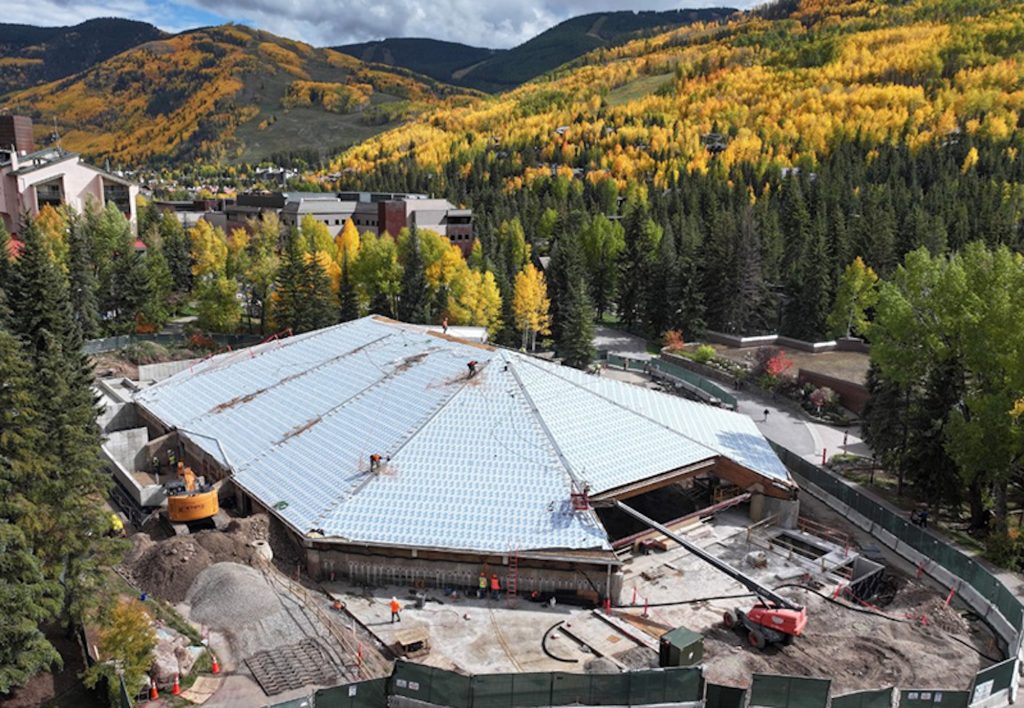
The Vail Town Council on Tuesday will consider a $9.1 million energy performance contract that would create a geothermal district for town facilities — including the Vail Public Library and Dobson Ice Arena — as part of Vail’s broader push to cut emissions and modernize aging infrastructure.
The proposal is the result of more than a year of work with energy-services firm McKinstry, which conducted an audit of roughly 2 million square feet of town facilities. By tapping geothermal energy, the town could eventually eliminate natural gas use in its snowmelt systems, which are among the town’s most fossil-fuel-intensive operations.
In addition to geothermal heating and cooling, the proposal includes solar photovoltaic panels, battery storage for backup power and expanded electric vehicle charging infrastructure.
In a presentation on Nov. 3, Kristen Bertuglia, the town’s environmental sustainability director, said the town has been working on this plan “since the last brick was laid over the snowmelt system” in the early 2000s.
“We’ve been trying to figure out a way to decarbonize (the snowmelt system) and reduce the financial burden to the town associated with all the burning of gas that we’ve been doing,” Bertuglia said. “And we’ve tried all manner of doing that over the years,” including biomass, solar and “offsets until the end of time.”
Support Local Journalism
A long-term geothermal vision
Bertuglia said the creation of the geothermal district, if undertaken at this moment, creates “a truly incredible opportunity, I think, to finally do it.”
That’s because the town, if it acts now, can leverage more than $4.2 million in outside funding, much of which expires in 2026.
That includes a $1.78 million Colorado Energy Office grant for geothermal installation and an estimated $2.2 million in federal Inflation Reduction Act incentives for geothermal, solar, battery storage and electric-vehicle charging. Holy Cross Energy has also committed $150,000 to $200,000 in in-kind support for electrical upgrades linked to the project.
The town would also avoid roughly $1.5 million in deferred capital costs for critical upgrades already needed, such as replacing the library’s failing HVAC system and improving deteriorating lighting in the municipal parking structures.
The long-term geothermal vision for the town, which could reduce town-wide emissions by more than 10,000 metric tons annually, would come in three phases. A full build-out, likely under a public-private partnership or utility ownership model, would also allow the Eagle River Water and Sanitation District to meet its long-term goals.
“It’s really the wastewater treatment plant, where most of that energy originates, that would otherwise be going into the creek,” said Vail Energy Efficiency Coordinator Cameron Millard. “They actually have to lower their effluent temperatures in the future, so they’d like to partner on this, as well. This is the blueprint for what decarbonization looks like on a large scale.”
When the grants, incentives, partner commitments and capital cost avoidances are totaled up, the $6 million initial geothermal node — which would be created by boring into an area near the library — is projected to come at a net cost of $1.3 million for the town.
In the long term, when the utility-bill savings are factored in, the project is projected to produce a positive cash flow of $2.1 million.
“That’s very unusual,” said Stephan Rank, a project director at McKinstry. “Usually it kind of balances out, and that’s the goal of these energy performance contracts, to kind of balance out the costs with the savings over 20 years, but this actually comes out positive by $2 million. That’s a very unique opportunity.”
The town has set a strategic goal to reduce emissions 50% by 2030 and 80% by 2050, and the immediate plan outlined in the energy performance contract would move Vail about 27% of the way toward the 2030 target.
“Short of shutting off the snowmelt system, or stopping our free bus system, or turning off all of our lights, we can’t get there, we will not come anywhere close to any of these goals,” Bertuglia said. “And then, more exciting, the future of the geothermal district gets us to 100% (of the 2050 goal), gets us all the way there, and gets our business community there, because they can tap into this geothermal district, as well.”
To establish an official geothermal energy district, two or more buildings that can share energy must be included. The need to revamp the Vail Library’s HVAC system, along with the remodel of the Dobson Ice Arena currently underway, created a logical reason to join those buildings together to form an official district. The town said it is also in talks with the Evergreen Lodge to allow it to tap into that system, as well.
“All of the pieces had to fall into place at this moment, from grants, to end-of-life equipment, to technology being present, to the (Inflation Reduction Act), to partnerships, to the remodel at the Dobson Ice Arena,” Bertuglia said.