
US scientists swap neutrons for LEDs to build glowing nuclear reactor
Scientists in the US have developed a new glowing surrogate nuclear reactor that replaces dangerous neutron-driven reactions with thousands of LEDs in order to simulate the complex physics of a working reactor core.
The reactor, referred to as ViBRANT (Visual Benign Reactor as Analog for Nuclear Testing) is controlled by a Microreactor Automated Control System (MACS). Both were developed by researchers at the Idaho National Laboratory (INL).
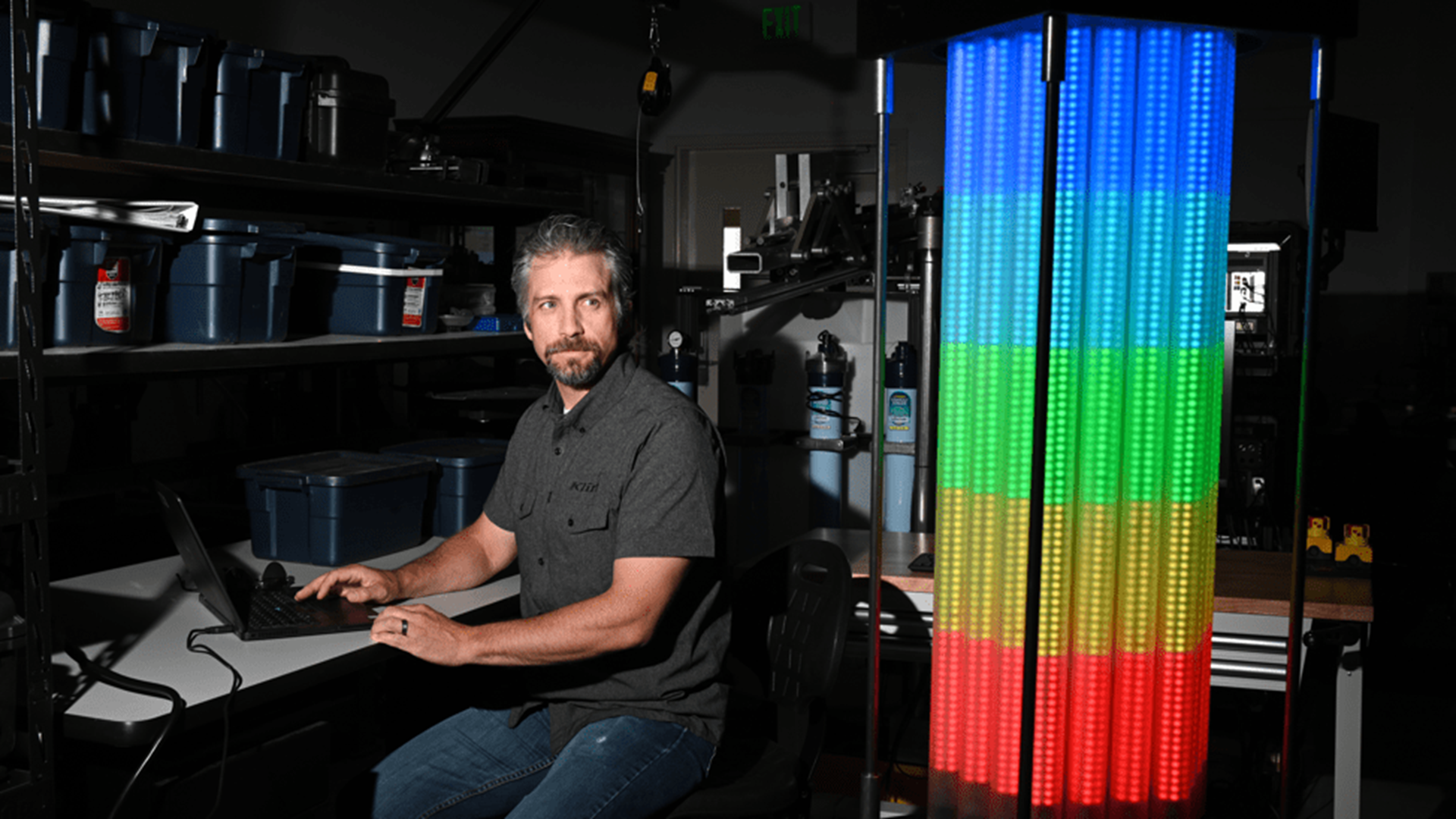
ViBRANT is a surrogate nuclear reactor the size of a telephone booth. Instead of using uranium fuel and radiation shielding, it runs on photons, particles of light emitted from thousands of LEDs to safely mimic the heat and neutron feedback seen in real reactor cores.
Meanwhile, the LEDs increase in intensity as ViBRANT powers up and can change color as the core’s temperature and neutronics evolve. The innovative approach allows researchers to study core behavior in complete safety.
Safe fission simulations
Tony Crawford, PhD, an INL researcher, and MARVEL (Microreactor Applications Research Validation and Evaluation) reactivity control lead, reportedly designed MACS/ViBRANT to pair precise motion control with advanced reactor physics models, to speed up safe microreactor development.
“The fuel, the hazardous reflector and absorber materials driving reactor physics are actually replaced by benign materials amenable to light physics,” Crawford said. “It reduces all the hazards from a real reactor to safe and accessible levels with the promise of accelerating development.”
Credit: Idaho National Laboratory (INL)
Crawford equipped ViBRANT with LEDs to simulate reactor flux and heat, along with sensors for closed-loop control. This created a high-fidelity hardware-in-the-loop modeling platform that closely replicated real reactor behavior.
Along with the LED-driven surrogate core, MACS/ViBRANT uses the exact same electromechanical devices that will control MARVEL. “MACS/ViBRANT is a hybrid,” Crawford noted. “The actual actuators are the same technology that will be used in the MARVEL reactor.”
MARVEL features a sodium-potassium cooled microreactor designed to generate 85 kilowatts (kW) of power. INL recently selected firms for MARVEL experiments. They will study how microreactors can power data centers and desalination plants while using autonomous controls and advanced sensors.
Replacing nuclear fuel
ViBRANT glows brighter as it “powers up.” The LEDs change color and intensity to reflect shifts in simulated temperature and reactor reactivity. At the same time the entire system is visually intuitive.
It’s accessible enough that even non-specialists can watch and understand how changes in reactor conditions affect output and safety. “By being accessible and as intuitive as watching a TV screen, nearly everyone in the reactor development process – from the modeler to the control system developer to the assembler – can get involved and learn,” Crawford said in a press release.
As a training tool, MACS/ViBRANT can closely mirror the MARVEL reactor while allowing faster timelines. Processes that take MARVEL a full day to reach normal operation can be simulated in about 10 minutes.
MACS lets engineers observe and test real reactor components without radiation risks, enabling hands-on adjustments and design improvements. During testing, engineers discovered that one of MARVEL’s actuator designs slipped during scram conditions, an emergency shutdown scenario.
That insight, discovered in the safe environment of ViBRANT, led to a redesign of the actuator before it reached a working prototype. “We had a surrogate drum that was on a bearing, and the friction had changed.” Crawford stated. “It would slip during operation and wouldn’t scram properly. Consequently, we refined the actuator design.”
ViBRANT also helps calibrate and validate advanced nuclear modeling software like RELAP, MCNP and MOOSE, tools used to simulate reactor behavior. By linking these digital models to physical components and real-time control, the team can refine their code and algorithms.