
From university professor to renewable energy billionaire: How Cao Renxian amassed $15B fortune
Shares of the Shenzhen-listed firm, as well as its 57-year-old founder’s wealth, more than doubled last year amid a global battery boom driven by power demand from AI data centers.
The firm is now seeking an initial public offering in Hong Kong, which analysts estimate would raise its equity value to nearly $50 billion when including its existing shares, according to Bloomberg.
Founded in 1997 by Cao with just 500,000 yuan (US$72,000), Sungrow has grown into a 17,000-strong group with businesses spanning batteries, solar inverters, electric vehicle chargers and hydrogen equipment.
Consultancy Wood Mackenzie last year named it the world’s second-largest producer of battery energy storage systems with a 14% market share in 2024, trailing only Tesla.
But despite the company’s rising prominence and his quiet climb up the billionaire rankings, Cao remains little known beyond industry circles.
 |
|
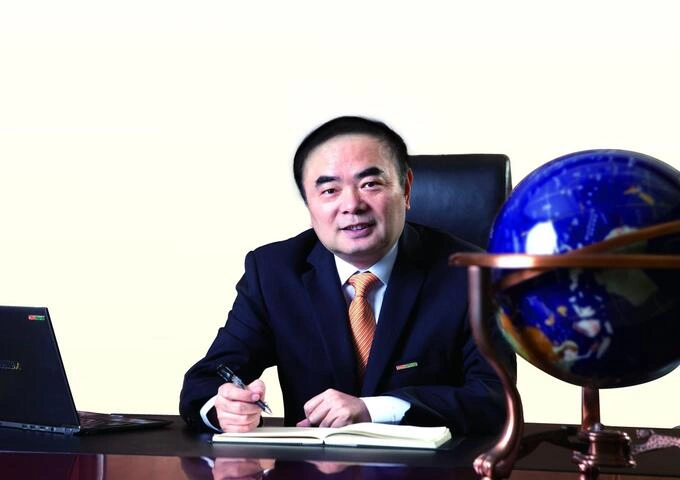
Cao Renxian, founder of Sungrow Power Supply. Photo from the company’s LinkedIn |
Born to a poor rural family in Hangzhou, the capital of eastern China’s Zhejiang province, a younger Cao was a top student with excellent grades who was admitted directly to graduate school without examination.
He earned a bachelor’s degree and a master’s in industrial automation from Hefei University of Technology in Anhui, another eastern Chinese province, and began teaching there in 1993 as a professor of renewable power.
At the time, a university professorship was seen as a highly sought-after “iron rice bowl,” a local idiom for a role with lifetime security.
Still, after a few years of teaching, Cao left to venture into business, determined to make the planet greener and convinced that renewables would eventually replace fossil fuels.
“If we continue to use coal and oil, they will soon get exhausted, and the global environment will get worse and worse,” China Daily quoted Cao as saying in a 2013 article.
“By that time, what can we leave for our future generations?”
Sungrow started out making inverters, devices that enable solar panels to power homes, a risky bet when solar power was still in its infancy in China.
Its first few years were difficult. With few solar projects coming in, the company took on traditional power supply work that Cao did not like to survive.
“The goal is to one day make new energy products bigger, just like getting a little dry food to pad my stomach when I’m hungry, but my goal has always been firm,” he later recalled, according to a report cited by Yicai Global.
The limited solar sales Sungrow did make were largely small generators for nomads in remote regions such as Tibet, Qinghai and Xinjiang.
“Though the economic return was undesirable, we were consoled because the nomads didn’t have to live in darkness in the evenings,” Cao said.
His breakthrough came in 2002, when Sungrow took part in a government project to bring electricity to remote villages in Northwestern China. It then set up operations in the Hefei State Hi-tech Industry Development Zone in 2007 and secured $7 million in venture capital, giving it the resources to hire more talent and ramp up research and development.
The firm expanded abroad and went public in Shenzhen in 2011. By 2019, it had built the world’s largest solar inverter plant.
Forbes first recognized him as a billionaire in 2015 when Sungrow shares closed at a then-record 25.99 yuan.
The rise of Sungrow and Cao mirrors several other tycoons who grew rich by riding the boom in China’s renewable energy sector.
But even as the tide has turned in recent years, with overcapacity and price competition squeezing profits and denting the fortunes of industry titans such as Li Zhenguo of LONGi and Liu Hanyuan of Tongwei, Sungrow has weathered the downturn far better and still managed to grow in 2024, albeit at a much slower annual pace.
Cao has attributed Sungrow’s success to making the right moves at the right time and seizing opportunities as they emerged.
He steered the company into energy storage in 2015, long before batteries became a necessity for data centers as the AI boom drove up power demand.
That early positioning, analysts say, has left Sungrow well established in the field.
“Timing is crucial,” Cao said in a 2023 interview cited by Bloomberg. “Starting too early risks failing just before dawn, but entering too late may leave no room at all.”
Some employees say Cao has an unusually egalitarian leadership style, regularly sharing reading lists and making himself available for direct conversations, which has won him the nickname “Cao Laoshi,” or “Teacher Cao.”
He is also closely involved in the business, personally joining earnings calls and even apologizing when results fall short.
While other tech tycoons like Alibaba’s Jack Ma and Tencent’s Pony Ma frequently appear in the spotlight, Cao has kept a far lower profile and his few public remarks tend to stay on technology and the energy sector.
Remarking on Cao’s success, Jeremy Cheng, principal of family office advisory Lansberg Gersick Advisors, said: “While figures like Jack Ma captured the imagination of the consumer internet era, Cao Renxian represents a new guard of Chinese industrial leaders: technocratic, highly specialized, and quietly dominant.”