
Unilateral Disarmament
Since his inauguration, Donald Trump and his administration have launched a systematic assault on a wide range of American organizations that collectively promote American values around the world: democracy, the rule of law, free elections, free speech, human rights. I’ve already written about the State Department’s evisceration of its own annual human rights report, which was dumbed down and politicized in an extraordinarily crude manner. Now I have just published a new article about another set of changes. Collectively, they amount to unilateral disarmament in the global war of narratives.
The attack is aimed firstly at America’s foreign broadcasters, including Voice of America, Radio Free Europe/Radio Liberty, Radio Free Asia and several others:
At the end of February, President Donald Trump appointed Kari Lake as senior adviser to the U.S. Agency for Global Media, which oversees them. Lake is an ideologue and former local-TV anchor who failed to be elected governor of Arizona, and then failed to be elected as a senator from Arizona. With no experience in international broadcasting or foreign policy, she put the entire staff of VOA on administrative leave and announced plans to cut the funding of all of the organizations under the USAGM umbrella; she did so with venomous relish, hypocritically accusing chronically underfunded broadcasters of wastefulness, tarring journalists as foreign agents. She began firing contract employees, in some cases giving visa holders who had worked for years on behalf of the U.S. government 30 days to leave the country.
But the administration is also systemtically dismantling another institution, one that was charged with identifying Russian, Chinese and Iranian influence campaigns overseas:
Consider the fate of the Global Engagement Center, a small State Department office, also the product of a bipartisan effort and initially designed, well before the 2016 election, as a response to online terrorist and extremist campaigns. For the past several years, the GEC dedicated itself to identifying and revealing covert Russian and Chinese propaganda, most recently in Africa and Latin America. The GEC never played any role inside the United States and never aspired to do so. Nevertheless, the organization became the focus of a series of far-right conspiracy theories, amplified on X, which dishonestly described the GEC as an institution promoting “censorship.”
Late last year, congressional Republicans refused to renew its funding. When announcing the organization’s final closure, the State Department declared that the GEC “spent millions of dollars to actively silence and censor the voices of Americans”—a statement that not only provided no evidence but also represented an extraordinary example of the department smearing its own employees. On Donald Trump Jr.’s podcast, Darren Beattie, the acting under secretary of state for public diplomacy and the person who shaped this policy, boasted about how he had killed off the GEC, a “censorship operation within the State Department.”
In truth, the only real beneficiaries of the GEC’s closure were the foreign dictators conducting covert propaganda campaigns. In the weeks before the organization ceased operations, employees were preparing an exposure of a Chinese information operation in Europe and other regions. Three people familiar with this plan, who requested anonymity to avoid jeopardizing current and former colleagues at the State Department, told me that it was presented to Beattie, who stopped work on the exposure. “Far from spiking a single plan, we were proud to spike the entire GEC,” Beattie said in a statement today. “Indeed, not only was GEC’s infamous censorship activity profoundly misaligned with this Administration’s pro-free speech position, it was woefully and embarrassingly ineffective on its own terms. We prefer to advance our public diplomacy objectives by telling the truth to our adversaries, rather than censor our own citizens.” Beattie did not explain how exposing Chinese propaganda campaigns would restrict Americans’ freedom of expression.
I also mentioned the National Endowment for Democracy and its sister organizations, which include the International Republican Institute, affiliated with the Republican Party, and the National Democratic Institute, affiliated with the Democrats.
These organizations were not, before November, of special concern to Trump. All of them were founded in 1983, inspired by Ronald Reagan’s call for new institutions to “foster the infrastructure of democracy—the system of a free press, unions, political parties, universities—which allows people to choose their own way, to develop their own culture, to reconcile their own differences through peaceful means.”
Until now they have also played important roles in countering authoritarian propaganda and fighting censorship around the world. NED makes small grants to groups that monitor elections, promote free speech, fight kleptocracy, and counter authoritarian propaganda. For example, NED once funded the Asia Fact Check Lab, which exposes and explains Chinese information operations. The IRI has among other things polled more than 1.5 million people in more than 100 countries in recent decades, helping provide reliable information about the public’s views, often in places that don’t have many other sources. The NDI’s Open Government Partnership was one of many programs designed to fight corruption.
The endowment has so far successfully fought attempts to cut its funding in court, winning an unambiguous legal ruling, with which the administration complied, to preserve in full this year’s funding. NED also enjoys deep support across Congress, and has an organizational structure designed to protect it from political attack: It is run not by the U.S. government but by an independent, bipartisan board, which allows it to keep its distance from partisan politics. I was on that board from 2016 until 2024 and can attest that the conspiracy theories are wrong. The endowment’s board members are not secret intelligence officers but former civil servants, members of Congress, academics, and regional experts. Nobody pays them for the work they do, pro bono, on NED’s behalf.
Strangest of all, these cuts, all of which are being challenged in courts, are being carried out under the false, indeed hypocritical, banner of “fighting censorship,” and in the context of an administration that claims to be withdrawing from the world.
In a speech in Riyadh earlier this year, Trump promised Saudi Arabia and other Middle Eastern monarchies that America would stop “giving you lectures on how to live and how to govern your own affairs.” That made it sound like the administration would be somehow neutral.
But in a world of intense ideological competition, there is no such thing as neutrality. Since Trump’s election, China has not stopped spending billions of dollars broadcasting autocratic propaganda, buying space on television networks around the world, and training international journalists. Russia has not stopped using social media and deceptive websites to weaken and divide the U.S. and Europe, to prop up dictatorships in Africa, or to lie about the war in Ukraine.
In fact, this all amounts to what James Rubin, former head of the GEC, calls “unilateral disarmament.” We are simply giving up the fight.
Kleptocracy Tracker
Continuing to monitor conflicts of interest, ostentatious emoluments, outright corruption and policy changes that will facilitate outright corruption. (Read my original article, Kleptocracy Inc.)
August 29
- The White House directed the General Services Administration to deploy Elon Musk’s Grok AI chatbot across federal agencies—marking yet another lucrative government contract for one of his companies.
August 31
- Trump’s firings at the National Labor Relations Board left the agency without a quorum to rule on cases of illegal labor practices, effectively rendering the oversight body nonfunctional.
September 1
- A side deal with fintech company Alt5 Sigma—chaired by Zach Witkoff and with Eric Trump on its board—and World Liberty Financial guaranteed payouts for the Trump family during the trading debut of the firm’s digital token WFLI.
- The debut of World Liberty Financial’s digital token boosted the Trump family’s paper wealth by $5 billion.
September 3
- Federal regulators allowed Polymarket, the world’s largest prediction market—where users bet on future events—to resume operations in the US just days after Donald Trump Jr. joined the firm as an advisor.
To-Read List: The Alternate World Order
I was very struck by the similarity between a photograph that emerged from last weekend’s Shanghai Cooperation Organization summit and military parade, and an old Atlantic cover illustration that was used for my article, The Bad Guys Are Winning. Compare and Contrast:
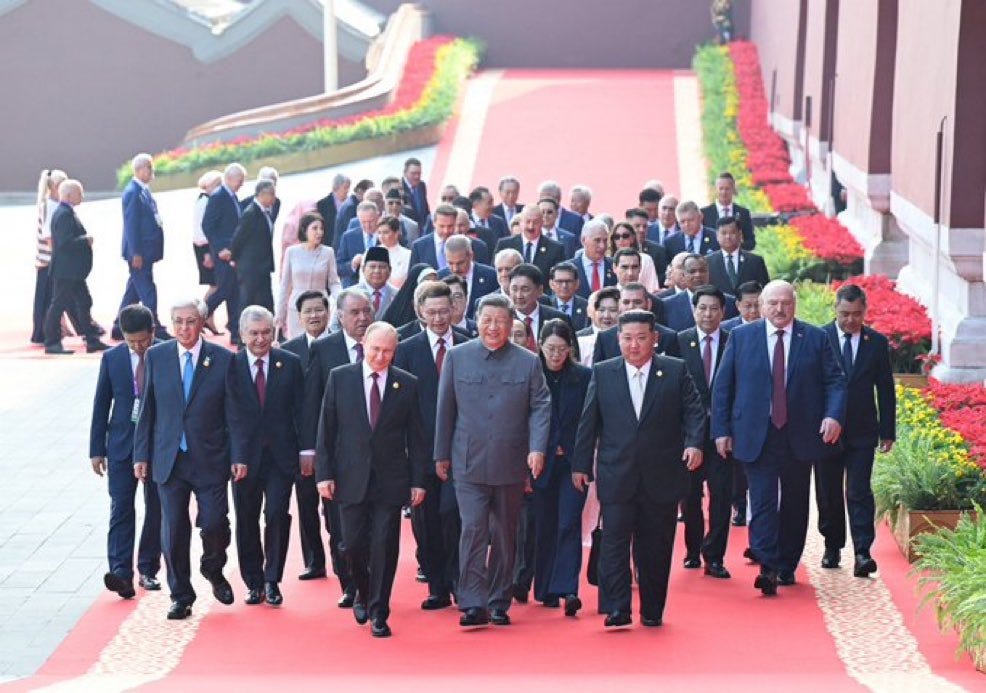

The point of the meeting, as Joe Leahy and Kathrin Hille write in the Financial Times, was to position China as an alternative pillar of global security, in contrast to the now erratic, unpredictable United States. Using vague proclamations about “sovereign equality,” “international rule of law” and “multilateralism,” Xi is appealing to American enemies and allies alike. America’s steep and capricious tariff hikes, bellicose language and threats of military action against “gangs” in Mexico or Venezuela all encourage other countries, even former American partners such as India, to draw closer to China. Of course Beijing offers neither more equitable bilateral relations nor better multilateral institutions, but (see my article above) China is right now telling a better story. Read more here (gift link).
On Morning Joe, I pointed out that the Chinese meeting supports the argument I made in Autocracy Inc: that the world’s autocracies, regardless of ideology, geography, or history, are uniting around their opposition to the democratic world. Instead of seeking to fight back against this network, Trump is appeasing Russia and alienating allies and partners. Watch here. On Fareed Zakaria’s GPS, I also pointed out that none of this inevitable: there are democratic coalitions to be built around the world too, if we want to build them. Watch here.
One of those previous partners signaled its discontent with Washington this past weekend. As Kapil Komireddi writes in his New York Times guest essay, the United States spent thirty years courting India. Successive post–Cold War presidents, including Trump in his first term, viewed India as a crucial counterweight to China and, as the world’s largest multicultural democracy, an important economic and diplomatic partner. In just six months, Trump has seriously undermined that effort. Today, India’s fractious political parties are united on one issue: opposition to the United States. The shift became visible when Prime Minister Narendra Modi embraced both Putin and Xi in Tianjin. Read more here (gift link).
The Strand
I was in New York for a wedding, and stopped by the Strand bookstore to sign some copies of the Autocracy Inc paperback. I am delighted to report that, on a Saturday afternoon, it was absolutely packed. Independent bookstores continue to thrive…
Open Letters, from Anne Applebaum is a reader-supported publication. To receive new posts and support my work, consider becoming a free or paid subscriber.
Related Knowledge Center: Democracy and politics
News organizations are scrambling to find a coverage approach that adequately informs the American public about the country’s slide from democracy to authoritarian rule.
Related Knowledge Center: Free speech and public protest
The First Amendment is facing challenging times: Crackdowns on campus protests prompted both-sides claims of intolerance. Attempts to head off dangerous health misinformation have been characterized as violations of free speech. Donald Trump is publicly punishing news outlets that deviate from his administration’s version of events while privately suing some outlets into submission.
The White House vs. the press | Voiceless America
Related Knowledge Center: Voiceless America
More than 80 years after its creation during World War II, President Trump is attempting to shut down the Voice of America, but his executive order is facing a skeptical response from the courts.