
‘Under Water’: Tara Menon’s fragmented debut on grief and climate change never quite comes together
When the reader meets Marissa, the protagonist of Tara Menon’s Under Water, all that could happen to her has already happened. The banality of a new, if lax, life taxes her. A home awaits her – one she surely misses. She cannot fathom returning, though. It was in Thailand that a ravenous tsunami had gulped down Arielle, her once-infallible friend.
Six-year-old Arielle, upon meeting a freshly motherless Marissa, asserts that they can share hers. From then on, they share everything. They slice open a watermelon and eat it whole. Their teeth sink into fridge-cold mangoes. They bite into piping-hot pa thong ko slathered in condensed milk. They chug stolen bottles of Bacardi Breezers. For all their shared endeavours, what these two friends don’t seem to share is conversation; their banter is often laconic, even if the narration insists otherwise. No wonder, then, that Arielle, a literal apparition in half of the novel, is a literary apparition in the other. By the time she dies her inevitable death, I know her even less. To be a spirited, beautiful friend in Under Water is to be nothing more.
Such a truncated characterisation is perhaps par for the course for a novel that comes with a thesis: “So many people imagine that climate change, when it comes, will be spectacular,” Marissa preaches. “…But most of the time, devastation is quiet, subtle, humdrum.” In an interview, Menon parrots her character: “…climate change is imagined as something that will happen in the near or distant future, and when it does, it will be total and spectacular.” She writes Under Water as a “riposte” to the dominating assumption that has prevailed in her genre of choice. What Menon doesn’t defend as carefully is her style of choice.
A distracted book
The fragmentary novel, like the Impressionist painting, is composed of blotches that the seeing eye is obliged to bring together. For Menon, it seems that fragmentation is the appropriate treatment for a subject as misunderstood as grief. Indeed, she is right that it is not considered “acceptable to endlessly grieve” for a friend. In the face of her grief over Arielle, Marissa is often asked, “Were you in love with her?”, to which she bristles: “As if that could be the only explanation for this kind of grief.” For a book that wishes to remedy this misapprehension, Under Water is too distracted, burdening itself with marketable productivity, which, for a novel, is as good as death. (If you haven’t caught on, it is also about a “friendship [that] is already running out of time,” a friendship between women, at that. How the sales team must’ve rested easy.)
The structure of the novel, which flits between before Arielle’s death (Thailand) and after Arielle’s death (New York), is uniform in tone. That Menon wants the “…Thailand sections to feel light and beautiful, and the New York sections to feel dark and heavy” cannot be discerned. As with the Thailand sections, trivia, now chiefly on the Western canon, abounds, this time with the stated intent to demonstrate how Marissa’s loneliness shrinks her imagination to solely the literary: “…if she hadn’t lost Arielle, the years of college would have been extraordinarily social.”
Marissa, it is worth noting, is not of an entirely different temperament in the Thailand sections. There, too, her imagination is literary, if anything, pretentiously precocious. In the occasional paragraph in the Thailand sections where the reader forgets the looming ruination, the narration withholds, and its austerity gains the characteristic weight of its New York counterpart. That Marissa appears arrested in her teenage angst seems less the product of writerly control than mere happenstance.
Confused detours
Through its fragmentation, many of the novel’s sections reach for significance they never assume. Here is Marissa deliberately rubbing chilli-stained fingertips on her person. There are the gullible dodos that make for Dutch sailors’ meat. Look here, an etymological lesson on how pitcher plants acquired their scientific name. We detour so often, gathering reams of trivia, all of it narratively justified by interactions with the many researchers the girls meet at Marissa’s father’s research station.
Sometimes, Under Water reads as though an essayist stopped midway through a draft to write a novel instead. Its braided structure demands that at least some chapters abandon the reader with an abrupt image, and they do: a butterflied squirrel on a pavement, a hawk “ripping out flesh” as it feasts on a pigeon, a mother kite that “stands guard” to protect its young, a black-and-white warbler that “lies face up in the grass, dead.” What all of these vignettes motivate is unclear. In its insubordination to clarity, the novel, so intent on articulating grief, constipates it.
Of course, a novelist can, and sometimes should, grant narrative free rein to put the reader to task. It is clear that Menon considers ecological loss and personal loss to structurally rouse the same category of denial, the belief that the hurt will leave if you ignore it. Unfortunately, in Under Water, it is these losses that compete for the already spartan narrative room. There isn’t enough here to read that competition as the point. Authorial choices, however well thought out and theoretically airtight, are only half the labour of writing a novel. The rest you must actually write.
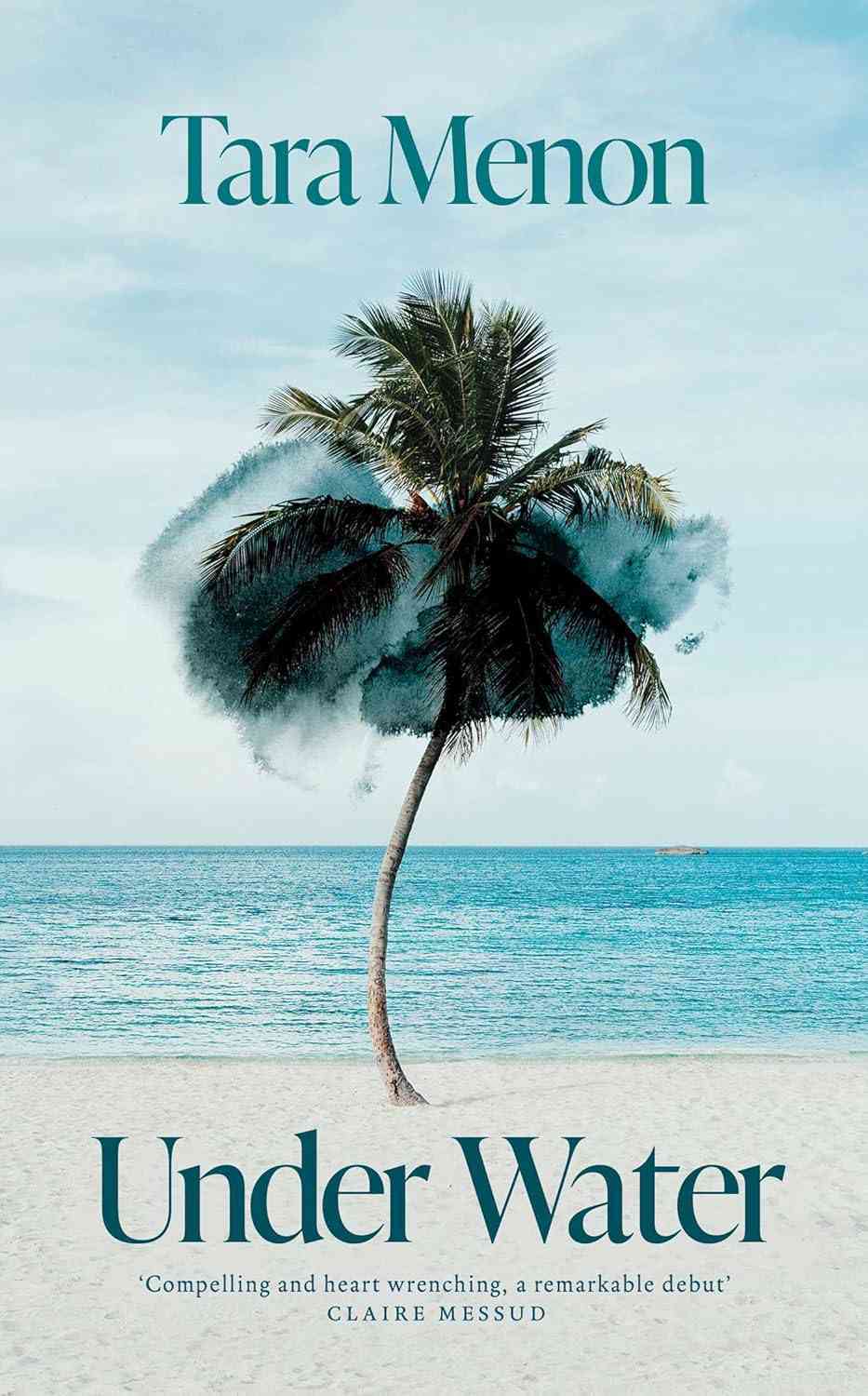
Under Water, Tara Menon, Simon and Schuster India.