
Under the Volcano
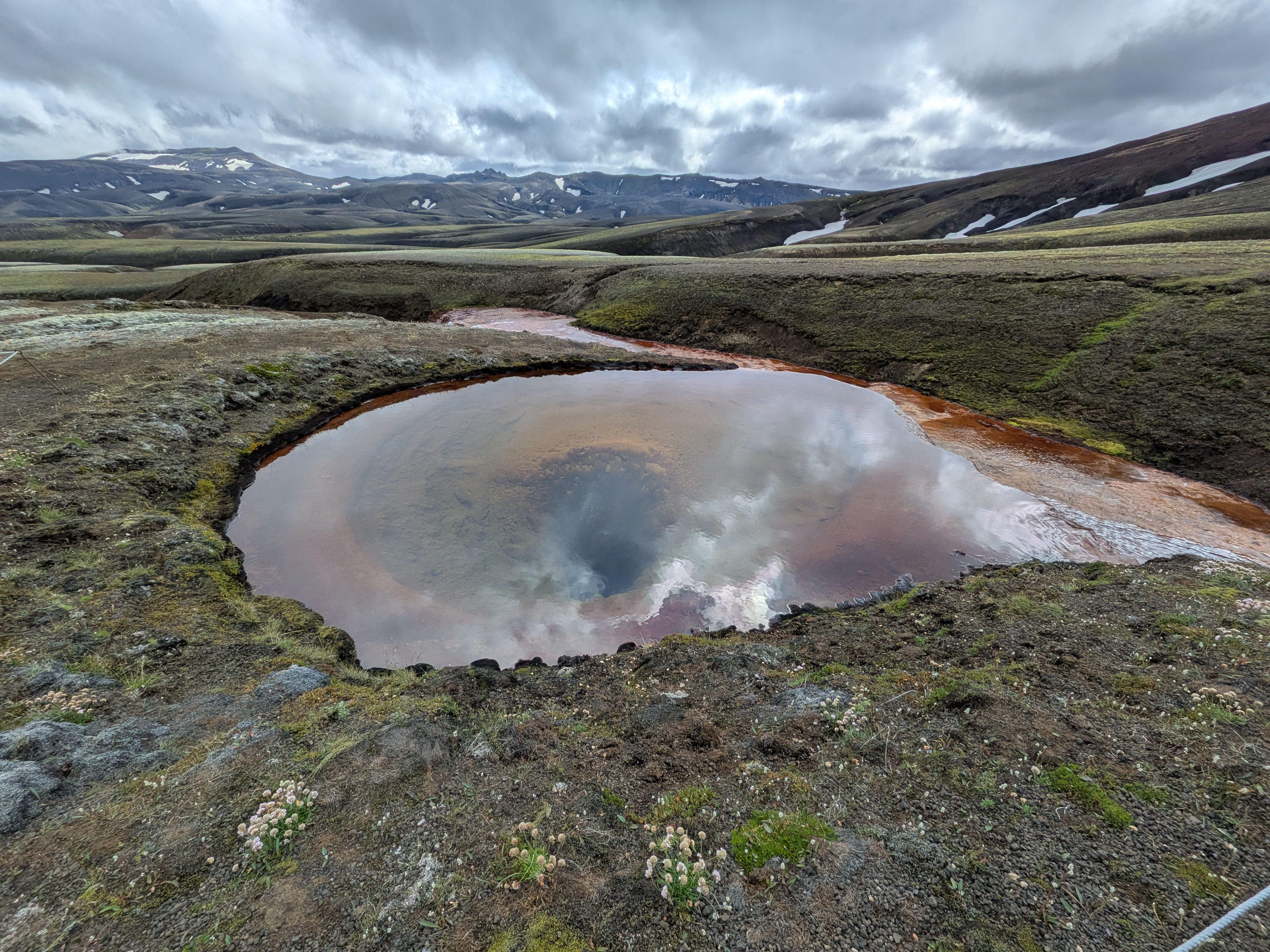
When you wake up in the morning in Iceland, you can check not just the weather, but the earthquake map. The weather changes from hour to hour, but so do earthquake predictions. Iceland is located right between the North American and Eurasian tectonic plates, which are currently pulling away from one another at the rate of 5 cm a year. This means that Iceland has some 200 volcanoes, deep cracks in the ground, extraordinary rock formations, lava fields that date from many different eras and frequent earthquakes. I spent a week there this month and came to appreciate not just the extraordinary landscape, but the dedication required to live in it.
Iceland has the same political divisions as everywhere else (see footnote below). 1 Nevetheless, Icelanders remain unified around the most important threat: their own geology. Verified, up-to-date scientific information is extremely important to everyone’s daily life. Here is the English version of the national earthquake map:
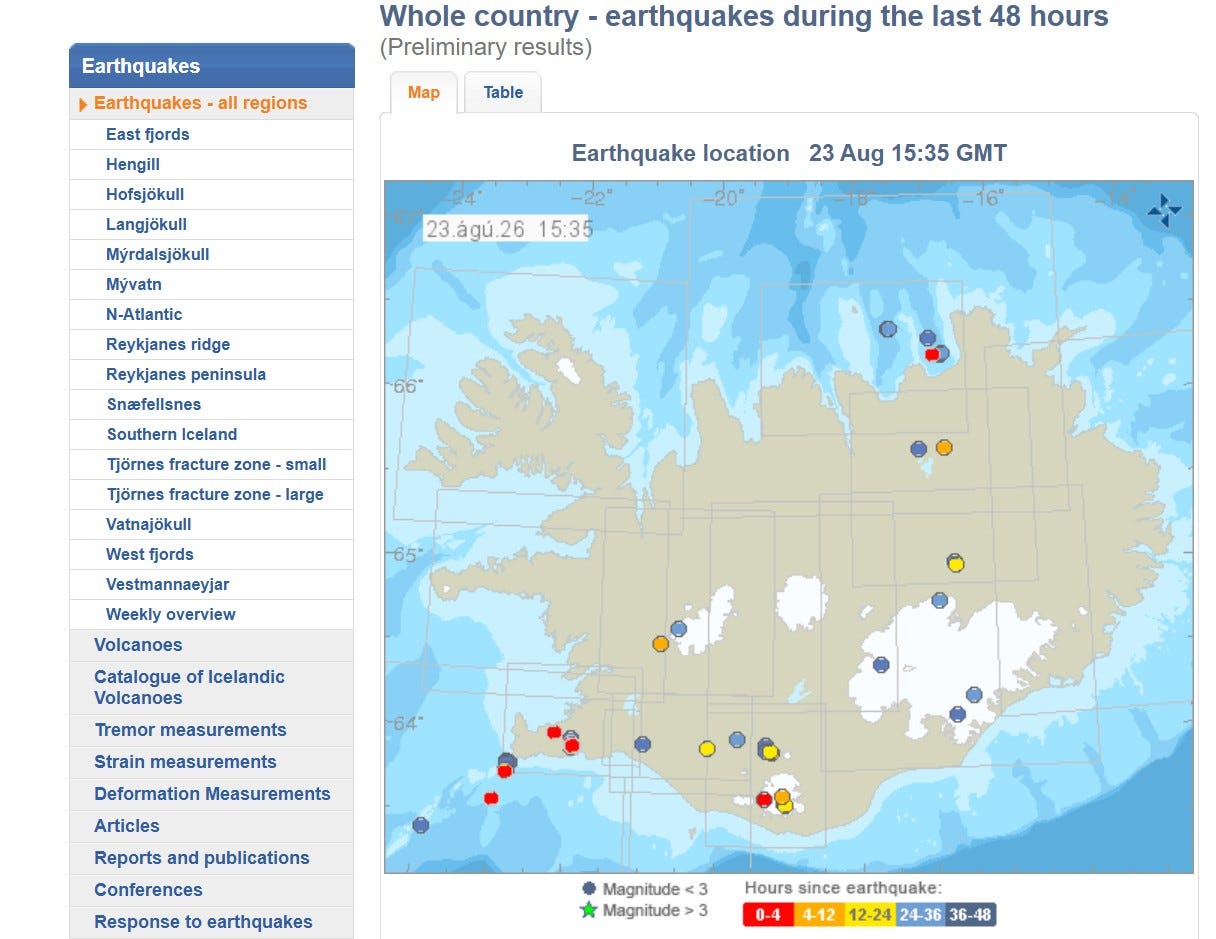
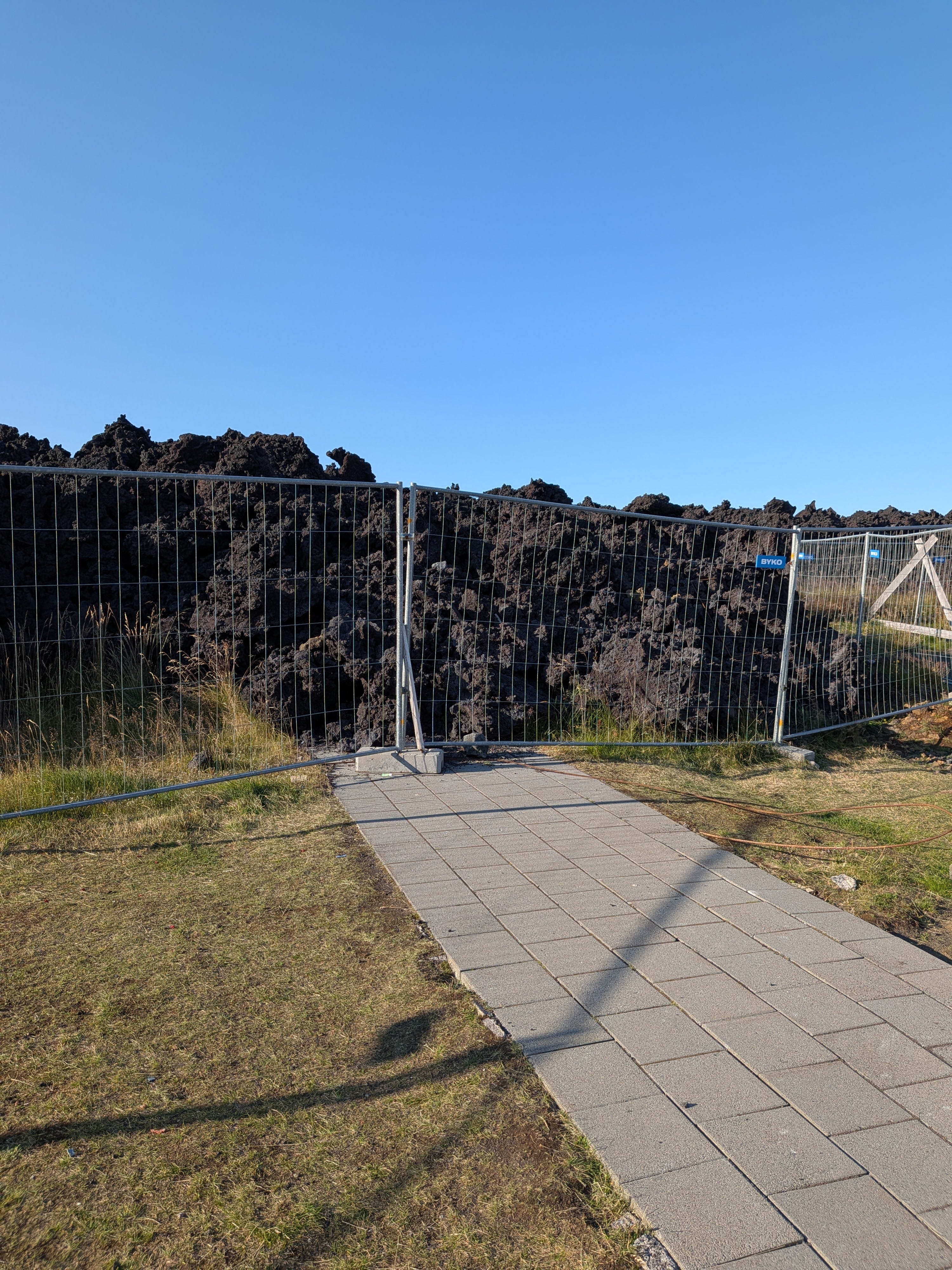
To keep this map current, the government uses sensors around the country, and employs multiple experts and emergency responders. We visited Grindavík, a town that was evacuated following a series of volcanic eruptions, most recently in August 2025. The eruption breached several lava walls built to protect the town (you can see those elsewhere too) and destroyed a handful of houses. Here you can see how the flow stopped just before engulfing a sidewalk:
After these explosions, the Icelandic government bought up more than 950 residences in the town, at a cost of some $1 billion, more than 2% of the country’s annual budget. A few people have moved back. One woman told us she felt safe living there with her children because she feels certain that goverment insitutions would warn her if she were in danger.
Maybe Iceland’s size and history contribute to this feeling of trust. Founded in the 9th century by Viking settlers, the island had some 50,000 inhabitants at the beginning of the 19th century, and still has only some 400,000 today. Iceland nevertheless has its own poetic and literary tradition, ranging from medieval sagas to a Nobel prize-winning writer, Halldór Laxness. (His novel, Independent People, is still in print). Those who stuck out the years of volcanic eruption, plagues and economic crisis are clearly willing to make the adjustments and sacrifices needed to live there.
Still, I suspect the real reason why Icelanders trust one another, as well as their government, is those looming volacanoes. Because everyone understands the importance of science, there has been no anti-vax movement to speak of, not even during the pandemic. Conspiracy theories are just to dangerous to promote in a place where everyone needs to grapple with actual reality in order to survive. Of course that’s true for the rest of the planet, but somehow we don’t take natural threats seriously, whether from plagues or climate change. Maybe it’s because they don’t seem as urgent and immediate. Perhaps we need daily maps to remind us too.
Photographs don’t really capture the scale or the openness of the Icelandic landscape, but I did my best:
Kleptocracy Tracker
Continuing to monitor conflicts of interest, ostentatious emoluments, outright corruption and policy changes that will facilitate outright corruption. (Read my original article, Kleptocracy Inc and check out the SNF Agora Institute chart)
August 7
The SEC dropped its insider trading lawsuit against healthcare executive Terren Peizer after Trump pardoned him for his 2024 insider trading conviction.
August 9
Guren “Bobby” Zhou, a failed hardwood flooring retailer in Britain who is under investigation for money laundering, bought $100 million worth of World Liberty Financial’s tokens. World Liberty Financial is the Trump family’s most important crypto project. Zhou’s purchase shows how easy it is for foreign nationals to direct substantial sums to Trump-linked ventures.
August 10
An Emirati real estate firm paid Trump $12.5 million during the first year of his second term, while another division of the company moved to build data centers in the US.
August 12
The Trump administration plans to spend at least $900 million on White House renovations—including the East Wing ballroom and a helipad—financed by a patchwork of funds from other agencies and private donors, bypassing Congressional approval.
Texas has frozen billions in federal broadband funds amid scrutiny over whether the state broadband office gave Starlink preferential treatment in distributing Broadband Equity, Access and Deployment program grants.
The Trump administration has decided to scale back enforcement of the Corporate Transparency Act, which was intended to prevent the illicit use of shell companies by giving law enforcement agencies access to information about their ownership structures.
August 13
The Department of Homeland Security paid a firm chaired by a donor to a political committee supporting former Secretary Kristi Noem $464 million for 10 used airplanes through a no-bid contract, justifying the sole-source award by citing time constraints, even though the department has barely used this new fleet.
August 15
World Liberty Financial, has received preliminary conditional approval from the Office of the Comptroller of the Currency—part of the Treasury Department—to become a bank.
August 18
Since mass firings of inspectors general at the beginning of his term, Trump has appointed government watchdogs with overtly political backgrounds. Many are conducting state-level fraud investigations targeting the president’s political adversaries rather than scrutinizing agencies within the administration as intended.
August 19
Trump hosted executives of cryptocurrency companies at the White House to offer accolades—including business partners of World Liberty Financial—and to push for passage of the Clarity Act, which would create business-friendly rules for the technology.
August 20
SpaceX has received billions of dollars in government contracts this year for building and launching military satellites. The Trump administration has granted the firm exemptions from certain regulations, helping the company entrench its competitive lead.
End-of-Summer books
As promised, I will periodically post links to books that help shed light on our current situation. This time I chose three works of journalism:
Casey Michel, The United States of Oligarchy. Michel is an indefatigable chronicler of corruption. Here he turns his lens directly on the current American administration. Available for purchase here.

Jacob Weisberg, Profiles in Cowardice. Short biographies of people who compromised their beliefs to work on behalf of a corrupt administration. Available for purchase here.

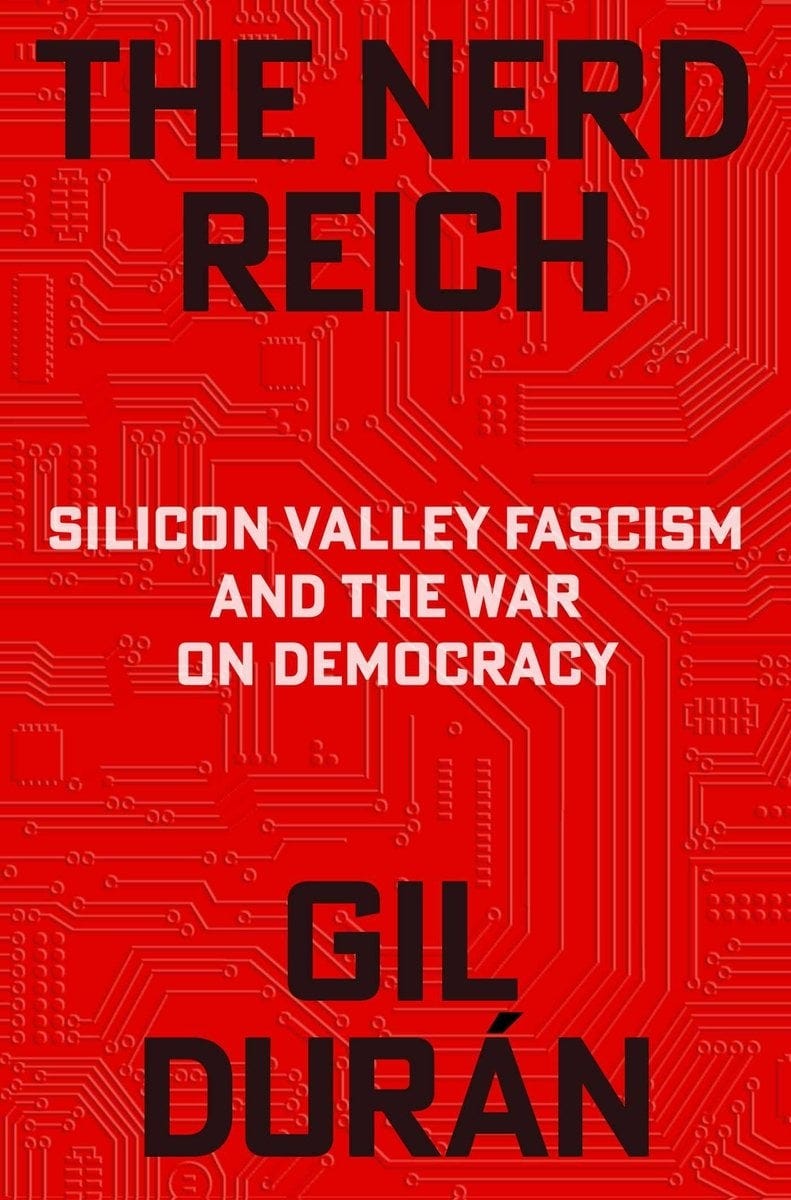
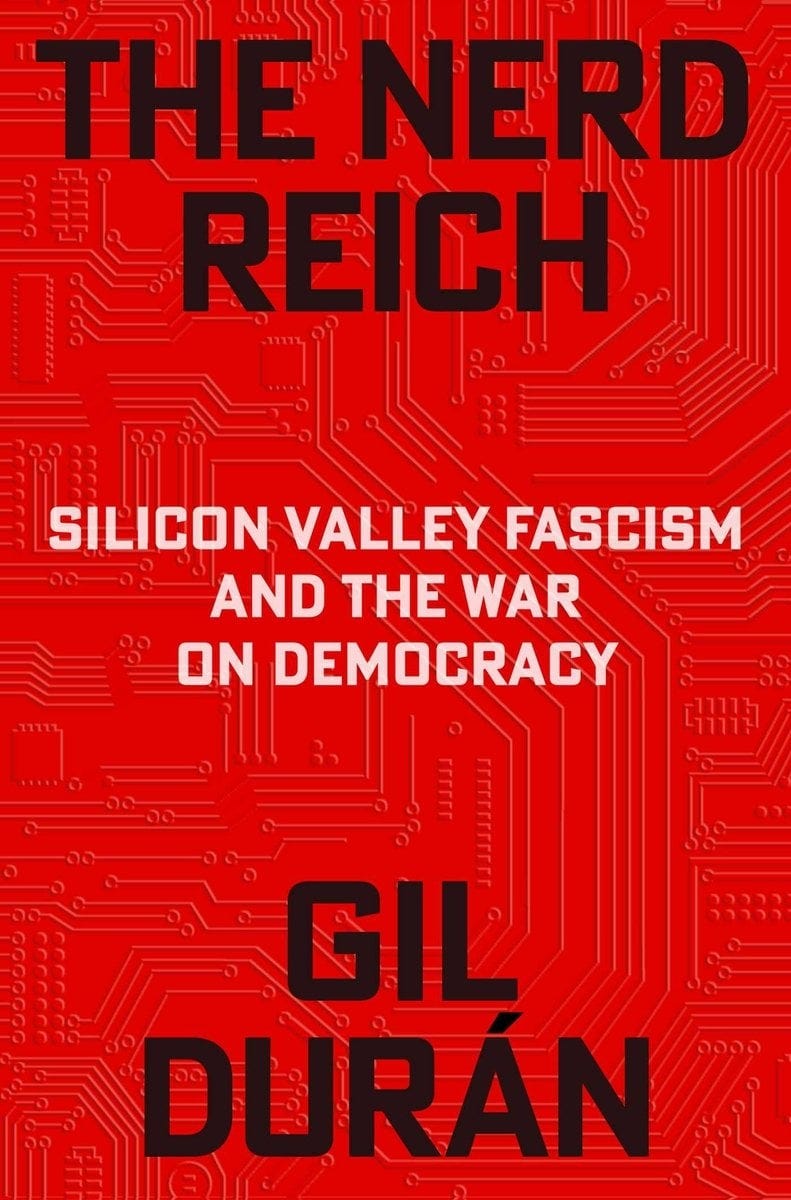
Gil Duran, The Nerd Reich. Duran argues that the most important assault on American democracy isn’t coming from Washington, but from Silicon Valley. Available for purchase here.


Happy Reading, and enjoy the last weeks of summer.
Open Letters, from Anne Applebaum is a reader-supported publication. To receive new posts and support my work, consider becoming a free or paid subscriber.
While we were there, Iceland was getting ready to vote in an August 29 referendum on re-opening negotiations with the European Union. Iceland is already a member of the Schengen travel area, and has adopted the regulations of the European Single Market as well; goods, services, money and people already move freely between Iceland and the rest of the EU. The obstacles to membership negotations are not regulations or border issues but rather fish quotas (Iceland is a fish superpower) and agriculture (Icelandic agriculture is heavily subsidized, more so than the rest of the EU). But if fish and agricultural lobbies are against, people who worry about security and geopolitics are in favor. The Trump administration’s ongoing obsession with Greenland feels menacing to everyone in Scandinavia, indeed everyone in Europe. In Iceland, no one has forgotten that Trump repeatedly confused Iceland and Greenland during his Davos speech. Iceland is a founding member of NATO, but the old American base was closed back in 2006 (and transformed into Keflavik airport). It can feel lonely in the middle of the Atlantic, despite the presence of rotating NATO teams, which is why this referendum is happening at all.