
Two opposing media takes on Epstein's 'lost world'
I admire Will Bunch, a columnist for the Philadelphia Inquirer, who writes his opinion pieces from a staunchly pro-democracy position and who has a clear moral compass.
This past week, his column about the recently released emails involving sexual offender Jeffrey Epstein spends exactly zero time bemoaning the tawdry world he inhabited.
Bunch writes:
“I don’t know if the emails, so far, are enough to take down Trump but the president should be even more worried — and he probably is — about the much deeper rot that’s already been laid bare about the entire decrepit class of men (because they’re almost all men) who rule the world with atrocious grammar amid a non-stop booty call.” The emails, he writes, “reveal the evil banality of the world’s most rich and famous whose vast pursuit of money or teenaged blondes or whatever, knew no bounds, or at long last any sense of decency.”
Contrast this to a prominently displayed New York Times feature story that puts a nostalgic gloss on Epstein’s world. Looking back on that world and the people who inhabited it, it carried the headline, Epstein Emails Reveal a Lost New York.
The recently revealed emails “are like a portal back to a lost Manhattan power scene. …It was the world that Donald Trump came out of and the one that Mr. Epstein had so effectively beguiled after having grown up in a middle-class household in Coney Island. … As the emails stretch through the years, they show how that protected realm vanished into the mists of time…”
Let’s wipe away a tear and listen to one social media commenter’s trenchant analysis: “The article and headline don’t arise in a vacuum, they arise on the front page of the New York Times, which has selected a very specific way to approach moral and political issues, characterized by detachment, both-sidesism and trolling.” The commenter, who writes under various versions of the handle “Popehat,” is the criminal defense attorney Ken White.
Similarly, the Times offered us an airbrushed look at the relationship between journalist Olivia Nuzzi and Robert F. Kennedy Jr. Nuzzi was fired from New York magazine after their digital romance was made public, and now she’s written a book. The article, by Jacob Bernstein, magnifies Nuzzi’s defense for getting way, way too close to a prominent public figure she had written about — that it was all for love. The photos are glamorous, and undoubtedly, this piece will help to rehabilitate Nuzzi and sell her book.
Let’s just say I don’t think Will Bunch would have gone anywhere near it.
Oh, and before we leave the Epstein topic, let’s not miss the actual media low point of the week which was Megyn Kelly suggesting on her Sirius XM podcast that there’s a big difference between grown men’s sexual interest in, say, an 8 year old girl and a 15 year old girl and that she was told that Epstein wasn’t really a pedophile because he only liked teenagers. Here’s a good look at what she said from the fact-checking site Snopes.
Now to correct my error, which was made in a video podcast with Paul Krugman, the Nobel laureate who writes a best-selling Substack and who was a columnist at the Times for many years. We were talking about all the billionaires who have cozied up to Trump, often by using their media companies to curry favor. In talking about the presence of some of them at Trump’s inauguration earlier this year, I mentioned that Jeff Bezos and Mark Zuckerberg were there in a prominent position, and I said I thought that Patrick Soon-Shiong, the owner of the Los Angeles Times, was among them. Turns out, I was wrong about that; Soon-Shiong (though he has been friendly to Trump in other ways) was not in that rich-guy crowd at the inauguration.
But — how’s this for a cautionary tale about the dubious accuracy of artificial intelligence? — a Google “AI overview,” in response to a search, almost immediately took my error and spread it around: “Yes, Dr. Patrick Soon-Shiong attended Donald Trump’s inauguration in 2025. He was seen there alongside other prominent figures like Mark Zuckerberg and Jeff Bezos.” It cited Krugman’s and my conversation. Again, I was wrong and I regret the error.
Krugman and I did cover a lot of ground about the media in our conversation, and you can read the transcript here. We talked about the Times (where we both worked), the Washington Post’s odious editorial defending Trump’s ballroom, the vast changes at CBS News, and the settlements made to Trump after he sued ABC News and CBS News. Krugman described his daily news diet, and we agreed that large news organizations like the Times and the Washington Post are still doing a lot of important and worthwhile work, and that they have certain advantages over independent voices.
American Crisis is a community-supported project where I explore how journalism can help save democracy. Please consider joining us!
Separately, I wrote for the Guardian last week about Trump’s performative anger at the BBC for its misleading editing in a year-old documentary, and his threat to sue the UK-based news organization. Here’s the link.
Welcome to a lot of new readers and subscribers who came to me from the Krugman interview. I’m glad to have you here.
Question of the day for the comments section. Do you think the Epstein matter will affect Trump in any meaningful way? Could it even bring him down, when he’s survived so many other scandals and so much malfeasance? I was interested to read longtime journalist Jonathan Alter’s view on his Substack. Alter thinks the Epstein stain will always remain with Trump. He puts it in a category of presidential scandals ranking with Teapot Dome, Watergate and the Monica Lewinsky affair. Let me know your thoughts, please.
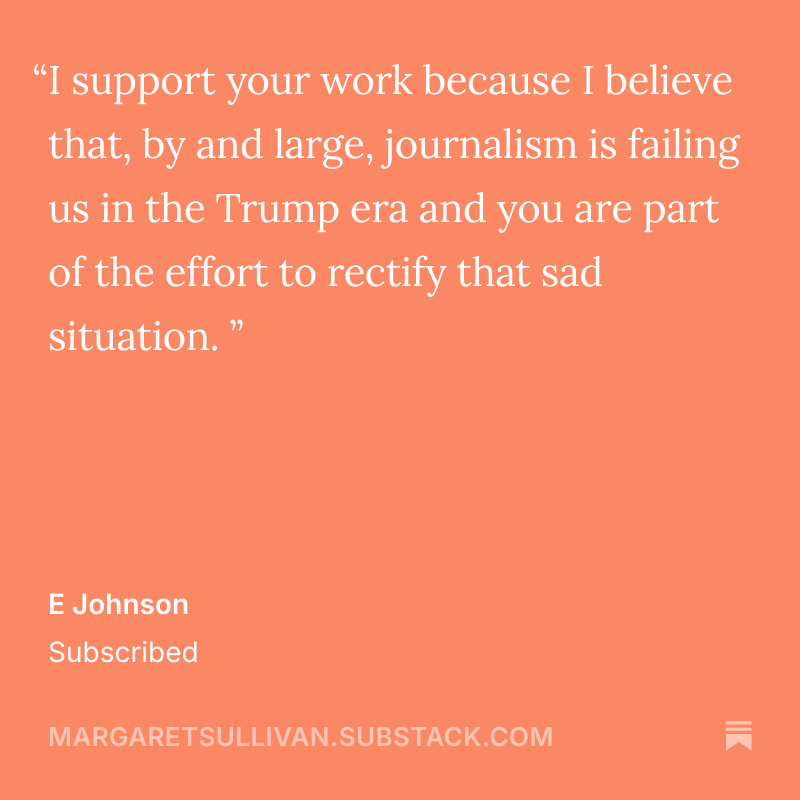
To the newcomers, you’ll notice there is no paywall. I took it down last fall so all could read and comment. A description of what I’m trying to do here is below the kind comment from a new paid subscriber.
My background: I am a Lackawanna, NY native who started my career as a summer intern at the Buffalo News, my hometown daily. After years as a reporter and editor, I was named the paper’s first woman editor in chief in 1999, and ran the 200-person newsroom for almost 13 years. Starting in 2012, I served as the first woman “public editor” of the New York Times — an internal media critic and reader representative — and later was the media columnist for the Washington Post. These days, I write here on Substack, as well as for the Guardian US, and teach an ethics course at Columbia Journalism School. I’ve also written two books and won a few awards, including three for defending First Amendment principles.
The purpose of ‘American Crisis’: My aim is to use this newsletter (it started as a podcast in 2023) to push for the kind of journalism we need for our democracy to function — journalism that is accurate, fair, mission-driven and public-spirited. That means that I point out the media’s flaws and failures when necessary.
What I ask of you: Last fall, I removed the paywall so that everyone could read and comment. I thought it was important in this dire moment and might be helpful. If you are able to subscribe at $50 a year or $8 a month, or upgrade your unpaid subscription, that will help to support this venture — and keep it going for all. Thank you!