
Two brutal developments for the journalism that serves democracy
I was all set this past weekend to write a positive post. Not only had spring finally arrived after our frigid winter, but a few good things had happened in the world of journalism.
Just to tick them off quickly: A publication is expanding in Washington, DC. and hiring some talented reporters from the Washington Post with plans to fill some of the gaps left by the Post’s decline. (It is called NOTUS, but may change its name to the Washington Star with a nod to a fine publication of years past.) The New York Times won its suit challenging the Pentagon rules that have deprived reporters of their press passes unless they agreed to absurd rules to produce propaganda. It’s been reasonably called a victory for press freedom — we haven’t had a lot of those lately. And Andy Lack, the former NBC News chairman, made a $7 million gift to the network of nonprofit newsrooms in Louisiana and Mississippi that he cofounded. That will allow Deep South Today to expand its investigative reporting.
But then two brutal blows were delivered. The awful new management at CBS News —under the thumb of Trump-friendly CEO David Ellison and his handpicked editor Bari Weiss — decided to completely shutter CBS News Radio. That nearly hundred-year-old network, among many other attributes, was the home of the legendary journalist Edward R. Murrow. All employees were laid off, and 700 affiliated stations around the country will be deprived of this source of news.
“Genuinely disturbed by this,” wrote journalist Kitty Eisele in a post on X. “CBS Radio has remained one of the few serious broadcast sources in the country. It’s a huge blow to news.”
“This hits me like a sledgehammer,” a journalist friend who got her start in radio texted me. Radio news isn’t exactly cutting-edge stuff, but CBS Radio is a storied institution, with integrity and credibility. That it comes amid the overall diminishment of CBS News over the past few months makes it that much worse.
“Corporate greed is killing another worthy newsroom,” wrote Chris Bury, formerly of ABC News Nightline.
Then came the second blow, this one in the realm of broadcast TV on the local level. Federal regulators approved a $6.2 billion acquisition by Nexstar of its rival Tegna — notably, just a few weeks after President Trump said he thought it was a swell idea. That means Nexstar is positioned to own more than 250 local TV stations around the country and through them would reach 4 of every 5 American households.
Nexstar has called itself the “anti-fake news” and put out a statement praising Trump. Trump says the deal will “help knock out the fake news.”
Yeah, right.
Those statements are upside down. And notably, the approval also happened just a day after attorneys general in eight states sued to block the deal. (Some are now challenging it.)
Trump loyalist Brendan Carr, the chairman of the FCC, said his agency waived a rule that prevents a single company from owning stations that reach more than 40 percent of American households.
The only Democrat on the FCC, Anna Gomez, harshly criticized the deal, saying it was “approved behind closed doors with no open process, no full Commission vote, and no transparency for the consumers and communities who will bear the consequences.”
Nexstar has been notably Trump-friendly and right-leaning in the past.
To really understand the scope, you have to zoom out and get the big picture of what’s going on. Trump is trying to control the media as he marches the US from democracy to something more like autocracy, with billionaires helping him at every turn.
I wrote about this bigger picture in the Guardian last week, after Trump suggested that news organizations could be charged with treason and after FCC chairman Brendan Carr threatened media companies with losing broadcast licenses if they didn’t change their approach to the news (essentially to make it more supportive of Trump — particularly of his ill-conceived war in Iran). Here’s an excerpt:
In US media, oligarchs are increasingly in charge, and their chief motivations tend to be protective of commercial interests, not of traditional press rights. That works just fine for Trump, who can manipulate the levers of governmental regulation to help achieve his ends.
Although Americans (and people around the world) are hardened to Trump’s outrageous behavior – especially his unhinged rants on social media – they ought to be aware of what this is.
It’s the language and the strategy of authoritarian states.
Jameel Jaffer, who directs the Knight First Amendment Institute at Columbia University, noted that Trump can say what he wants in criticizing the press, but news outlets have the right to publish reporting as they see fit, not as government officials demand.
“This is constitutional bedrock, if anything is,” Jaffer said in a written statement on Monday. He added that Trump’s latest threats are “an intensification of his long-running effort to bring news organizations into closer alignment with his own ideological and political agenda”.
And unfortunately, the Nexstar deal and the shuttering of CBS News Radio fit right into this troubling trend.
American Crisis is a community-supported project where I explore how journalism can help save democracy. Please consider joining us!
I was also disgusted by Trump’s social media post celebrating the death of Robert Mueller, a dedicated public servant and a man of integrity.
I was reminded, too, of how badly the news media was manipulated by Trump and then-Attorney General William Barr just before Mueller’s report on Russian interference came out. Remember this front page headline (“a front page that should live in infamy,” according to the Media and Democracy Project)? Taking Barr’s word for it, it failed to convey so much of what the report actually found and allowed Trump to claim “exoneration” in the sub-headline.
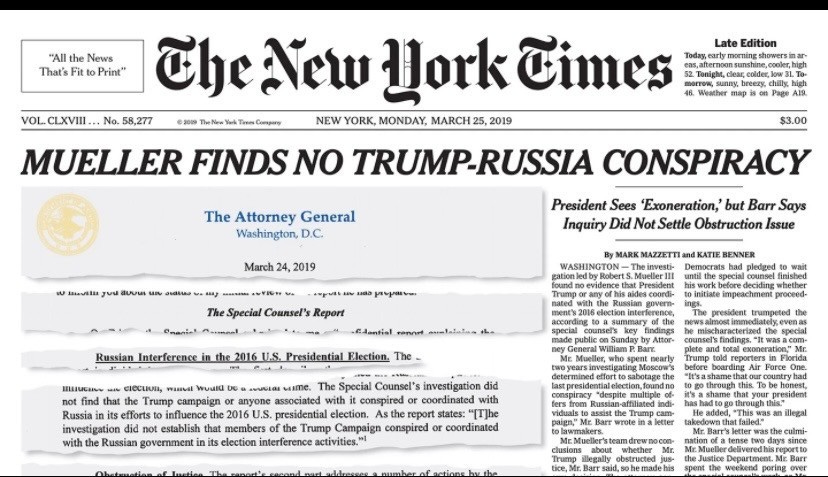
As I wrote for the Washington Post at that time (click for a gift link), Senator Elizabeth Warren, by contrast, summarized her takeaways after reading the full report:
Part 1, a hostile foreign government attacked our 2016 elections for the purpose of getting Donald Trump elected.
Part 2, then-candidate Donald Trump welcomed that help.
And Part 3, when the federal government tried to investigate Part 1 and Part 2, Donald Trump as president delayed, deflected, moved, fired and did everything he could to obstruct justice.
Tragically, the news media — even the most prominent — have never fully figured out how to cover Trump, as the Times showed again this past week when a story described his supposed joke about Pearl Harbor to Japan’s prime minister. Here’s a line from their news story: “The remark was the latest example of Mr. Trump’s penchant for tossing aside diplomatic norms.” Is that what happened? James Fallows on Bluesky described the “incredibly crude, ignorant, insulting and racist ‘joke’ about Japan, with the prime minister of Japan sitting next to him,” and blasted the Times for the clueless characterization.
Readers, a big-picture question for you, and please let me know in the comments. What is giving you hope these days? And what is causing you the most angst?
Further, will you participate in the next No Kings protests next Saturday, March 28th? If so, where?
Thanks so much for reading, commenting and caring about these issues. Some information for newcomers is below.
Here’s why one very kind reader became a paid subscriber. I’m grateful to those who make this decision, because I understand personal budgets have their limits. There is no paywall here and I want to keep it that way for all. But I’m happy to have you here either way.
My background: I am a Lackawanna, NY native who started my career as a summer intern at the Buffalo News, my hometown daily. After years as a reporter and editor, I was named the paper’s first woman editor in chief in 1999, and ran the 200-person newsroom for almost 13 years. Starting in 2012, I served as the first woman “public editor” of the New York Times — an internal media critic and reader representative — and later was the media columnist for the Washington Post. These days, I write here on Substack, as well as for the Guardian US. I’ve also written two books, taught journalism ethics, and won a few awards, including three for defending First Amendment principles.
The purpose of ‘American Crisis’: My aim is to use this newsletter (it started as a podcast in 2023) to push for the kind of journalism we need for our democracy to function — journalism that is accurate, fair, mission-driven and public-spirited. That means that I point out the media’s flaws and failures when necessary.
What I ask of you: Shortly after Trump’s election in November of 2024, I removed the paywall so that everyone could read and comment. I thought it was important in this dire moment and might be helpful. If you are able to subscribe at $50 a year or $8 a month, or upgrade your unpaid subscription, that will help to support this venture — and keep it going for all. Thank you!