
Twenty-five Years After 9/11: What Have We Learned, and Forgotten?
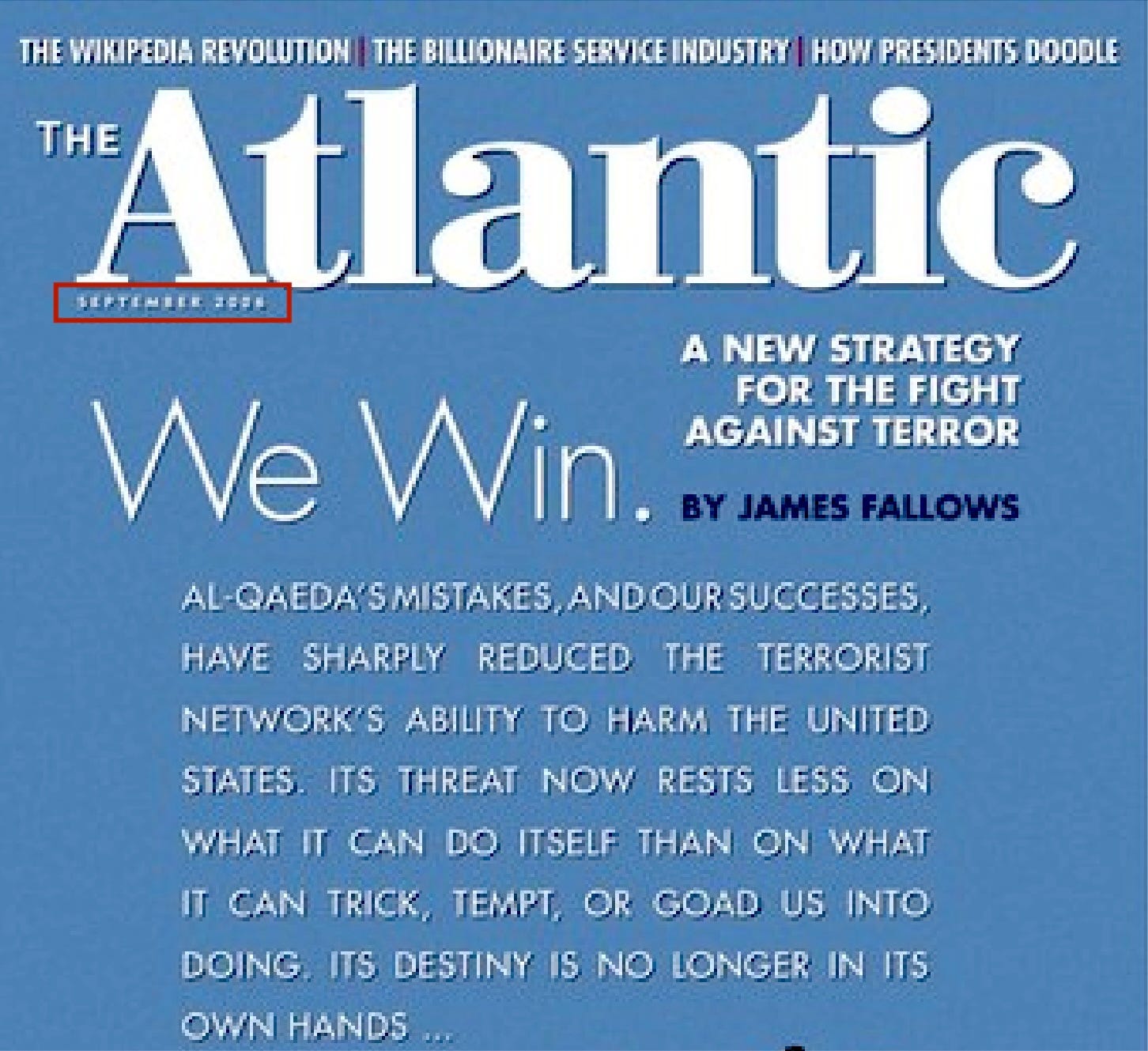
Shown above, with date highlighted in red, the cover of The Atlantic’s print issue of September 2006. On the fifth anniversary of the devastating 9/11/2001 attacks, this story argued that the worst threat of terrorism was not from what attackers might do to the US. Rather it was from what they might make us do to ourselves.
Twenty years ago, I wrote the magazine story shown above, to mark five years after the original 9/11 assaults. For the story I interviewed dozens of experts in terrorism, about what the US should really fear.
Most of them said that the US and its allies had been remarkably successful, through strategies of disruption overseas and protection in the US, in reducing the threat of direct terrorist attacks on “the homeland.”
What the US really had to worry about, these people said, was the damage that a crusade against terrorism could do to this country itself. The ways it could deform our civic and cultural life. The strains it could put on our international alliances and openness to the world. The unwinnable wars it might tempt us to enter or wage.
The way to deal with terrorism, several of them said, was of course to punish whatever enemy is attacking you—as with the retribution against al-Qaeda immediately after 9/11. But then to be ever vigilant about the risk of being sucked or goaded into damaging yourself, your long-term interests, and your values. You can read much, much more in the piece.
The view from 2006, and 2026.
That report was 20 years ago, five years after the initial 2001 attacks. I will say that I considered it an act of journalistic courage for my colleagues at The Atlantic to play the story the way they did, at just that time. What if there had been another big “homeland” attack, during the publishing twilight zone when an issue has already gone to the printer, but before it was yet in any readers’ hands? Might this cover then win fame as a huge gaffe, “Dewey Defeats Truman” style?
The magazine went ahead. The buck-stops-here call, to feature the story and run “Declaring Victory” as its title inside the magazine, was made by James Bennet, then the editor-in-chief.1
And now we look back, with another 20 years behind us. What do we see?
On today’s broadcast of CBS Sunday Morning, I have a brief commentary on lessons learned, and ignored. (A URL for today’s whole show, which includes several powerful segments on 9/11, is here. One segment is about the “Come From Away” welcome that citizens of Gander provided to stranded travelers, largely American. I mention that in my commentary. A link to video of my segment is here. The text of what was aired is here.)
Writing for the screen, either TV or film, is like composing haiku: You omit ten words for every one you keep. And then you omit a few more. You suggest rather than spell out. You rely on images to express what you don’t need to say.
With that prelude, what follows is the pre-haiku-ized version of what I wrote for Sunday Morning. After it, I’ll mention one more way in which 2001 is connected to 2006—which is connected to 2026, and beyond.
‘What we have remembered, and have forgotten.’
Here’s my Sunday Morning commentary from today, slightly longer than what was aired and with a few differences in phrasing. If you watch the TV version you’ll see how carefully and powerfully their editors have matched images and videos to the text—about Pearl Harbor, for instance, or George W. Bush’s post-9/11 appearance at the Islamic Center.
The text:
We live through history’s turning points, with no idea which way history will turn.
-Nearly 85 years ago, the attack on Pearl Harbor was “a date which will live in infamy.” It marked the clear end of US isolation and the beginning of permanent US engagement around the world.
-Fifty-seven years ago, Neil Armstrong’s first steps on the moon were heralded as a “giant leap for mankind.” Yet three years later, the moon landings closed down, leaving still only 12 human beings ever to have stood on lunar soil.
And 25 years ago? Like all memories, it is fading. Barely half of the world’s current population is old enough to have any recollection of that day.
At the time, it seemed to change everything. We can’t know how it will be judged after 85 years, like Pearl Harbor, or 57, like the moon landing. But on this 25th anniversary, here is my sense of changes we might have hoped would be permanent, but weren’t, and others that future generations may strive to change back.
The worst of events can bring out the best in people. And so it was after the original 9/11, as everyone who was around then can attest, “We are all Americans,” an instant-classic headline in the French newspaper Le Monde put it. At US embassies around the world, citizens of other lands brought flowers and left notes of tribute. America’s neighbor and then-closest ally, Canada, took in Americans who were stranded when airline travel shut down. For the only time in NATO’s history, its member countries all voted to come to a stricken partner’s defense.
In the US, people honored our firefighters and police officers, our emergency workers, our ordinary brave fellow citizens. Then-president George W. Bush, who had been caught unawares by the attack, went just days later to the Islamic Center in Washington. There he reminded his country that while the attackers were Muslim, Islam itself was not the enemy, nor were the world’s billion Muslims. Within the US, this Republican president said, Muslims must not be made to fear because of their faith. “In our anger and emotion,” he said, “our fellow Americans must treat each other with respect.”
Too much of that unifying spirit faded, too fast. And too little of what lastingly changed in America has received the awareness and scrutiny it deserves.
-Before 9/11 there was no Department of Homeland Security. No TSA. No ICE. Those functions were carried out more modestly—with less coordination, but also with less overreach.
-Before 9/11 there was no Patriot Act, and barely any of the modern structure of the surveillance state.
-Before 9/11, local police in the US were not kitted out in combat gear as if fighting in Fallujah. That is because before 9/11 there was no war in Iraq—for which 9/11 was the excuse, though no Iraqis were involved—and nothing like the “forever wars” that have followed. Humvees, armored personnel carriers, and weapons left over from Iraq have filtered down from military surplus to municipal police.
-Before 9/11, the US had not become such a “chickenhawk nation,” in which people ritually “salute the troops” before football kickoffs but don’t think seriously about where Americans in uniform are sent, and how they are equipped, and for what causes they are deployed.
Much of this was bi-partisan. Most of it was step-by-step. But as we look back, we see a country that survived an attack, and avoided a repetition, but whose culture and civic life the attackers managed to change.
The US has had other hinges of history that turned in the wrong direction. In the late 1800s, with the rise of lynchings and the Klan. In the 1920s and 30s, when the US closed its doors to the world, even as Nazis and fascists rose to power elsewhere.
Let us hope that 25 years from now, the US has reckoned more seriously with this trauma than it has done so far.
A reckoning, for 25 years from now.
What would it mean to reckon with this national trauma more seriously? I keep thinking about one of the experts I interviewed for my fifth-anniversary piece, in 2006.