
Trump’s False MMR Vaccine Claims
In signing an executive order about childhood vaccines, President Donald Trump falsely suggested that the measles, mumps and rubella, or MMR, vaccine was unsafe and that splitting up the combination shot would reduce the number of children with autism. There’s no evidence for those claims, and the vaccine has been well-studied for several decades.
Together with Health and Human Services Secretary Robert F. Kennedy Jr., he also repeated many other falsehoods we’ve fact-checked before about vaccines. We wrote about those in another article.
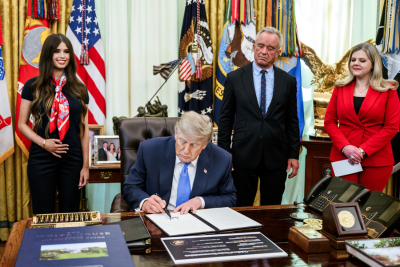
On Aug. 10, Trump signed the executive order aiming to overhaul childhood vaccination in the U.S. Couched in the language of “gold standard” science, but bypassing the Centers for Disease Control and Prevention’s typical process for recommending vaccines, the order attempts to reinstate earlier efforts by the administration to cut the number of universally recommended vaccines. The earlier changes to the vaccine schedule were blocked in court.
In addition to lowering the number of recommended vaccines and asking states to revise their immunization requirements for schools, the order also called for administering the MMR vaccine in separate shots, preferably giving all vaccines “at separate medical visits.”
“We want it in three separate vaccinations given at separate times,” Trump said of the MMR vaccine in remarks made when signing the order. “Together, there could be a possibility they’re quite lethal. And separately, it looks like they are not at all lethal, but just very effective.”
“It’s inconvenient, it’s five stops,” he said later, referring to multiple trips to the pediatrician. “But it’s something that I think will have a huge impact on autism.”
“The worst thing that would happen would be nothing happens. We’re not going to lose anything,” Trump said of splitting up the MMR vaccine. “At the same time, we could gain tremendously. We could save hundreds of thousands of lives, millions of lives.”
There is no evidence that splitting up the MMR vaccine, which has been in use for more than 40 years, would be safer, save lives or prevent cases of autism. Since a fraudulent scientific paper first proposed a connection between the vaccine and autism nearly 30 years ago, the MMR has been rigorously investigated for any link to the condition. No credible link has been found.
More broadly, the MMR is among the most well-studied vaccines on the planet, with far more data on its safety and effectiveness than any of the standalone vaccines. More than 800 million doses of the Merck MMR vaccine have been given in more than 75 countries as of 2021, with decades of post-marketing safety surveillance and clinical and population studies.
“To date, there has been no published scientific evidence that shows any benefit in separating the combination MMR vaccine into three individual shots,” a Merck spokesperson told us in a statement. “Use of the individual components of combination vaccines increases the number of injections for the individual and may result in delayed or missed immunizations.”
Merck’s combined MMR vaccine was first approved in the U.S. in 1971, not long after the individual vaccines were introduced in the 1960s. In 1978, the vaccine was updated to include a superior rubella component. The Food and Drug Administration approved a similar MMR vaccine made by GSK in 2022. That vaccine has been licensed in more than 100 countries, including all of Europe, and more than 800 million doses have been distributed, according to a company press release in 2022. GSK did not reply to our request for comment.
While health officials in the administration have frequently pointed to European countries as a model for U.S. vaccination policy, all exclusively use the combined MMR shot. No country in the world gives each of the three components separately as part of the childhood immunization schedule.
Some countries, mostly lower- and middle-income countries, use a measles and rubella combined shot rather than the MMR largely because it is cheaper, and not due to any safety concerns. Japan is one of the few, if not only, high-income countries to separate out the mumps vaccine. This policy stems from a safety concern with the mumps component that used a mumps strain that was never used in the U.S. (Autism rates did not decline when Japan stopped using the combined MMR vaccine.)
Moreover, as the executive order acknowledges, no U.S. vaccine manufacturer still makes the individual shots. Merck stopped in 2008 due to manufacturing constraints, and declined the following year to resume production.
“Today’s executive order is not based on ‘gold-standard science.’ There is no new evidence to justify significant changes to childhood immunization guidance. Dozens of studies involving millions of people show there is no link between vaccines and autism, and yet federal leaders continue to promote this outdated, disproven idea to scare families,” Dr. Andrew D. Racine, the president of the American Academy of Pediatrics , said in a statement. “The only purpose of this announcement is to sow confusion so that more people doubt the importance of vaccines. Delaying or skipping shots is risky, especially as measles continues to spread and children go back to school.”
“This executive order is part of a troubling pattern by the administration to attempt to unilaterally change vaccine guidance, particularly for children, rather than relying on the transparent, scientific review that has guided the U.S. childhood vaccine schedule for decades,” Dr. Jan K. Carney, the president of the American College of Physicians, said in a statement. “If implemented, the changes could increase costs to patients and families, including additional copays while also placing a greater burden on families needing to schedule multiple appointments for a multiple-dose MMR vaccine.”
The executive order does not give a scientific rationale for recommending that the MMR vaccine be broken up. Rather, it simply states that its recommendations “recognize” that the MMR vaccine “should be administered in three separate single-disease shots once such products are domestically available.” It directs Kennedy, through a task force, to “present plans” to Trump within 90 days to offer the single vaccines as options.
“President Trump is one of countless parents who have voiced questions and concerns about the combined MMR vaccine,” White House spokesman Kush Desai told us in an email when asked to explain the reasoning for splitting up the MMR and for evidence that the combination shot is a problem. “The Administration’s push to develop separate vaccinations for all three diseases will give parents more options on timing and frequency for their children, which ultimately will increase vaccination rates for all three diseases.”
Experts, however, fear that adding the option of separate MMR vaccinations will lower vaccination rates.
It remains to be seen how Trump’s executive order will play out.
“There’s not the force of law behind this,” Dr. Paul Offit, a pediatrician and vaccine expert at Children’s Hospital of Philadelphia, told us. “He’s asking states to consider implementing this. I think that it will be ignored because it should be ignored. It’s not a science-based recommendation.”
Autism Claims Come from Fraudulent 1998 Paper
As we’ve explained before, the notion that the MMR vaccine might be safer separated out goes back to a fraudulent research paper by the British physician Dr. Andrew Wakefield. In 1998, Wakefield published a case series of 12 children in the Lancet that proposed the MMR vaccine might cause autism.
The British journalist Brian Deer reported that in a press conference announcing the results, Wakefield recommended that the government stop using the combination MMR vaccine and switch to individual shots, given a year apart.
“I can’t support the continued use of these three vaccines given in combination until this issue has been resolved,” Wakefield said.
But the underlying data had been faked or misrepresented. Five of the 12 children had developmental problems prior to vaccination, and many did not even have an autism diagnosis. Prior to the study, Wakefield had been hired as a consultant by a lawyer who wanted to sue MMR manufacturers, and many of the kids in the study had been recruited by law firms or groups opposed to vaccination. The publication was later retracted. Wakefield, who has since lost his medical license, also did not disclose at the time that he had previously filed a patent on his own measles-only vaccine, which he alleged was “most probably safer.”
Fraud aside, the hypothesis that the MMR vaccine causes autism has now been formally tested repeatedly. In 2012, the Institute of Medicine, now the National Academy of Medicine, concluded that the evidence “favors rejection of a causal relationship between MMR vaccine and autism,” finding a “high degree of confidence in the epidemiologic evidence” of no connection and a lack of evidence of any mechanistic link.
Since then, even more studies have continued to support this conclusion. In 2019, a Danish study used population registry data to probe the link again, also looking to see whether there might be a link for higher-risk children. “The study strongly supports that MMR vaccination does not increase the risk for autism, does not trigger autism in susceptible children, and is not associated with clustering of autism cases after vaccination,” the study concluded.
Last month, a study looking at the electronic health records of 2.5 million American children also found no association between the MMR vaccine and autism when giving the first dose before the age of 2, as is recommended. The first dose is typically given between 12 and 15 months of age, with a second dose at 4 to 6 years of age.
“This is Groundhog Day 25 years later,” Offit said, of the idea that the MMR vaccine should be broken up.
False Allegation of Lethality
During the Q&A portion of the signing, a reporter asked Trump if there was any evidence for his comment that the MMR combination vaccine is “quite lethal.”
“What I’ve heard is that there are some people that say it is that way,” Trump said. “And I say, well, let’s say there’s a 5% chance of it.”
“Let’s split it up,” he continued, adding that when the MMR is given separately, “they” say “there is no impact. In fact, they’ve said how safe it seems to be. But I’ve heard when you put them together, they can be explosive.”
Regardless of what Trump might have heard, this is false. While serious side effects can occur, they are rare. And death from MMR vaccination is exceedingly rare.
“There have been no deaths shown to be related to the MMR vaccine in healthy people,” the Infectious Diseases Society of America website says. “There have been rare cases of deaths from vaccine side effects among children who are immune compromised, which is why it is recommended that they don’t get the vaccine.”
The concern for immunocompromised children is the measles component of the vaccine, which is a weakened but live virus. For almost everyone, this weakened virus poses no risk of death, in contrast to the virus that can circulate in an outbreak and sicken people. But on very rare occasions, if a child is severely immunocompromised, and doctors don’t realize it — or mistakenly still vaccinate against recommendations — it can prove fatal. A 2015 article by the CDC noted that there have been “at least six case reports of death among severely immunocompromised persons that have been linked to vaccine strain measles virus infection.” This exceptionally rare outcome, however, would still occur if children got a separate measles shot rather than the combination vaccine.
Anaphylaxis, a serious allergic reaction that can be life-threatening, can also occur with any vaccine, but these are extremely rare, and in many cases can be treated.
To be clear, a 5% chance of death would be astronomically high and easily detectable in both studies and surveillance. Trump’s claim that the combination MMR vaccine is “quite lethal” is false.
Negative Impacts from Splitting the Vaccine
Many experts disagree with Trump that the worst outcome of splitting up the MMR vaccine would be “nothing.” On the contrary, the main concern, assuming the shots were available, is that fewer people would get vaccinated, putting more people at risk for disease and leading to more outbreaks.
“We’re in the midst of a big measles epidemic. There are more cases of measles than we’ve seen in more than 30 years,” Offit said. Moving to a six-dose regimen, he said, would introduce chaos and confusion, and children would be less likely to get all their necessary vaccines. He called it “an incredibly irresponsible thing to do.”
University of Utah pharmacotherapy professor Joey Mattingly wrote in a Health Affairs perspective last month about using single-disease shots: “The available evidence on vaccination behavior and coverage favors retaining the combined formulation, and the same evidence suggests that moving to separate vaccines, whatever flexibility it might offer families, could make it harder to recover the coverage levels that population immunity requires,” referring to the decline in measles vaccination rates.
Offit said that first, the FDA would need to license the standalone vaccines. It remains to be seen whether any manufacturers would want to go through the process.
The Health Affairs article noted that doing so would require significant investment and clinical trials. “There is little commercial incentive to build a less convenient product to compete with a vaccine that already works,” Mattingly wrote. Clinics and pharmacies would then need to stock them, when it might not make financial sense to do so.
Moreover, just the suggestion that the MMR should be split — as Trump and other officials have now done — could discourage vaccination with the only available vaccine.
As Katrine Wallace, an epidemiologist at University of Illinois Chicago School of Public Health, wrote in STAT, “the government is directing the health system toward an alternative that is not licensed here — and asking parents to reconsider a familiar, highly effective combination vaccine in the process.”
Editor’s note: FactCheck.org does not accept advertising. We rely on grants and individual donations from people like you. Please consider a donation. Credit card donations may be made through our “Donate” page. If you prefer to give by check, send to: FactCheck.org, Annenberg Public Policy Center, P.O. Box 58100, Philadelphia, PA 19102.
The post Trump’s False MMR Vaccine Claims appeared first on FactCheck.org.