
With Trump, you have to ask: War crimes? Are you the 'crazy bastard'?
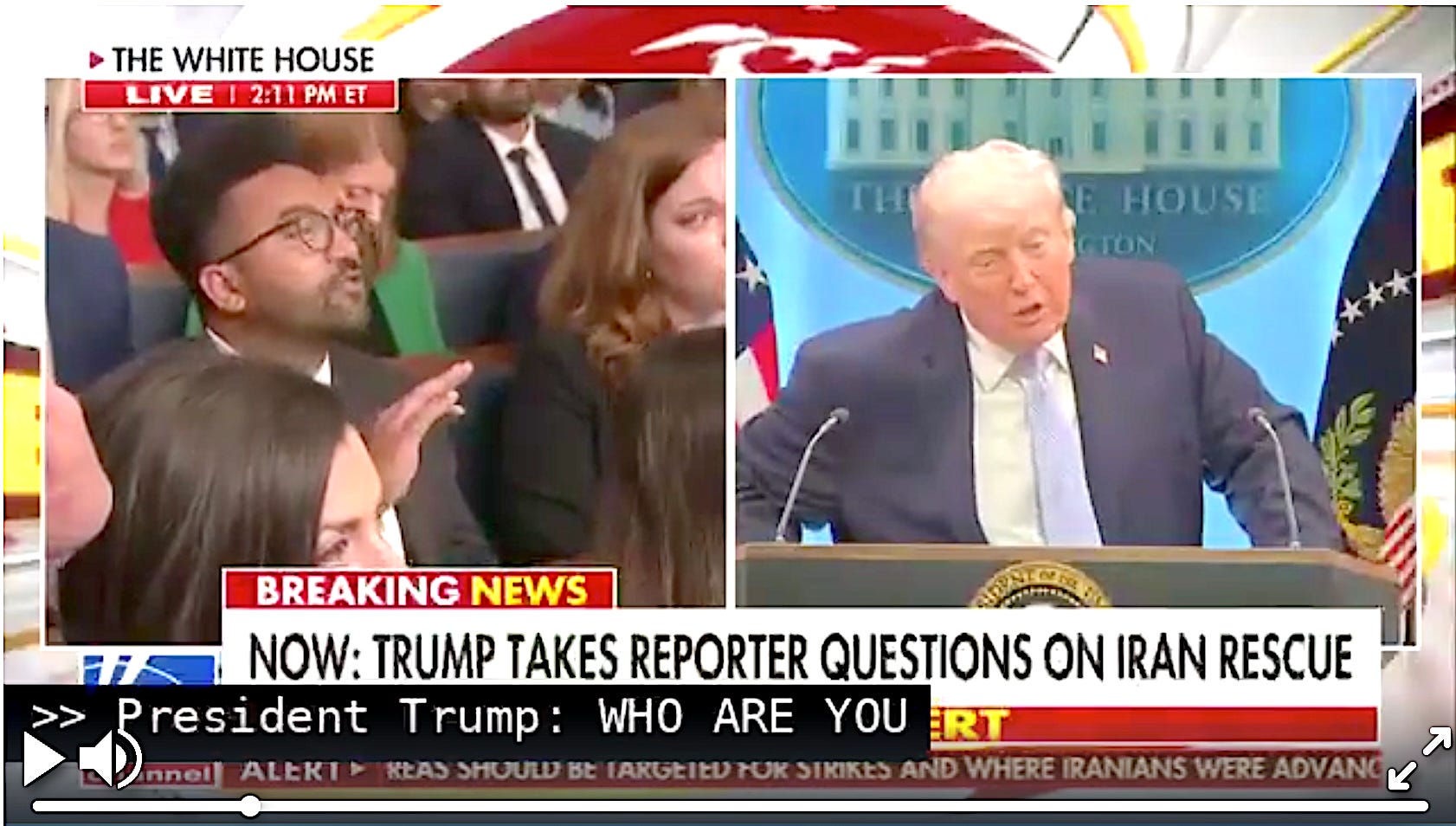
The day after President Trump posted his Easter message threatening to destroy all the power plans and bridges in Iran (“You crazy bastards… you’ll be living in Hell — JUST WATCH’!”), reporter Zolan Kanno-Youngs had a question for the president.
Thanking Trump for taking his question, Kanno-Youngs, a White House correspondent for The New York Times, said:
Deliberate attacks on civilian infrastructure violate the Geneva Conventions and international law —
He couldn’t get any further before Trump interrupted. The back and forth unfolded like this:
TRUMP: Who are you with? Who are you with?
KANNO-YOUNGS: I’m with The New York Times, Zolan from The New York Times.
TRUMP: Failing, failing! Circulation way down at The New York Times. What’s going on with that?
HOW TRUE: Stories & Strategies of Nailing Stuff Down is a reader-supported publication. To receive new posts and support my work, consider becoming a free or paid subscriber.
(For the record, The Times surpassed $2 billion in digital revenue for the first time last year and increased its total subscribers to 12.78 million (up from about 10.3 million at the end of 2023.)
Kanno-Youngs wisely refused to engage the president’s falsehood. Instead, he persisted:
KANNO-YOUNGS: Are you concerned that your threat to bomb power plants and bridges amount to war crimes?
TRUMP: No, not at all. No, no I’m not. I hope I don’t have to do it. But, again, I just said, 47 years they’ve been negotiating with these people. They’re great negotiators —
KANNO-YOUNGS: Why would that not violate international —
TRUMP: And because they’re not going to have a nuclear weapon. And if somebody that takes my place someday is weak and ineffective…
Trump’s attempts to divert and deflect continued. But Kanno-Youngs managed to focus attention on the war crimes issue. Trump, meanwhile, drew even more attention to it with his evasive blustering.
As Dan Froomkin noted in his Press Watch column, another good question from that same briefing came from Danny Kemp, White House correspondent for Agence France-Presse:
…In your Truth Social you called the Iranians crazy bastards… What is your response to critics who say it’s your mental health that should perhaps be examined as this war continues?
Trump responded by saying he doesn’t care about critics and that he hadn’t heard their assessment of his mental health. But point made.
Kanno-Youngs, who was a student in a journalism ethics class I taught as an adjunct at Northeastern University in 2015, declined comment on his exchange with the president.
In an email exchange, he told me:
I think it’s best for me to just let the reporting speak for itself and keep working.
For its part, The Times responded to Trump’s claims by pointing to his “pattern of answering fair questions with inaccurate attacks.”
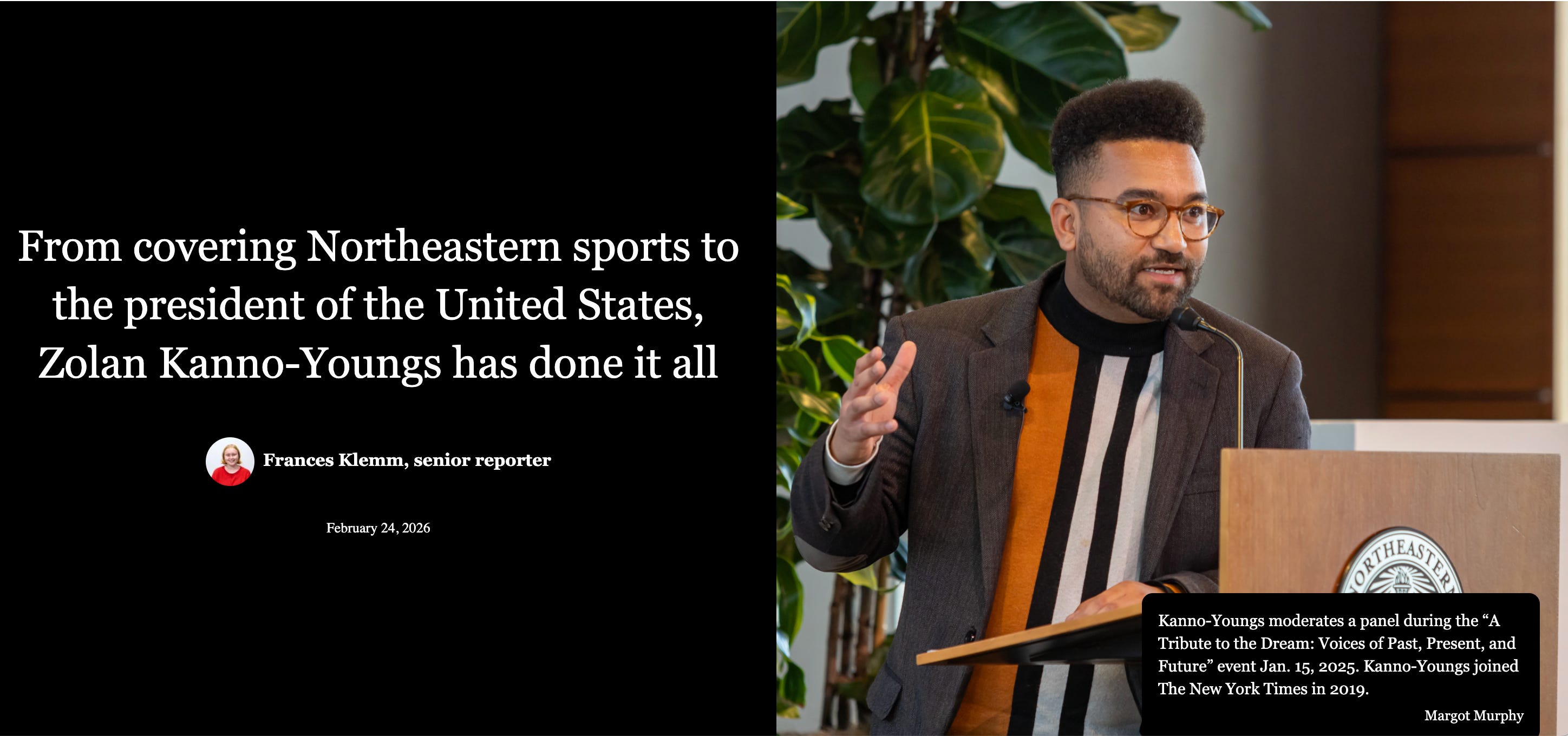
The student newspaper at Northeastern, the Huntington News, profiled Kanno-Youngs earlier this year.
Trump’s presidencies have prompted a range of proposed adjustments to the way journalists work, including the idea of a “truth sandwich” and a steady drumbeat of good suggestions from media critic Margaret Sullivan’s American Crisis Substack.
An early lesson in why it’s important to just Ask the Question!
It was nearly 50 years ago that I stumbled into a situation that made me a forever believer in the “Ask the question!” rule.
It was December 1980 and I was a brand new foreign correspondent, trying to find an angle on what was then the biggest question in the world: Would the Soviet Union invade Poland to suppress the burgeoning Solidarity movement?
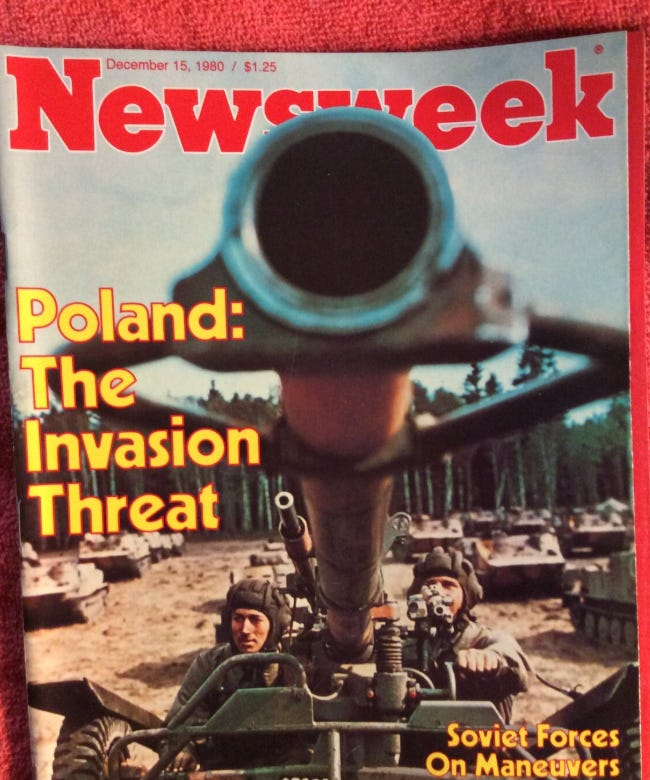
I recall pacing around the government press room in Warsaw, surrounded by veteran correspondents who could rely on sources they’d developed over decades to offer some insight as to what was likely to happen.
Brand new in the job, I had no sources. But I did have an idea. And a question.
I checked in with one of the new friends I’d made in Warsaw that week, Robert Strybel. Robert, who died last year in Warsaw, was a freelance journalist and interpreter who was born in Hamtramck, Mi. and whose languages included Russian as well as Polish.
In words along the lines of “Let’s go, Robert,” I told him: “We’re gonna ask the Soviets if they’re gonna invade.”
Robert told me I was crazy but probably figured, “Why not?”
We hopped in a taxi and Robert told the driver something like: “Zabierz nas do ambasady radzieckiej na Alejach Ujazdowskie.”
It was about a 15 minute drive to the Soviet Embassy on Ujazdowskie Avenue.
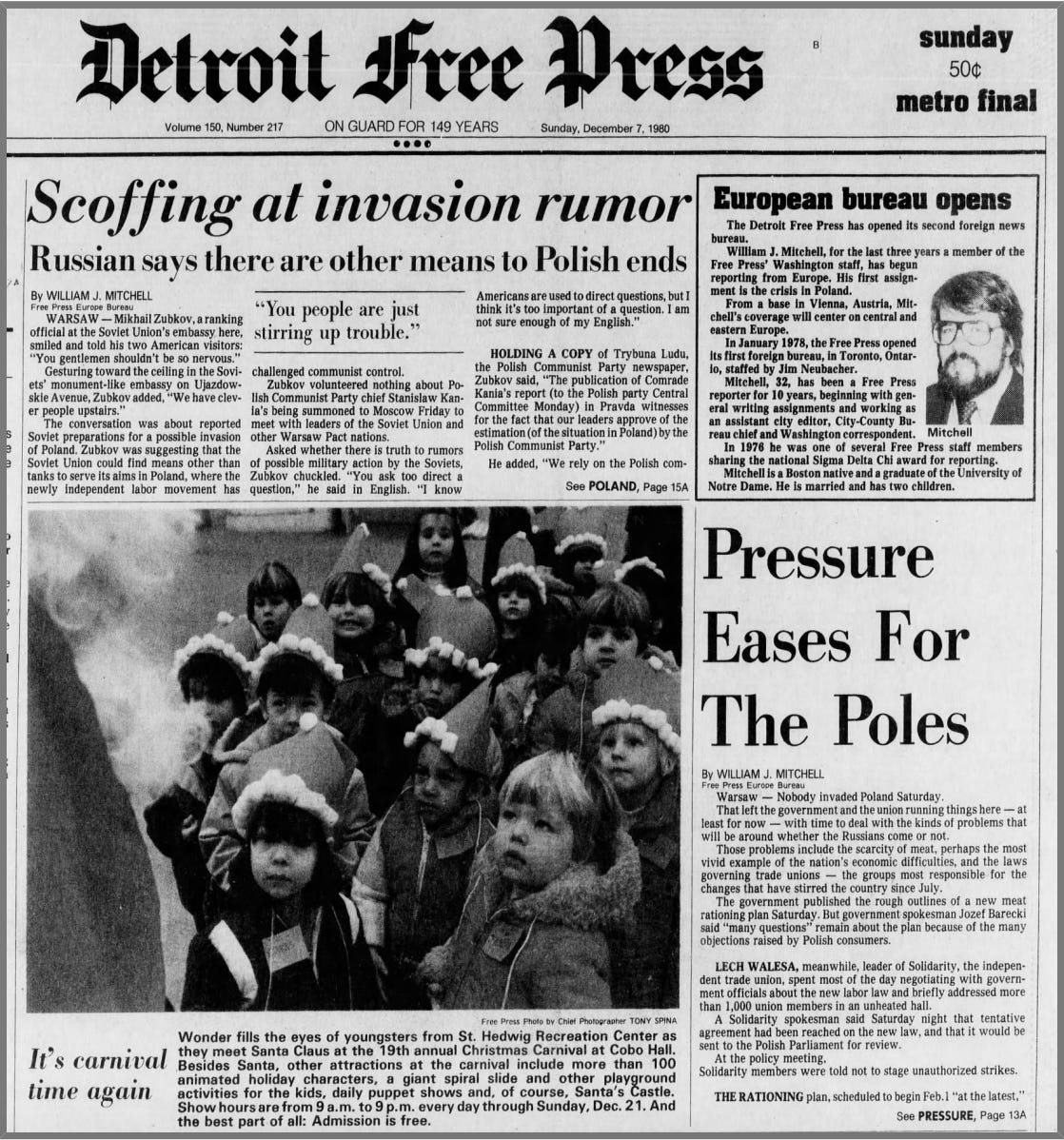
At the gates to the embassy grounds, I pushed the doorbell and a staffer asked what we wanted.
Speaking this time in Russian, Robert said something like: “Мы здесь, чтобы спросить, собираетесь ли вы вторгнуться в Польшу.”
Unaccustomed to visitors asking if the Russians were planning to invade Poland, the staffer asked Robert to repeat the question. After several minutes, the gate was buzzed open and we were invited to take a seat in the high-ceiling reception area of the embassy.
Within a few minutes, we were greeted by Mikhail Zubkov, a ranking official at the embassy.
A direct question yields an indirect answer that reveals plenty
“You ask too direct a question,” he told us before providing an indirect answer.
Gesturing toward the ceiling, he said: “We have clever people upstairs.”
He suggested that the Soviets had a variety of ways of dealing with the troublesome Poles.
Despite Robert’s offer to interpret from Russian to English, Zubkov insisted on speaking in English even though, as he put it, “I am not sure enough of my English” to speak in great detail.
But he made it clear that tanks rolling across the border was not necessarily at the top of the Soviets’ list of options.
The tanks never did roll. Instead, the Solidarity movement continued to grow until a year later when the Poles, no doubt at the Soviets’ insistence, arrested its leaders and imposed martial law.
In the meantime, though, a question that we had no reason to believe would yield a candid response had, in fact, pointed us pretty directly at the truth of the matter.
It never hurts to ask.
Related Knowledge Center: The White House vs. the press
Whether it’s the Des Moines Register’s publication of an unfavorable election poll, a routine edit of a 60 Minutes interview with Kamala Harris, or the Associated Press’s decision in its authoritative stylebook to continue to use “Gulf of Mexico,” Donald Trump and the White House have used executive authority and legal reprisals in an effort to punish and suppress press coverage that runs contrary to the administration’s preferred narratives.
Democracy and politics | Signalgate | The CBS submission | Voiceless America
Related Knowledge Center: Democracy and politics
News organizations are scrambling to find a coverage approach that adequately informs the American public about the country’s slide from democracy to authoritarian rule.
Related Knowledge Center: Information integrity
In an increasingly fractured media landscape, truth has been a casualty in the public discussion. Coverage has been warped by the business needs of struggling news organizations, and a significant segment of the public relies on bad-faith outlets that are little more than propagandists. While fact-checking has become routine, some organizations are exploring other ways to combat the trends. And misinformation spewed by AI-driven chatbots has become more of a feature than simply a bug.
Fact-checking and its detractors