
Trump just loves the revamped CBS. Here's the ugly backstory.
Last week, John Dickerson left the network where he had worked for many years. On his way out the door, he got a heartfelt standing ovation from his CBS News colleagues.
A well-respected, accomplished journalist, Dickerson certainly deserved the kudos. But I strongly suspect that the high emotion behind the newsroom’s applause was increased because of what has happened at CBS News in recent months. There’s a new editor in chief who leans way right. There’s a “bias monitor” (misleadingly called an ombudsman) to make sure outside claims of liberal slant are brought to the attention of top brass. And, of course, the network paid millions to settle a frivolous suit brought by Trump last year; and then, after Stephen Colbert called that settlement a “big, fat bribe,” the network cancelled his late night show, blaming it on poor ratings.
For longtime viewers and admirers of the “Tiffany Network,” it’s all been disturbing. CBS, after all, was the long-ago workplace of Edward R. Murrow and Walter Cronkite; and more recently of important reporting by the likes of Scott Pelley, Bill Whitaker and others on the flagship magazine show, 60 Minutes.
During his interview with Norah O’Donnell for that show this past Sunday night, Trump decided to play media critic. This part of his interview didn’t make the cut of what was shown on the broadcast, but it certainly is telling about the rightward leanings of new editor-in-chief Bari Weiss — and even more telling about the direction of the corporate ownership.
CBS News published the entire transcript, including Trump’s lies about the 2020 election, which also didn’t make the cut for broadcast. Here are the parts I’m pointing to:
“And actually ‘60 Minutes’ paid me a lot of money. And you don’t have to put this on, because I don’t wanna embarrass you, and I’m sure you’re not — you have a great — I think you have a great, new leader, frankly, who’s the young woman that’s leading your whole enterprise is a great — from what I know.
Also this highly inaccurate depiction of the supposed basis of his lawsuit: “But 60 Minutes was forced to pay me a lot of money because they took (Kamala Harris’s) answer out that was so bad it was election-changing, two nights before the election. And they put a new answer in. And they paid me a lot of money for that. You can’t have fake news. You’ve gotta have legit news.”
And this: “I think one of the best things to happen is this show and new ownership — CBS and new ownership. I think it’s the greatest thing that’s happened in a long time to a free and open and good press.”
Trump is clearly talking about David Ellison, the son of pro-Trump mega-billionaire Larry Ellison, the second-richest person on earth. The younger Ellison is now the chairman and CEO of Paramount Skydance, parent company of CBS, after a merger. David Ellison installed Bari Weiss as editor in chief. It’s instructive that as the likes of John Dickerson walk out the door, she is said to be recruiting Scott Jennings (who makes a living defending Trump on CNN), as well as Bret Baier of Fox News.
To Tom Cibrowski, president of CBS News, Dickerson “epitomizes the very best of journalism.” In the words of Joan Didion, goodbye to all that.
Meanwhile, Paramount Skydance may well be on its way to buying the company that runs CNN — and that too is part of Trump’s master plan to control the media and therefore control the message.
“We are moving down a dark path,” wrote Matt Gertz of Media Matters. Trump’s remarks about CBS “demonstrate his glee at putting the U.S. information ecosystem under the thumb of compliant and supportive oligarchs.” Ellison hopes to buy Warner Brothers Discovery and, writes Gertz, the Trump regime may “use state power to box out other bidders.” Federal regulators can do a lot in a situation like this, as we saw in the approval of the merger between Paramount and Skydance.
It’s sickening to watch this happen before our very eyes. And it has nothing to do with what Trump disingenuously called “a free and open and good press.” Quite the opposite.
American Crisis is a community-supported project where I explore how journalism can help save democracy. Please consider joining us!
Separately, last week I criticized the awful editorial at the Washington Post — another news organization that ain’t what it used to be — in defense of Trump’s destruction of the White House East Wing and his plans for an opulent ballroom. As if that weren’t bad enough, the original version of that editorial left out a rather salient fact: That Post owner Jeff Bezos’s Amazon is helping to fund the ballroom project — the billionaire’s latest effort to curry favor with Trump. My Columbia colleague Bill Grueskin got to the bottom of it, noting that the Amazon information was added, but that no record of its being added was appended to the editorial. Best practices would have made the editing change transparent, but we’re not really in best-practices territory here. We’re in “oops, maybe no one will notice” territory. This piece by David Bauder of the Associated Press notes that the “stealth edit” appeared after Grueskin inquired about the absence of any mention of Bezos.
And finally, you may recall the urging (including by me) before the presidential election that journalists should focus on “not the odds but the stakes.” In other words, not the horserace or the polls or the savvy interpretation of today’s campaign drama but Why It Matters. The elegant odds/stakes phrase came from Jay Rosen of New York University. The news media did some of that “stakes” reporting but not enough and not forcefully enough.
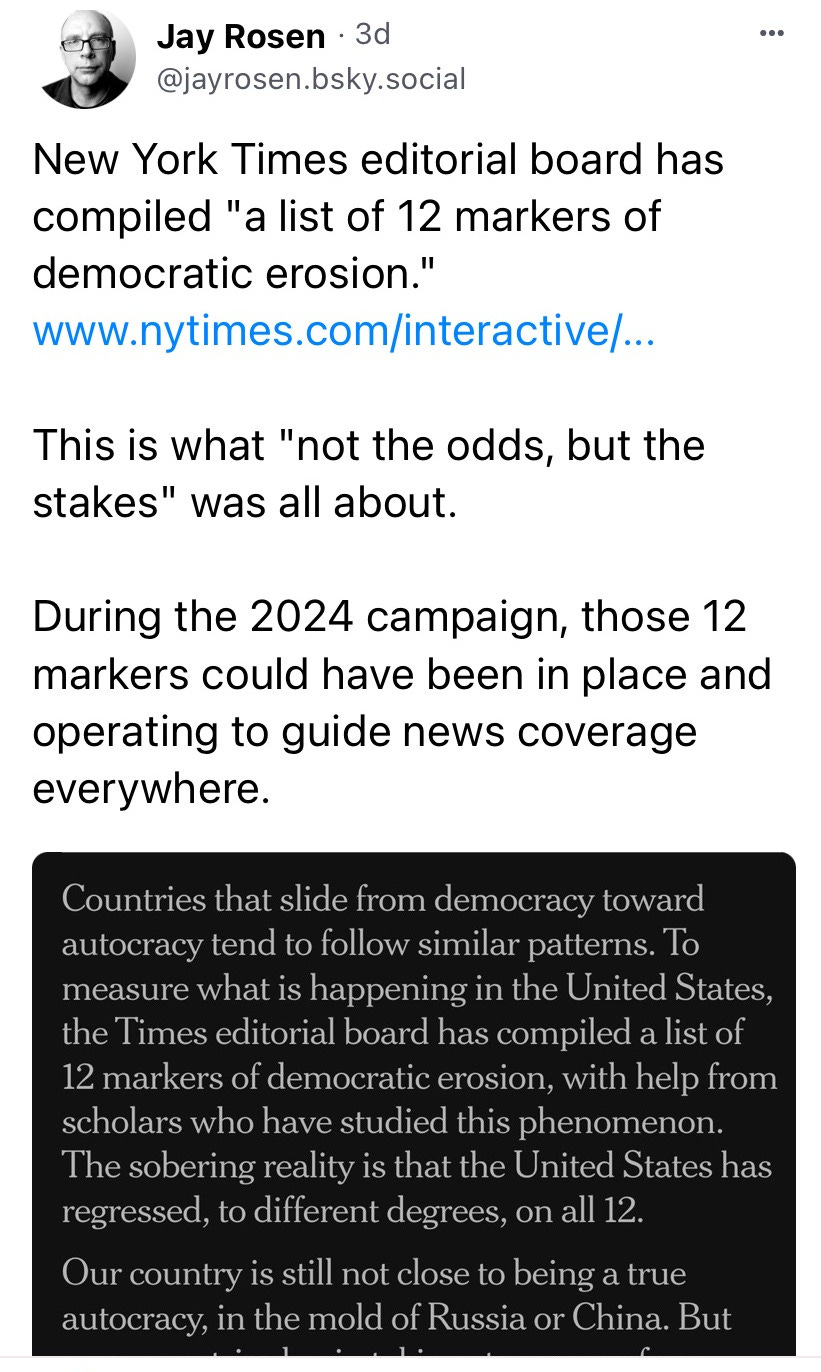
A few days ago, Rosen pointed out a piece in the New York Times that was an excellent example of focusing on the stakes: 12 markers of how democracy is eroding in the United States. Here’s a gift link.
But as Rosen commented, it illustrates an “opportunity lost” for a moment when it might have mattered more. “During the 2024 campaign, those 12 markers could have been in place and operating to guide news coverage everywhere,” he wrote.
Readers, I realize this is all pretty negative. But I think it’s important to point out these concerns and failures, and I know you think it is, too. There is good stuff happening out in media land, too, and I’ll be pointing those things out, too.
Meanwhile, be sure to vote today if you haven’t already. Please tell me about your voting experience and the media you saw leading up to it. Here in New York City, we await the results of the mayoral election, which could make some very interesting history. I wrote in the Guardian this week about why Zohran Mamdani appears poised for a huge win.
Thank you very much for supporting this effort with your attention, your comments and your subscriptions. All of these mean a lot.
Beneath this reader comment about why she became a paid subscriber (the paywall remains down), is some information to the very welcome newcomers about who I am and what I’m trying to do here.
My background: I am a Lackawanna, NY native who started my career as a summer intern at the Buffalo News, my hometown daily. After years as a reporter and editor, I was named the paper’s first woman editor in chief in 1999, and ran the 200-person newsroom for almost 13 years. Starting in 2012, I served as the first woman “public editor” of the New York Times — an internal media critic and reader representative — and later was the media columnist for the Washington Post. These days, I write here on Substack, as well as for the Guardian US, and teach an ethics course at Columbia Journalism School. I’ve also written two books and won a few awards, including three for defending First Amendment principles.
The purpose of ‘American Crisis’: My aim is to use this newsletter (it started as a podcast in 2023) to push for the kind of journalism we need for our democracy to function — journalism that is accurate, fair, mission-driven and public-spirited. That means that I point out the media’s flaws and failures when necessary.
What I ask of you: Last fall, I removed the paywall so that everyone could read and comment. I thought it was important in this dire moment and might be helpful. If you are able to subscribe at $50 a year or $8 a month, or upgrade your unpaid subscription, that will help to support this venture — and keep it going for all. Thank you!