
A Timely Reminder to Choose Our Words Carefully
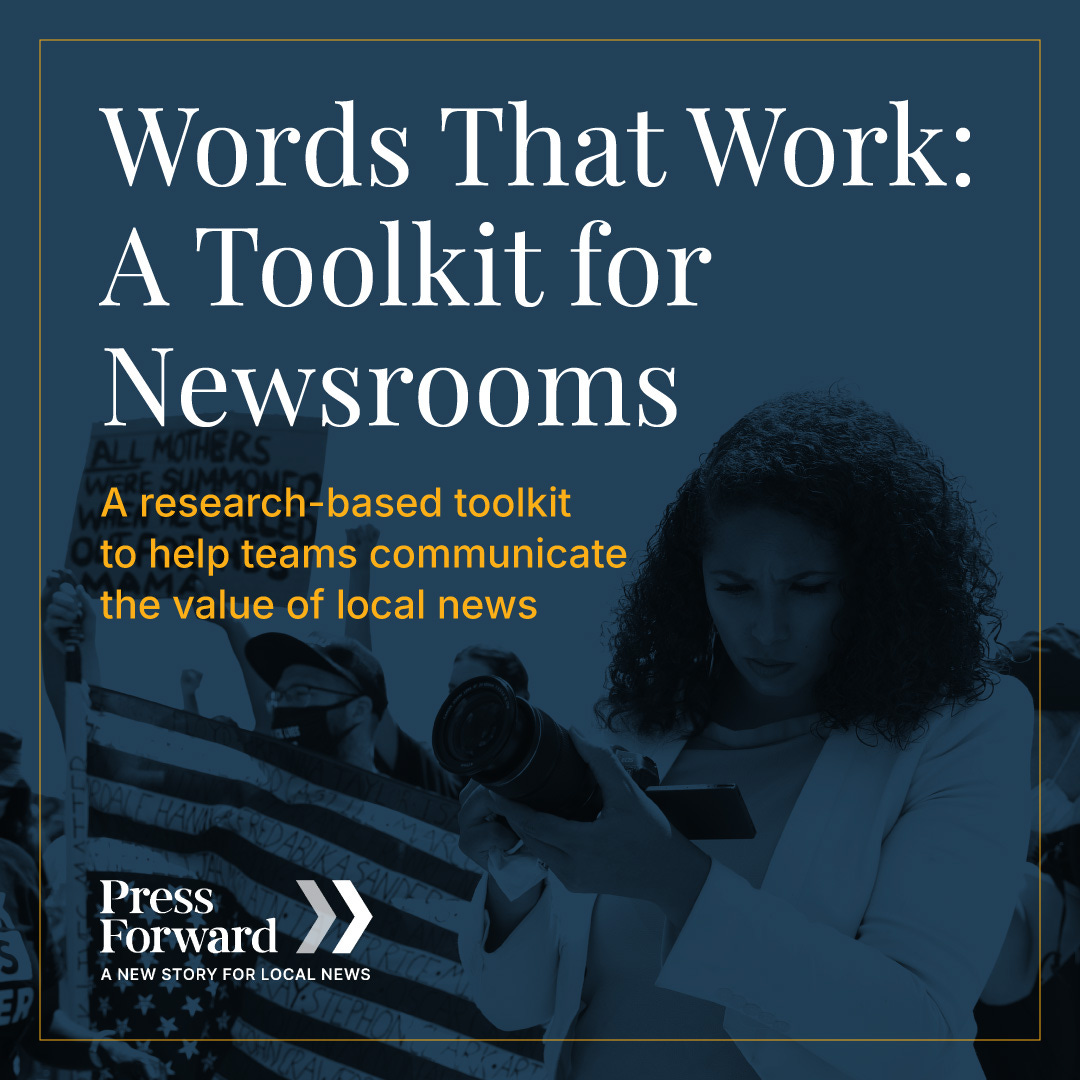
In our time, the phrase “poll-tested” when applied to messaging has both positive and pejorative meanings: It can convey “scientific” and effective, but also opportunistic and pandering. New “Words That Work” “toolkits” for how to talk about local news from Press Forward, released earlier this month, are all of these things, and this week I want to talk about some of the implications for our industry.
We should begin with some of the highlights from the toolkits—one for newsrooms and another for funders—based on a survey in April of more than 3000 adults, follow-up interviews and focus groups and message testing with more than 5000 people. (A webinar reviewing the findings is here.) Those suggested learnings include:
- Press Forward concludes that “journalism” and “democracy” are among the words you don’t want to use. Journalism “tests poorly” and is “often associated with bias, opinion or national politics.” For democracy, “years of political messaging have created fatigue,” except among self-described progressives. (Democracy Dies from Overuse.)
- The surveys indicate that more than 80% of Americans believe that they can easily find local news. Since Press Forward was created in response to an ostensible crisis in local news, it hastens to tell us that this “perception doesn’t match reality.” (This seems to be the only point, at least from my reading, on which the toolkits argue with the results they report.)
- There is broad interest in local news, although markedly less among those under 30. Perhaps they are less rooted in their communities; perhaps this is a more ominous harbinger of future demand.
- That said, “local” is better than “community.” Taking a scythe to many of the appeals I see, other words and phrases to avoid include “marginalized,” “storytelling,” “nonpartisan,” “objective,” “unbiased,” “civic,” “news deserts,” “watchdog” and “healthy”/”unhealthy.”
- Before you entirely despair, there are a few words we are encouraged to employ: “accountability,” “fact-based,” “independent” and “solutions.” “News” is the preferred substitute for “journalism.”
- Crises are seen as an opportunity for local news to shine. But the business crisis of the press itself is a turnoff—it “makes audiences feel hopeless.”
What to make of all of this? First, I actually don’t want to quarrel with the results. The methodology seems to have been careful, and the samples large. Marketers will want to take this work seriously. One exception: the toolkits report which local issues people nationally are most interested in. I am not even passing along these results, because they seem to me to miss the point that salient issues vary enormously from locality to locality, and over relatively short periods of time. Right now, for instance, with campaigns underway, New York City residents seem focused on inequality, New Jerseyans on electric utility rates and Virginians on abortion.
There are important warnings in this work for those of us in, ahem, journalism. Among them: the familiar theme (at least here) that we have made a colossal mistake in so blurring the line between news and opinion that readers, viewers and listeners are increasingly confusing the latter for the former.
Taking potential bad news seriously
Next, we need to reckon more seriously than do these toolkits with the satisfaction reported with the current availability of local news. For a few years now, a lot of us have taken a sort of paradoxical comfort from indications that many people do not understand how much the economics of local news have deteriorated. We have reassured ourselves that when they become aware of how bad things really are, they will be more widely willing to offer support. I still hope that is true.
But what if the lack of awareness of the problem stems from not seeing it as a problem in the first place? That is, what if the demand to replace the local news that we have lost is just not as great as we would wish? Or, to put it more positively, what we can do to make the additional local news we aspire to provide more salient in the lives of our audiences?
Don’t surrender core values
Finally, while, as indicated above, I do think we need to weigh these findings carefully in crafting our messaging, I hope we won’t merely accept them as unmovable. Just as people across the political spectrum have long understood that you cannot surrender the symbol of the American flag to the opposition, I hope we redouble our efforts to keep— or restore— especially journalism and democracy to the pantheon of national values.
Having said that, perhaps the phrase “the press” should be our preference these days—it is, after all, the one that appears in the Constitution. Similarly, maybe it’s time to remind people that while neither the Declaration of Independence nor the Constitution use the word “democracy,” the Constitution twice guarantees to the people a “republican form of government,” that is, a system for representatives of the people to secure the “consent of the governed” against despotism and tyranny. For that consent to be informed, the press is, after all, indispensable.
Second Rough Draft will be on vacation the next two weeks. See you soon.
Thanks for reading Second Rough Draft! Subscribe for free.
Related Knowledge Center: Inside the newsroom
As newsrooms struggle with rickety business models and precarious finances — as well as new technologies — they are deploying an array of editorial responses.
The Times and its critics | Washington Post mortem