
Time for Some Ground Rules for AI and Writing
There seems to be an increasing amount of heat, and precious little light, surrounding the issue of using AI to write. This week, I want to see if we can get past that, and begin to move toward a set of workable ground rules, for journalism and beyond.
First, some examples of the sorts of things that are happening in the absence of such ground rules:
- The Financial Times appended a note to a piece by a Harvard Kennedy School professor because he had broken its rules by using AI to condense his own work. Violating a publication’s rules (assuming you know them) is surely bad, but does a rule forbidding using AI to condense something you have written yourself really make sense? Microsoft Word has long challenged some sentence structures. Should heeding it have been barred? If not, what’s the difference?
- A group of authors a year ago advocated that AI be banned not only from the writing of books but also from any use in their copy editing, design of their text or covers or narration of audiobooks. Does this mean that those news sites that have added AI-based audio narration options for stories are committing an unpardonable sin? Is the line between using spell-check and global find-and-replace and having a machine do an initial copy edit as clear to you as it is to these authors? It’s not to me.
- If we are going to seek to ban books created by AI, how do we feel about the corporate earnings or sports game-stories or bullet point summaries that are increasingly generated the same way? Even putting aside the serious First Amendment issues (book bans ought to be disfavored) and critical economic questions (who’s going to pay for the additional cost of returning to human writers for stories machines do perfectly well?), don’t we need to make some distinctions here?
- Just this week, a powerful op-ed in the Wall Street Journal about Treasury Secretary Bessent’s recent misadventure in the bond market, bylined by Bessent mentor and investing legend Stanley Druckenmiller, was revealed to have been written with AI. Many journalists instinctively recoiled, but the Journal editorial page defended what they published, and as you will see below, I think they were mostly right to do so. (Also, Druckenmiller isn’t the only op-ed contributor using AI.)
Before we dive into the ground rules, let me set out where I come from on these questions. I have never used AI to write anything, but then again I like to think of myself as a writer. Most people don’t. I have experimented with AI as an editor a few times and mostly not liked (or used) the results, and I don’t use it regularly for this purpose. Its effect on writing mostly strikes me as similar to drugs that flatten people’s affect, which is not what I am seeking in my writing.
But I do use AI for illustrations (where I have a need, and no talent or budget), and also for research.
A reminder on how it helps, and why that matters
Let’s talk about research for a minute. I was recently writing about why I think we need, after two bad experiences in five years, to change the Constitution to prevent having more octogenarian presidents, and it got me to thinking about the order of presidential succession. Did you know that if a bomb exploded during one of Speaker Mike Johnson’s visits to Trump and Vance, Chuck Grassley, soon to be 92, would be President of the United States for the next two and half years? AI enabled me to determine, in just a couple of minutes, that presidents pro tempore of the Senate (the office that Grassley holds, by dint of seniority) have been elderly for all but eight of the last 45 years. That’s a pretty strong case, I think, for changing an important law, and instead placing the Senate majority leader in the line of succession. Just five years ago, before chatGPT, determining the underlying facts would have taken hours.
Moreover, I am old enough to remember life before Wikipedia, when the same research might have taken days, and been impossible for many people without access to an unusually good library. It is way too easy to forget how much we have benefitted from the democratization of information, even as it’s important to remember the costs. Twenty years ago, the same impulses rampant today led some people to forego using Wikipedia as a tool. Even now, I can’t bring myself to link to the site, despite knowing it’s frequently the best accessible source on historical facts. Do we want to inculcate more such silliness?
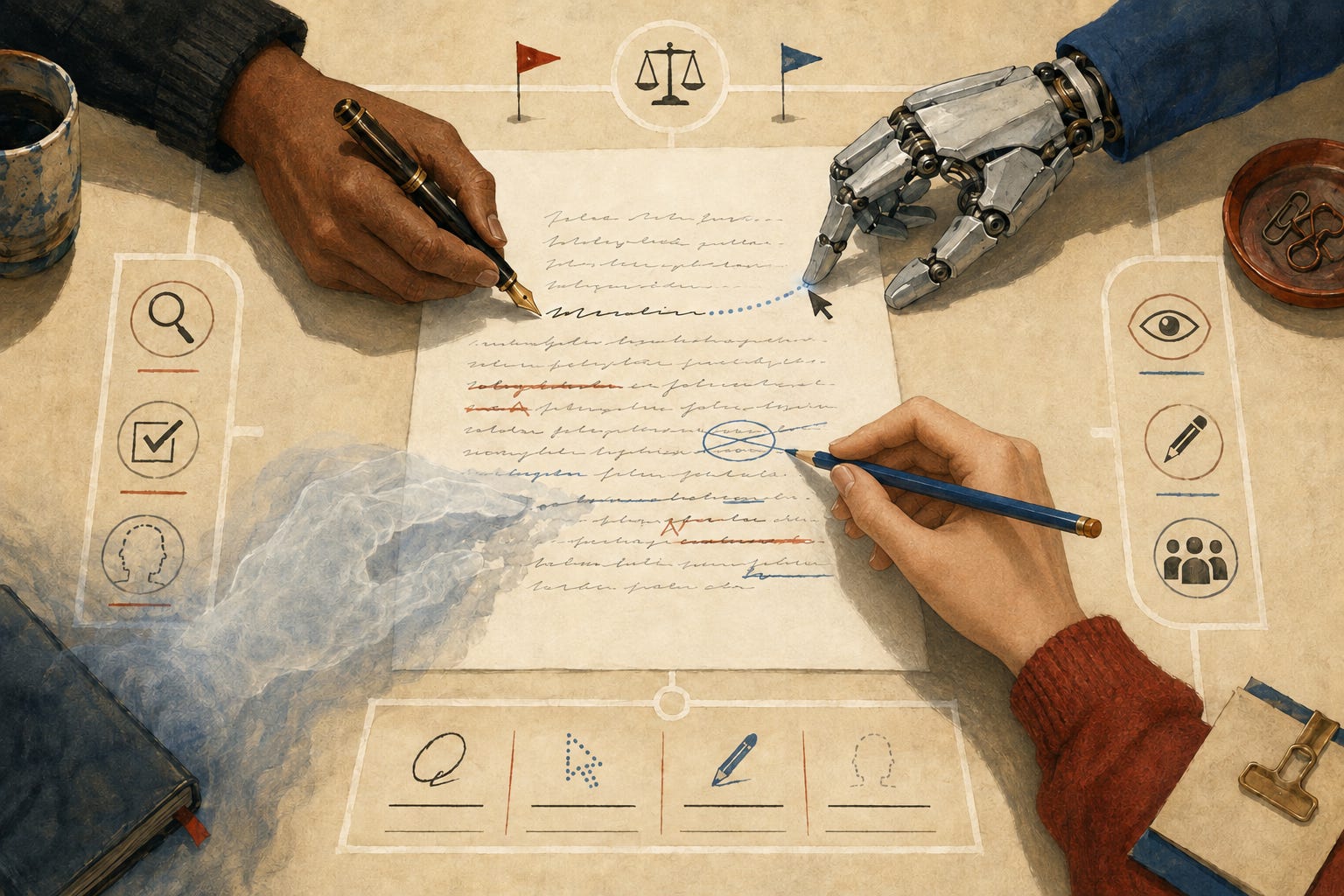
Now to those ground rules. Like almost all solid practices in journalism, transparency is the place to start. That means that using AI to compose a piece of writing should be fine so long as you disclose it. In a published piece of journalism, I would suggest something simple, such as “By chatGPT.” If a human mixes their own work with that of a machine, it could be “By Susie Smith and Claude.” Or vice versa if the machine was the principal author.
If you don’t want to read (or publish) pieces composed this way, that’s your prerogative. If you don’t want to read publications that use such material, ditto. The same would go for books, and even entire publishing houses or bookstores. The market for written information will adapt to people’s evolving preferences on this, as it should, and right now the market signal may be flashing yellow or even red on most such uses in journalism and books. If you don’t want to exclude machine-generated content from your own reading diet, that seems to me as much your choice as whether to eat ultra-processed food. (Also, the rest of us are equally allowed to judge you for it.)
What else needs to change
Let’s also admit that not all pre-AI work was conducted up to the standard I am suggesting. It should have been, and still should be. Those earnings and sports game-stories and bullet point summaries should have bylines revised to meet these standards. But so should ghostwritten books and articles. Surely, it makes no sense to say that help from a machine cannot be concealed but help from a human can be. The person who deserves the disclosure is the reader.
Does this mean that using AI to edit something you write must be disclosed? Here, I would be inclined to distinguish between substantive editing and copy editing. I know that’s more nearly a continuum than a dichotomy, but I also know most journalists believe they can characterize given work as one or the other. Copy editing, I would submit, need not be disclosed. Substantive editing should be. Condensing? Merely for space, it need not be disclosed, while to alter the substance conveyed, again, it should be.
But now let’s also concede that this is not how we have approached the editing and writing process in journalism generally, and maybe that needs to change as well. Perhaps editors who write entire chunks of stories, rather than asking authors to rewrite, even along specified lines, should start getting byline credit. Again, I think it would be hard to explain to a non-journalist how words written by a machine must be disclosed, but it’s fine to pretend authorship when a human editor does a thoroughgoing writethrough. And again, it’s the perception of readers on which we should be focusing.
Op-eds, or, more generically, opinion pieces signed by a non-staff member and published by a third party, present something of a special case. Many of these, over the years, have been written for rather than by the signatory, with no disclosure. (Think of pieces with the bylines of public officials, including presidents, or CEOs, few of whom are thought of as writers.) Readers likely understand roughly how this works, and thus disclosure seems less compelling, including for the use of AI in composition. Editors who publish op-eds, however, do have a responsibility for knowing who or what has done the writing, and for ensuring that the signatory stands behind every word.
Finally, we come to research. I’m sorry if this offends some people, but swearing off AI for research already feels like Luddism to me. I think the same will soon be true for copyediting, and some forms of illustration, and perhaps more down the road. I do not gainsay the human costs of this, and I think our society needs to grapple with that more forthrightly. Once again, as with the first digital revolution, profound things are changing, and we need to adapt our standards accordingly, while preserving our values.
Second Rough Draft paid subscribers support nonprofit journalism. To receive new posts, become a free or paid subscriber.