
Three lessons in unethical media behavior
I teach the required ethics course at Columbia Journalism School, and I normally spend a lot of time telling my graduate students that there’s quite a bit of gray area in this topic. Often, clear answers aren’t obvious.
Some things are obvious. We know not to lie or plagiarize or fabricate, of course, but what about the murkier issues? To name a few:
How should news organizations decide whether to publish hacked information?
If a source is vulnerable — for example, an undocumented immigrant — to what extent do reporters need to protect them even if they agree to be on the record?
Is misrepresenting yourself, as in undercover reporting, ever justified? When?
If you attend an event that’s generally understood to be off the record, but you haven’t formally agreed, can you ethically report what happens there?
We talk about all of that, and look back on real-life situations that are still debated years later.
But after the past two weeks of the news, some things were crystal clear.
Situations involving the best-selling author Michael Wolff, a former New York Times reporter named Landon Thomas Jr., and political writer Olivia Nuzzi certainly made my teaching job easier.
Don’t ever do that, I advised them after the startling emails between Michael Wolff and Jeffrey Epstein, in which the author and reporter seemed to be coaching the sexual offender on how to manipulate Donald Trump and preserve his own image.
Don’t ever do that, I told them, when more details of Olivia Nuzzi’s wildly inappropriate relationship with Robert F. Kennedy Jr. were revealed. (According to her ex-fiance Ryan Lizza, Nuzzi also was involved with former South Carolina governor Mark Sanford, whom she had written about.)
And don’t hit up a source for charitable donations, as Landon Thomas Jr. did while at the New York Times. He left the Times after that came out, years ago, but now we know (from the released emails) that he also had potentially incriminating information about Jeffrey Epstein; we don’t know whether he sat on it, gave it to his editors or what. The Times should be a lot more forthcoming about this than they have been.
What ties these situations together is the utter lack of critical distance from sources on the part of these writers. The other thing that ties them together is the apparent disregard for the primary journalistic mission of representing the public.
One of the best investigative reporters I know, Pulitzer Prize-winner James Risen, wrote to me about Landon Thomas, after the Epstein emails raised serious questions about that reporter-source relationship.
“This raises so many questions,” Risen told me. “Did this guy tell his editors he might have stuff on Trump and Epstein? What did they do about it? Did they ignore it?”
We may never know. The Times has said very little so far, despite being pressed. After the Intercept and other news organizations asked these kinds of questions, their spokeswoman declined to get into it, only noting that Thomas left the Times years ago. He departed in 2019 after he revealed to his editors that he had solicited charitable donations from Jeffrey Epstein; the Times put out a statement back then saying his solicitation was “a clear violation” of their ethics policy. But what about all he knew about Epstein and about Epstein’s dealings with Donald Trump? (“Would you like to see photos of donald and girls in bikinis in my kitchen?” Epstein asked Thomas in one recently released email.)
“Journalism’s week of shame,” was how former Times editor Jill Abramson, writing in the Boston Globe, aptly grouped these three cases. It’s no wonder, as she notes, that the public has such low trust in the news media, given this kind of behavior. And that’s too bad because most journalists would never consider doing any of this stuff. Most journalists I know are just as disgusted as I am. And I’m confident my students will avoid these pitfalls, too.
American Crisis is a community-supported project where I explore how journalism can help save democracy. Please consider joining us!
On a far more inspiring note, I’ll mention three examples that represent the direct opposite of these failures.
I’m sure many of you have already read the New Yorker essay by former Times reporter Tatiana Schlossberg about her extremely serious health problems in the form of leukemia and, not incidentally, her righteous anger at her cousin, RFK Jr. Hers is an incredibly moving and sad piece that’s well worth your time. It was published on Nov. 22, the anniversary of the 1963 assassination of her grandfather — President John F. Kennedy. The beautifully written piece rings with clarity, morality and decency, and gives journalists a good name.
Similarly, I want to commend to you coverage in Gateway Journalism Review of a great talk by former Washington Post executive editor Martin Baron. In his recent St. Louis speech, Baron said he’s no longer confident that the rule of law will prevail or that a free press will endure. Sounds depressing, but he offers five reasons for optimism, and he calls the press to its highest purpose.
“Vigilance of public officials is, above all, the task democracy imposes on every journalist,” he said. “It is a mission we can never forsake.”
And finally, I was delighted to see longtime media lawyer and free-press defender David McCraw of the New York Times recognized at the annual benefit for the Committee to Protect Journalists. In his acceptance speech (you can read it here), McCraw urged the many hundreds of journalists in the room not to engage in “anticipatory obedience,” which, as historian Timothy Snyder has counseled, only teaches those in power what they can get away with.
“Now is not the time to pull back,” McCraw said. “There’s work to be done.”
Readers, thanks for being here. There’s no democracy without a functioning press, and these egregious examples of bad behavior shouldn’t deter those of us who want to do it right.
One other note: I wrote for the GuardianUS this week on Trump’s “quiet, piggy” moment, berating a Bloomberg News reporter. I must say that, while it was far from the most important thing that happened last week, it made my blood boil.
I would love to hear your views on any or all of this — the good, the bad and the ugly. Have a great Thanksgiving holiday. Please know that I’m deeply grateful for all of you, for your support and your participation.
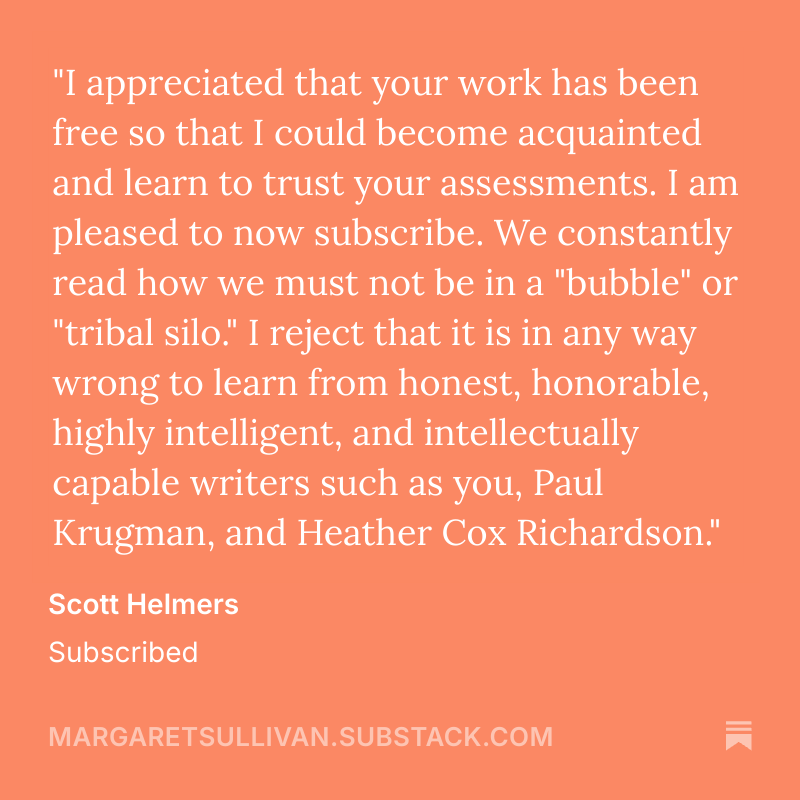
Here is why one American Crisis reader decided last week to become a paid subscriber:
My background: I am a Lackawanna, NY native who started my career as a summer intern at the Buffalo News, my hometown daily. After years as a reporter and editor, I was named the paper’s first woman editor in chief in 1999, and ran the 200-person newsroom for almost 13 years. Starting in 2012, I served as the first woman “public editor” of the New York Times — an internal media critic and reader representative — and later was the media columnist for the Washington Post. These days, I write here on Substack, as well as for the Guardian US, and teach an ethics course at Columbia Journalism School. I’ve also written two books and won a few awards, including three for defending First Amendment principles.
The purpose of ‘American Crisis’: My aim is to use this newsletter (it started as a podcast in 2023) to push for the kind of journalism we need for our democracy to function — journalism that is accurate, fair, mission-driven and public-spirited. That means that I point out the media’s flaws and failures when necessary.
What I ask of you: Last fall, I removed the paywall so that everyone could read and comment. I thought it was important in this dire moment and might be helpful. If you are able to subscribe at $50 a year or $8 a month, or upgrade your unpaid subscription, that will help to support this venture — and keep it going for all. Thank you!