
Thousands of Mysterious Blue Creatures Wash Up on Bay Area Beaches After Warmer Winters
Speyer said he had heard of these sightings occasionally but had never seen them for himself, especially in these amounts. “The trippy part was that so many of them had washed ashore. I’ve never seen something like that before,” Speyer continued.
These translucent organisms, related to the Portuguese man o’ war — a species of siphonophore closely related to jellyfish — use their small, stiff sails to ride the ocean waves. Unlike their venomous relatives, V. velella stings are relatively mild, according to Steven Haddock, a senior scientist at Monterey Bay Aquarium Research Institute.
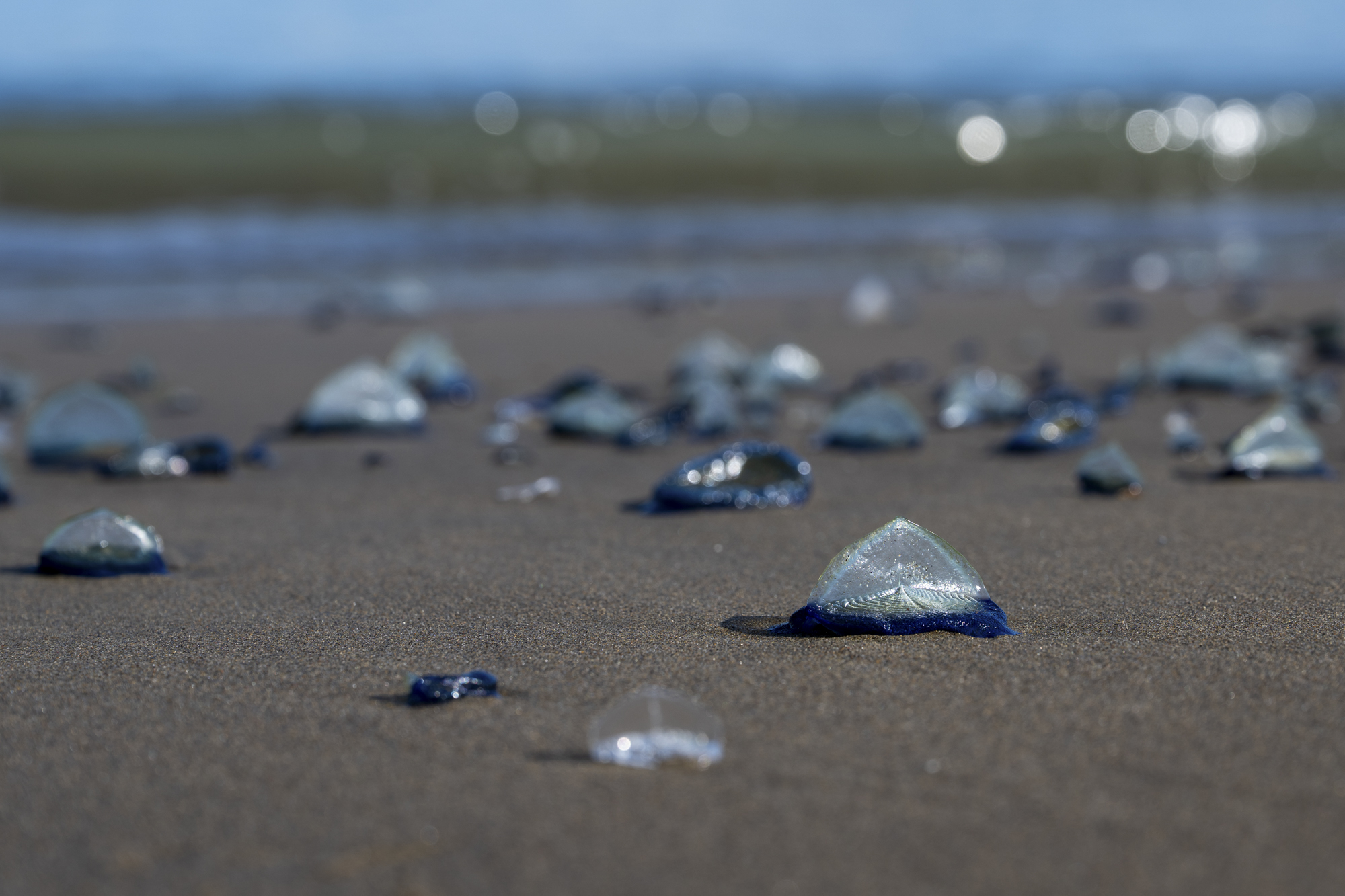
When beachgoers see them on the shore, they’ve usually been washed up and have dried out, turning them even more translucent. But when they’re alive, the V. velella is a bright blue, purple or indigo. “They’re beautiful when they’re alive,” Haddock told KQED in 2023.
They mainly feed on plankton, including tiny fish larvae and zooplankton, by using their tentacle-like polyps, which dangle beneath their floating bodies, to capture prey. These polyps contain special cells called nematocysts that help them break down their food before digesting them.
V. velella are most commonly found on Northern California beaches in spring or early summer, according to Raphael Kudela, professor of ocean science at UC Santa Cruz.