
Thinking About the Fragility of a Free Press
Welcome to Second Rough Draft, a newsletter about journalism in our time, how it (often its business) is evolving, and the challenges it faces.
We live in what many of us understand is a dangerous moment for press freedom. Our own country’s government is as hostile to independent journalism as it has been in more than two centuries—at the very moment that the business of journalism is in its toughest shape in modern times. There is lots of speculation, some of it off-target, but not all—of a loss of trust in our work. But this week I want to talk about a deeper problem, one that may lie close to the root of these others.
What values are really shared?
The problem can be summed up this way: We often assume in our rhetoric, and I think in our daily lives, that the value of a free press enshrined in the Constitution’s First Amendment is, or until very recently was, a universal value. For some segments of our society, especially those who feel generally secure in their lives, that is probably true. But for many of our fellow citizens, it is not true, and may never have been.
I was starkly reminded of this last week by a piece written by Vanderbilt’s John Sides, one of the nation’s leading political scientists. Sides is publisher and editor-in-chief of the website Good Authority, which brings current political science to a general audience. (Good Authority is a successor to The Monkey Cage, of which Sides was co-founder. The Monkey Cage which launched in 2007, was published at the Washington Post for nine years, roughly the same period of that paper’s now-aborted revival.)
Sides’s recent column focused on a 2025 study posing hard questions to Americans: If they had to choose between various sorts of freedoms, which would they pick? The data is sobering: most would choose both a guarantee of income and services (arguably a priority of the left) or low crime (often a stated objective of the right) over free expression. The choice of income and services is strongly bipartisan; Democrats prefer low crime over free expression by only the narrowest of margins. Here is a clear graphic of the results:
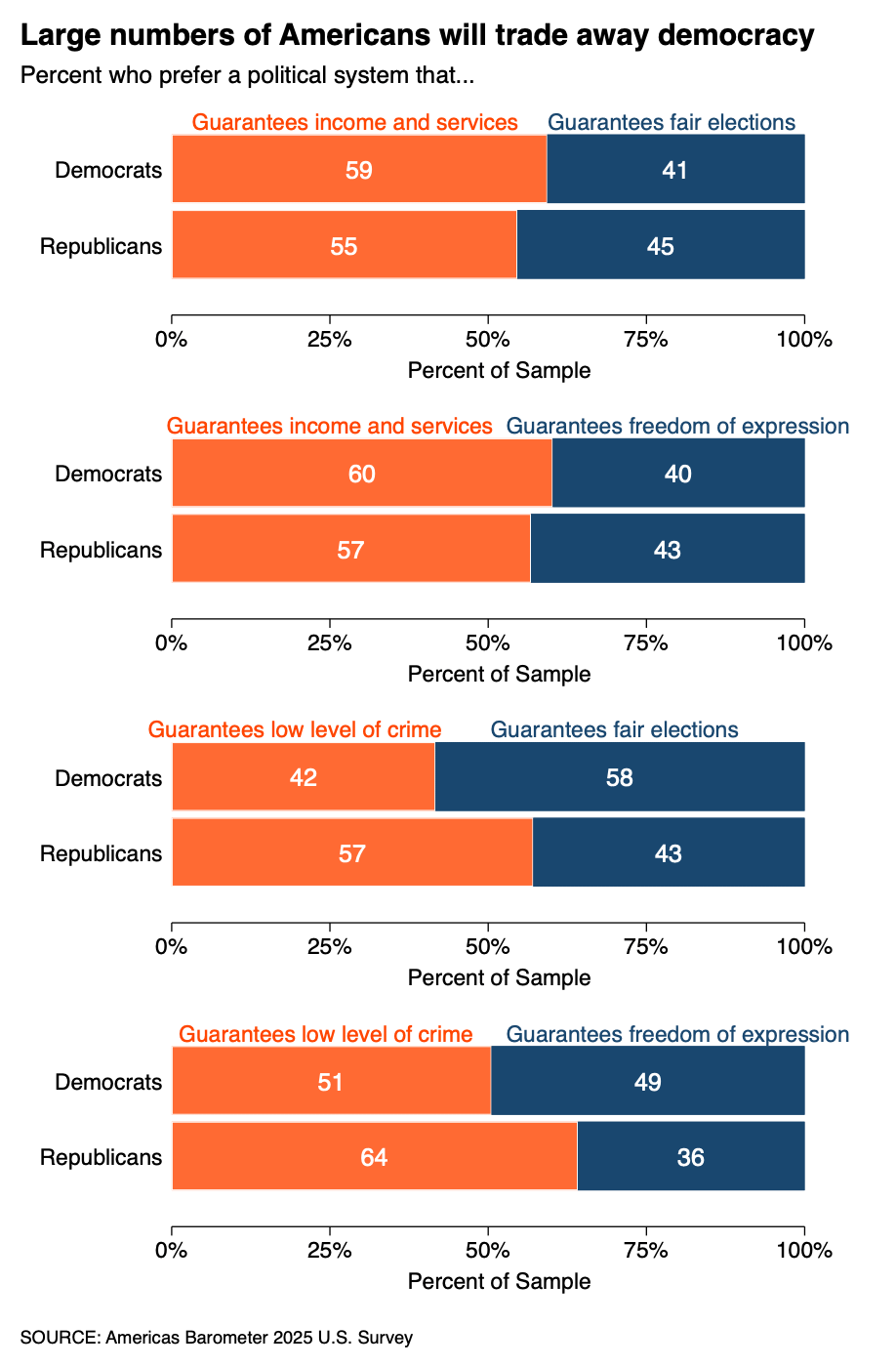
As you see, the results, especially in the context of this pivotal year, are even more disturbing if we look beyond First Amendment concerns. Bipartisan majorities also prefer income and services to free elections, while a significant majority of Republicans would choose low crime over democracy.
Why this isn’t so shocking
The first thing to say about these results is that we shouldn’t be as shocked by them as we may at first be tempted to be. They align with what psychologist Abraham Maslow identified more than 80 years ago in his hierarchy of needs. From the same time period, they also reflect why FDR spoke in 1941 of his ultimate goal of a universal Four Freedoms: Freedom of speech and expression and freedom of religion (the guarantees of the First Amendment) but also freedom from want and from fear. Roosevelt understood that free expression could only be secure where deprivation and fear were held at bay.
Where do these sobering findings leave us? I would suggest that there is no real point in decrying them. We take our fellows as we find them, and it is relatively easy, if you have enough to eat, decent housing, health care and education, gainful employment and more than a modicum of physical safety and security, to rush to the barricades to defend a free press. But, conversely, if you lack those advantages, threats to a free press may not be your greatest concern.
Second, however, while accepting why people may not share our priorities, we do not need to accept the status quo that causes them to have those views. Nor—and this is the key point—need we accept that the choices posed in the survey cited by Sides need be made.
That is why I included the video of FDR above. If you didn’t take time to watch it, I urge you to do so now. Speaking in one of freedom’s previous hours of maximum danger, Roosevelt reminded us both of what this country is supposed to stand for generally, and of how the particular concerns of a free press are inextricably bound up with America’s other goals.
When we talk with fellow Americans about journalism, we need to bear this in mind— both in understanding how their perspectives may differ from our own, and in conveying how our work may be in their interest.
Some these days are tempted to decry the “privileging” of accountability reporting. It has no special role, they say, when compared, for instance, with basic local information. That is wrongheaded, I think. Accountability reporting is how the press plays a role in integrating the four freedoms, and in extending their benefits to everyone by pointing out where and how we are yet falling short. If we can see the project of press freedom in this broader framework— as a critical means of assuring that we all enjoy all of our basic liberties— we can help secure not only journalism but society as a whole.
Thanks for reading Second Rough Draft! Subscribe for free.
Related Knowledge Center: Free speech and public protest
The First Amendment is facing challenging times: Crackdowns on campus protests prompted both-sides claims of intolerance. Attempts to head off dangerous health misinformation have been characterized as violations of free speech. Donald Trump is publicly punishing news outlets that deviate from his administration’s version of events while privately suing some outlets into submission.
The White House vs. the press | Voiceless America
Related Knowledge Center: Democracy and politics
News organizations are scrambling to find a coverage approach that adequately informs the American public about the country’s slide from democracy to authoritarian rule.