
Tesla Megapacks serving the grid as 300MWh BESS project comes online in New South Wales
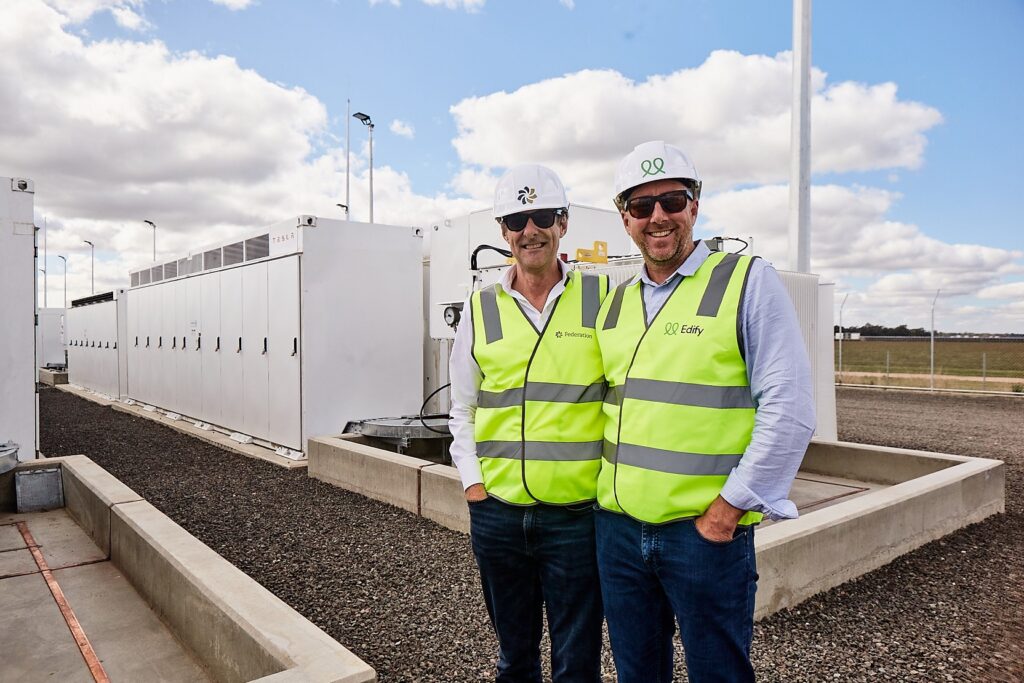
What has been described as the largest battery storage project to date in the state of New South Wales, Australia, has been brought online by Edify Energy.
Equipped with 150MW/300MWh of Tesla Megapacks, Edify’s Riverina and Darlington Point project comprises three separately operating co-located battery energy storage system (BESS) assets adjacent to an existing 333MWp solar PV plant and connected at the 132kV Darlington Point substation.
Completion of the project was announced yesterday (10 May) by renewable energy and storage developer-investor Edify Energy and fund manager Federation Asset Management, which owns 90% of the three-system portfolio’s equity.
Edify owns the remaining 10% stake and will be responsible for operation of the systems, while Federation is using Riverina and Darlington Point as a springboard to kick off a new Australian energy transition investment fund aimed at institutional investors.
The project also received a few million dollars in support from the Australian government via the Australian Renewable Energy Agency (ARENA) as one of a growing number of large-scale battery projects in the country to be kitted out with advanced inverters to help stabilise the grid as inertia supplied traditionally by thermal generators declines. ARENA and the NSW government jointly offered around half each of a total AU$13.1 million (US$8.87 million) assistance.
“This allows the storage system to operate in a manner akin to a conventional generator and provide crucial system strength services to help facilitate the connection of future clean energy power plants in the region,” Edify CEO John Cole said of the addition of advanced inverters, which can provide inertia when paired with Tesla’s virtual synchronous generator mode (other BESS providers also have modes of operation to deliver this).
Regular readers of Energy-Storage.news may already be familiar with the project in New South Wales’ southwestern Murrumbidgee Shire area from our earlier coverage:
May 2021: Shell Energy, the retail and energy services arm of the Dutch fossil fuel company signs a long-term services agreement with Edify Energy for 60MW/120MWh output from the project.
At that time, Edify was planning a total 100MW/200MWh of BESS for what was then simply known as the Riverina Energy Storage System project.
March 2022: Tesla is picked as BESS supplier to the project, with Megapacks to be used for the entirety of the project, which by this point is expanded in scope to its full 150MW of 2-hour duration resources.
The selection builds on Edify and Tesla’s previous experience working together on the 25MW/50MWh BESS retrofit at Gannawarra solar farm, Victoria. At Gannawarra, Megapack’s predecessor, Powerpack was used, brought online in 2018 and among Australia’s first-ever large-scale BESS projects.
April 2022: Australian energy generator-retailer EnergyAustralia signs up as an offtaker to the project too.
EnergyAustralia and Edify sign long-term services agreements for two of the systems, totalling 90MW/180MWh. EnergyAustralia will take the 65MW/130MWh Riverina 2 and 25MW/50MWh Darlington Point system into the National Electricity Market (NEM).
May 2022: Federation Asset Management acquires its 90% interest.
June 2022: Edify Energy secures project financing for Riverina and Darlington Point with the help of a loan from banks Commonwealth Bank of Australia (CBA), Westpac and DNB. Construction begins shortly after with start of operations scheduled for mid-2023.
The three systems are:
| System | Output | Capacity | Offtaker |
| Riverina Energy Storage System 1 | 60MW | 120MWh | Shell Energy |
| Riverina Energy Storage System 2 | 65MW | 130MWh | EnergyAustralia |
| Darlington Point Energy Storage System | 25MW | 50MWh | EnergyAustralia (& system support services to |
It’s the biggest battery project in New South Wales so far, but will be superceded by the Waratah Super Battery in the next few years. The ‘Super Battery’ will provide at least 1,400MWh of system-stabilising services to the grid, and will be several times larger than Australia’s biggest BESS to date, Victorian Big Battery (300MW/450MWh).
Meanwhile, large-scale BESS project announcements in Australia are only likely to increase in frequency with government-backed tenders for firm renewable capacity on the way, as was confirmed by the announcement of the Federal Budget 2023-2024 this week.
Energy-Storage.news’ publisher Solar Media will host the 1st Energy Storage Summit Asia, 11-12 July 2023 in Singapore. The event will help give clarity on this nascent, yet quickly growing market, bringing together a community of credible independent generators, policymakers, banks, funds, off-takers and technology providers. For more information, go to the website.
Related Knowledge Center: Offshore wind energy
Over the next decade, U.S. offshore wind power is expected to grow from a single 30-megawatt wind farm off Rhode Island to more than 2,000 MW of capacity along the Atlantic Seaboard. There are contracts for wind power off the coasts of Massachusetts, Connecticut, New York, Maryland, New Jersey, Rhode Island, and Virginia.
The National Renewable Energy Laboratory has estimated the United States has over 4,000 gigawatts (GW) of offshore wind potential, enough to power the country four times over.
The growth in part being spurred by state solicitations, including in New York, where then-Gov. Andrew Cuomo (D) set a commitment of 9,000 MW of offshore wind by 2035, and in Connecticut, where in June 2021, Gov. Ned Lamont (D) signed legislation authorizing the construction of 2,000 MW of offshore wind by 2030.
The offshore development is also being driven by an investment tax credit set to end in December 2019 and is equal to 12 percent of expenditures. U.S. Sens. Susan Collins (R-Maine) and Tom Carper (D-Del.) have introduced a bill to extend the tax credit for up to eight years.
The Interior Department has held eight competitive lease sales that resulted in 15 offshore wind leases over 1.7 million acres that has the potential for 21 GW of capacity. In February 2022, the Bureau of Ocean Energy Management completed a bidding process that realized $4.37 billion for 488,000 acres across six lease areas in federal waters off New York and New Jersey.
Projects have also been proposed off the Southeast coast, off California and Hawaii, and for the Great Lakes.