
Special Report – “Climate change poses significant challenges”
Climate change is already affecting Macau’s water supply—and that of the Greater Bay Area (GBA) as a whole—even if public awareness has yet to catch up
Macau Business | March 2025 | Special Report | Water: The Quintessential Asset
In 2021–22, the central and eastern parts of the Pearl River Basin experienced the most severe drought in 60 years, while the salt tide remained active at the mouth of the Pearl River.
During the dry season of 2022–23, the Xijiang River faced its second driest year since 1950. The salt tide at the mouth of the Pearl River was particularly strong, with 11 rounds of intense salt tides recorded. The impact lasted nearly a month longer than usual, seriously threatening water security in Macau, Zhuhai, and Zhongshan.
Throughout the 2023 flood season, water inflow from the West River remained low, leading to severe shortages in upstream water storage.
Finally, in the 2023–24 dry season, the Xijiang River’s natural water supply dropped by nearly 30 per cent, while the estuary endured seven rounds of strong salt tides, according to official data consulted by Macau Business.
Faced with these and other data that might make for tedious reading, Nian She, Director of the Smart Utility Research Institute at Tsinghua University Innovation Centre in Zhuhai, tells Macau Business that “Macau, surrounded by the sea on three sides and dependent on Zhuhai for over 95 per cent of its freshwater, is particularly vulnerable.”
Zhuhai, whose primary water source is the river, “experiences reduced base flow during prolonged dry seasons due to climate change and rapid urbanisation, exacerbating seawater intrusion and threatening water intakes,” says this renowned expert in water quality, hydrologic/hydraulic modelling, stormwater management, and water resources planning and management.
“Additionally, climate change may alter weather patterns, with heavy storms becoming more frequent and concentrated, while the dry season extends,” adds the Professor at Sun Yat-sen University in Guangzhou.
Cristina Calheiros, an Adjunct Researcher (Visiting Academic) at the Institute of Science and Environment, University of Saint Joseph (USJ), also warns of the risks.
“Concerning Macau’s drinking water supply, climate change poses significant challenges, primarily due to its reliance on external sources and vulnerability to environmental changes,” she tells Macau Business.

Some of the key impacts highlighted by this PhD in Biotechnology (specialising in Environmental Science and Engineering) include saltwater intrusion: “Macau depends heavily on freshwater from the mainland. The city’s coastal location makes it susceptible to saltwater intrusion, especially during winter salt tides when seawater encroaches into freshwater sources.”
She also highlights extreme weather events: “Climate change increases the frequency and intensity of extreme weather events, such as storms and harvests, that can disrupt water supplies and infrastructure.”
Professor Calheiros further points to water quality degradation, explaining that “rising temperatures and altered precipitation patterns can degrade water quality. Higher temperatures may promote algal blooms, while increased runoff during heavy rains can introduce pollutants into water sources. Additionally, prolonged droughts can concentrate contaminants in limited water supplies, posing health risks.”
The final challenge she mentions is infrastructure stress: “Macau’s water infrastructure faces stress from both increased demand and environmental challenges. The city has made efforts to reduce water loss; however, ongoing climate impacts require continuous improvements to maintain resilience.”
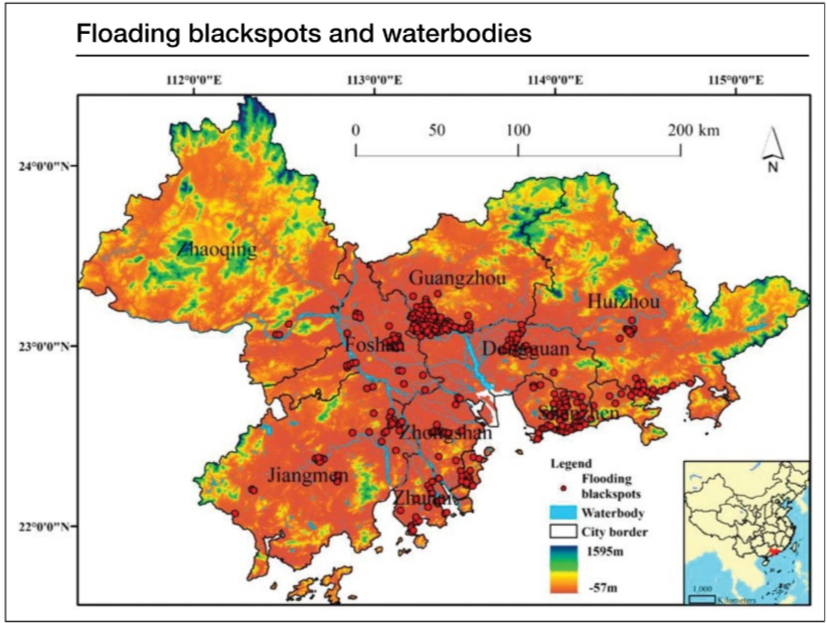
Professor Nian She has no doubts: “Climate change has undoubtedly led to an increase in heavy rainfall in the GBA. In recent years, not only have typhoons posed a threat, but also the more frequent and intense short-duration storms. These storms often result in local waterlogging.”
Another consequence of climate change is seawater intrusion in the Pearl River Estuary. “Zhuhai and Macau, located on the estuary, are significantly affected by this,” adds Prof. She.
And while significant efforts have been made to enhance water supply security in the GBA—particularly through the Datangxia Water Conservancy Project—climate change continues to present challenges. “The GBA is facing both pluvial flood risk and water supply shortages,” concludes Nian She.
“Macau, surrounded by the sea on three sides and dependent on Zhuhai for over 95 per cent of its freshwater, is particularly vulnerable” – Nian She
Smart water solutions
Macao Water “has enhanced the operational efficiency of water supply facilities and the distribution network with smart water solutions, thus providing more comprehensive protection for water supply security,” the company tells Macau Business.
At present, smart water supply technology “has been applied throughout the entire production and supply chain in areas such as online water pressure management, the use of a smart dosing system, and the dynamic hydraulic model, ensuring efficient production across the company’s water treatment plants.”
With the help of this technology, Macao Water “rigorously manages and maintains a water loss rate of 7 per cent–8 per cent through leakage detection as well as pipeline maintenance and replacement.”
Looking ahead, Macao Water “will continue to enhance the water supply system and infrastructure, proactively develop smart water solutions, and pursue the strategic goal of efficient, energy-saving production with reduced emissions. By 2030, the company aims to drive new quality productive forces in full alignment with the country’s environmental protection policy.”
A first intervention on the Coloane coast
The government will carry out an intervention on Coloane’s western coast with an ambitious project aimed at flood control, expected to take three years to complete.
According to data provided on Coloane’s official website, the plan includes constructing a 1,200-metre flood prevention embankment, four floodgates, and a hydrological observation station.
“The project is expected to begin at the end of March or April. The SAR government has assured that since the first phase will take place entirely at sea, it will not impact coastal residents or the surrounding environment,” said Yeong Keng Hoi, a representative of the Son I Welfare Association, in a report by TDM.
Macau Institute of Engineers president Eddie Wu stated that “facilities along the shore and waterside are temporary. When the water level is low, they can be safely used by the public.”