
A Special Grand Jury
Undoubtedly feeling pressure to perform after the debacle of the now-dismissed Reflecting Pool prosecution, Trump’s U.S. Attorney in Washington, D.C., Jeanine Pirro, has reportedly convened a special grand jury, according to the Washington Post. Special grand juries are used for complicated criminal investigations that are expected to take longer—special grand juries are impaneled for eighteen months and can be extended six months at a time for up to thirty-six months, as opposed to the six-month term of a regular grand jury—and require extensive work in front of the grand jury, such as taking witness testimony. The idea is to provide a grand jury with plenty of time on its docket to focus on a long-term investigation. While there are no subject-matter limits, special grand juries are frequently used for more complex matters like major trafficking cases or public corruption.
While it’s mandatory to use special grand juries in federal districts with a population of more than 4 million people, the District of Columbia falls outside of that purview. Some commentators have suggested that this means “a potentially big attempted prosecution is afoot.” That may well be the case. We don’t know the subject matter of this proceeding because grand juries are supposed to work in secrecy. But while prosecutors, grand jurors, and court personnel are obligated to maintain confidentiality, witnesses are not, which means there are often hints about a grand jury’s work based on their public commentary.
That hasn’t happened yet in this case; we don’t know if any subpoenas have gone out or if the U.S. Attorney’s Office has simply asked the court to impanel the special grand jury and is waiting for the grand jurors themselves to be selected and sworn in. But already there is speculation that Pirro may be interested in one aspect of the special grand jury process: provisions that permit a special grand jury to issue a report even if it doesn’t indict.
Given the rampant speculation, it’s important to understand precisely what a special grand jury can do in this regard. It’s governed by statute.
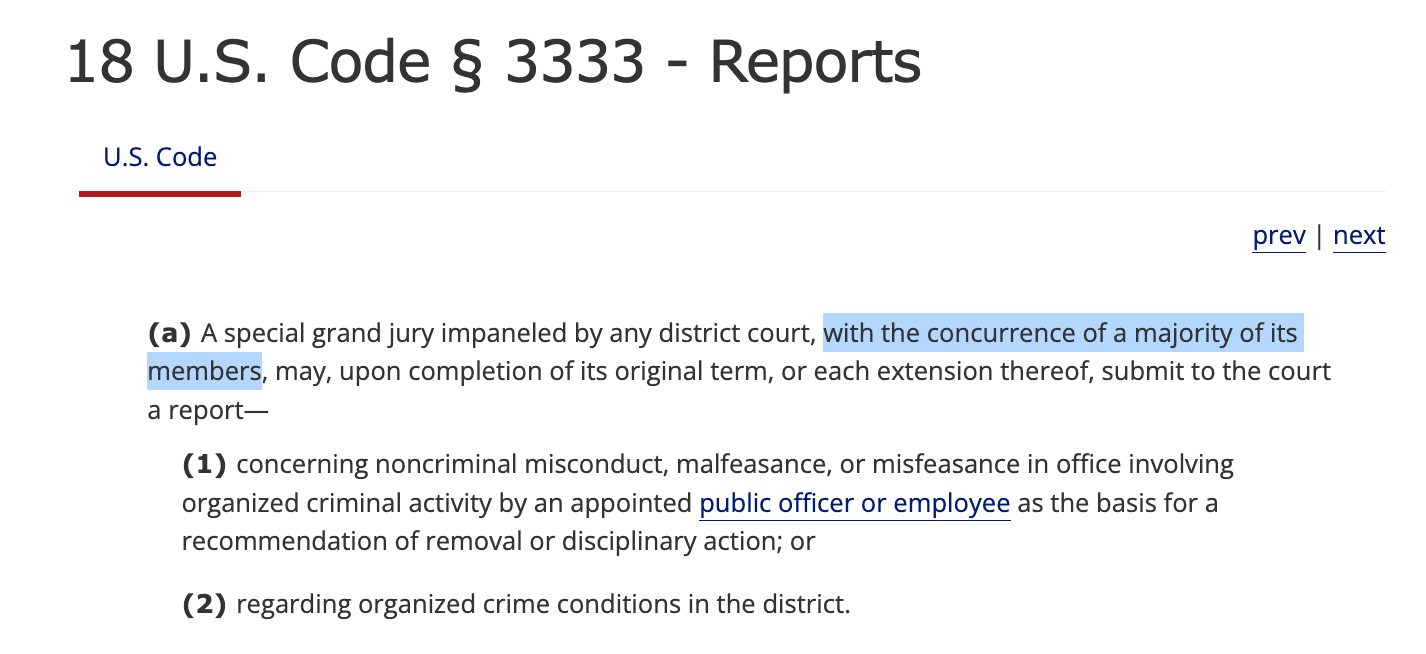
Special grand juries can submit a report, but it is made “to the court” and only if “a majority of its members” want to do so. And even then, a report must reflect either “organized crime conditions” (this is construed more broadly than organized crime in the Mafia sense) or “noncriminal misconduct” by a public officer or employee as part of some larger criminal activity that merits the discipline or removal from office even if prosecution isn’t warranted.
Not all special grand juries issue reports; it’s more the exception than the rule. Although a special grand jury in Georgia issued a report in connection with DA Fani Willis’s indictment of Donald Trump, that was under Georgia state rules, not the federal statutes that would govern proceedings here.
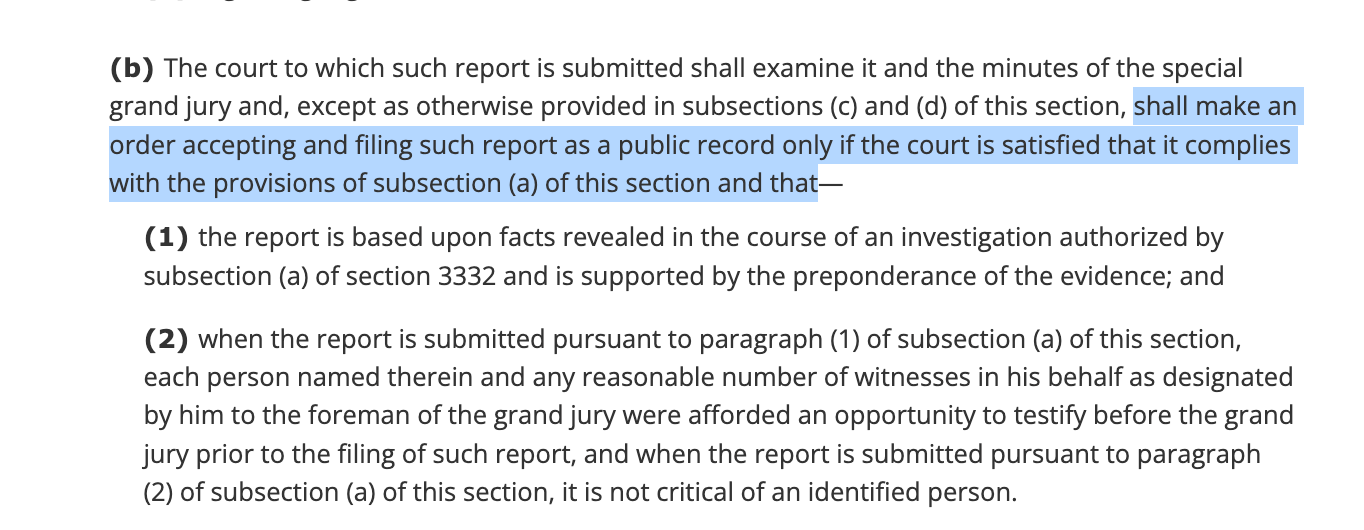
When a special grand jury writes a report, before it can become public, they must submit it to the court. Courts only “make an order accepting and filing such report as a public record” if the report satisfies additional conditions:
It must be based on facts developed during the investigation and supported by a preponderance of the evidence. (A preponderance is lower than the “beyond a reasonable doubt” standard used in a criminal trial and means that a claim is more likely to be true than not true.)
Before a report suggesting a public officer or employee should be removed from office can be made public, that person must have had the opportunity to testify and to offer additional witnesses on his behalf.
A report regarding “organized crime” conditions in the District may not criticize a person named in the report.
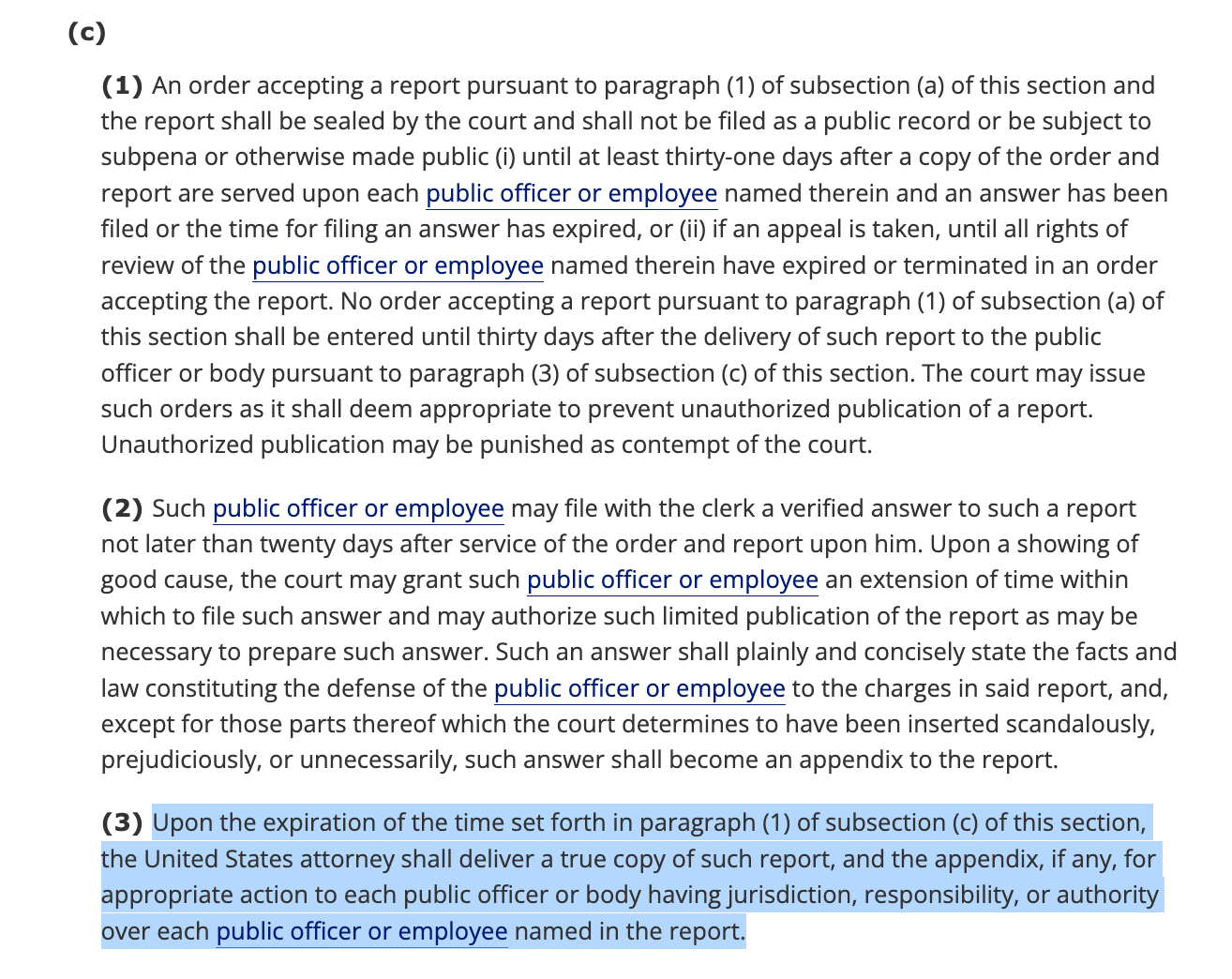
There are some due process/notice requirements that give anyone named in the report an opportunity to respond to the allegations made about them, with their response becoming a part of the report. Unauthorized publication is a contempt of court and can be punished by the judge in charge of the special grand jury.
Once all of this is done, the U.S. Attorney delivers the report to “each public officer or body having jurisdiction, responsibility, or authority over each public officer or employee named in the report.”
So, there are clear legal constraints on the process—if the special grand jury is not going to issue indictments, it doesn’t become a vehicle for a U.S. Attorney to write and publicize a burn book. A majority of the special grand jury must vote to issue a report. Its content must be tailored to the requirements of the statute. It must focus on noncriminal conduct by public employees or officials that merits discipline or removal but falls short of criminal prosecution, and both sides of the story must be told in the report. And because special grand juries are long-term projects, it’s unlikely to deliver fast results.
There is a certain echo of Trump’s request to Ukraine’s then-new president, Volodymyr Zelensky, to open an investigation into the Bidens, or of his efforts to have his Justice Department investigate “fraud” as he was trying to block the outcome of the 2020 election. Because this is Trump, we should always assume the rules that are binding on “Earth I” may not be applied. But here, absent legitimate grounds for reporting and action, it’s difficult to envision how a special grand jury could become a mechanism for executing Trump’s revenge agenda, although even falling under investigation can cause serious reputational damage and financial harm to those who find themselves under scrutiny.
But here, DOJ’s longstanding advice to its prosecutors is also a caution against abuse of the process: “The wording and the legislative history of [the laws authorizing them] indicate that a special grand jury should not investigate for the sole purpose of writing a report; the report must emanate from the criminal investigation. At bottom, then, a special grand jury functions essentially like a regular grand jury. It is only after the ‘completion’ of the criminal investigation, when the time is near for discharging the jury, that a report may be submitted to the court…The grand jury will by that time have exhausted all investigative leads and have found all appropriate indictments.” There is no rush to issue a report. It would come only after the indictment process was complete and only if there was serious remaining misconduct that couldn’t be addressed in the context of the criminal justice system.
It’s easy to assume the worst under an administration that is more than capable of it. But we should never assume it’s open season on the rule of law; that it no longer matters. Here, the law, and the grand jurors and judges charged with executing it, can impose serious constraints on the ability of a U.S. Attorney to pander to a president. When something happens with this grand jury—and it’s very likely that it will—you now have the context for understanding the legal landscape. That’s what Civil Discourse is about, knowledge and speaking truth to power. If you’ve been reading for free (which I encourage), this is a good night to become a paid subscriber. Paid subscribers make it possible for me to do this work along with you—and to keep it available to everyone.
We’re in this together,
Joyce