
Some Rationalization May Finally Be Coming for Newsroom Intermediaries
Welcome to Second Rough Draft, a newsletter about journalism in our time, how it (often its business) is evolving, and the challenges it faces.
Something I hear pretty often these days in our industry is a complaint about redundant intermediaries who are soaking up scarce philanthropic dollars, with resultant inefficiencies and unnecessary burdens on newsrooms overwhelmed with too many trainings, too many conferences, too many audits, just too many distractions.
Why, a funder asked me recently, do two intermediaries this funder saw as offering duplicative services both still exist? Because you—and your funder colleagues—let them, I said.
Something’s brewing
Now I am sensing the early stirrings of a movement to push back, to begin to rationalize at least some of the offerings, affiliations and services. Knight Foundation, the industry’s largest institutional funder, is taking early but seemingly meaningful steps in this direction, gathering data and, yes, planning a convening (always a sign of philanthropic seriousness).
Amalie Nash, Knight’s VP/Journalism, tells me Knight recently sent a survey to intermediaries “to better understand the conversations occurring around collaboration and consolidation and how we can best provide support.” Knight’s view is that “as the field matures, we believe this is a good time to assess the landscape… We share the same goals of ensuring the field can effectively innovate and scale.”
Erin Millar, CEO and co-founder of for-profit technology platform Indiegraf (they prefer the term “operating system”), which has just completed the acquisitions of Hearken and Stylebot, puts it this way in addressing clients and potential clients:
You’re exhausted by the fragmented ecosystem of tools and services. It’s frustrating to see precious philanthropic capital go to organizations who waste resources competing with one another or building duplicative solutions. You hate it when we won’t play nice together. We need to do better.
Indiegraf, Millar tells me, expects to announce another, larger acquisition in a couple of weeks. It sees more potential opportunities in what Millar calls “sub-scale,” “subsidy-dependent” tools which have proved useful to publishers but which are not independently sustainable, especially after declines in support from Facebook and Google. Indiegraf, it should be noted, has a program-related investment (PRI) from Knight, and a Knight program officer sits as a non-voting member of its board.
In my interview last month with scholar Elizabeth Hansen Shapiro (which has become easily the most-viewed column in the five years of this newsletter) on a study she did funded by Arnold Ventures and published by Media Impact Funders, Hansen Shapiro called for consolidation. While that column offered her views, this week I want to offer my own on this and related questions.
Before we dive in, a note on nomenclature: I continue to use the term “intermediaries,” as I have for years. The trendy phrase “journalism support organizations” (JSOs) feels to me like the sort of thing intermediaries waste time and money crafting—and also pre-judges the debate about whether particular entities, on balance, are proving more support than distraction.
Common premises
I have long been concerned about too much of institutional funding going to intermediaries rather than newsrooms, and that remains my view. (It’s not one Hansen Shapiro appears to share, by the way.) But beyond this, I think we can all agree on a couple of basic propositions:
- First, not all competition between intermediaries is inefficient or bad. It may be, in some areas, that competing offerings serve different sorts of newsroom customers or use cases. In others, optimal solutions may not yet have been developed, and competition may spur us to get closer to them. In general in our economic system, competition is healthy.
- With that said, however, devoting limited resources to competing services where one offering is superior not only leads those using the inferior service to poorer results, it also subsidizes entirely unnecessary administrative costs at the inferior service. And in circumstances where competing services are roughly equivalent, mere duplication can also be inefficient—and, as noted above, may place an administrative burden on already over-stressed client newsrooms. Time is one of the scarcest resources of all.
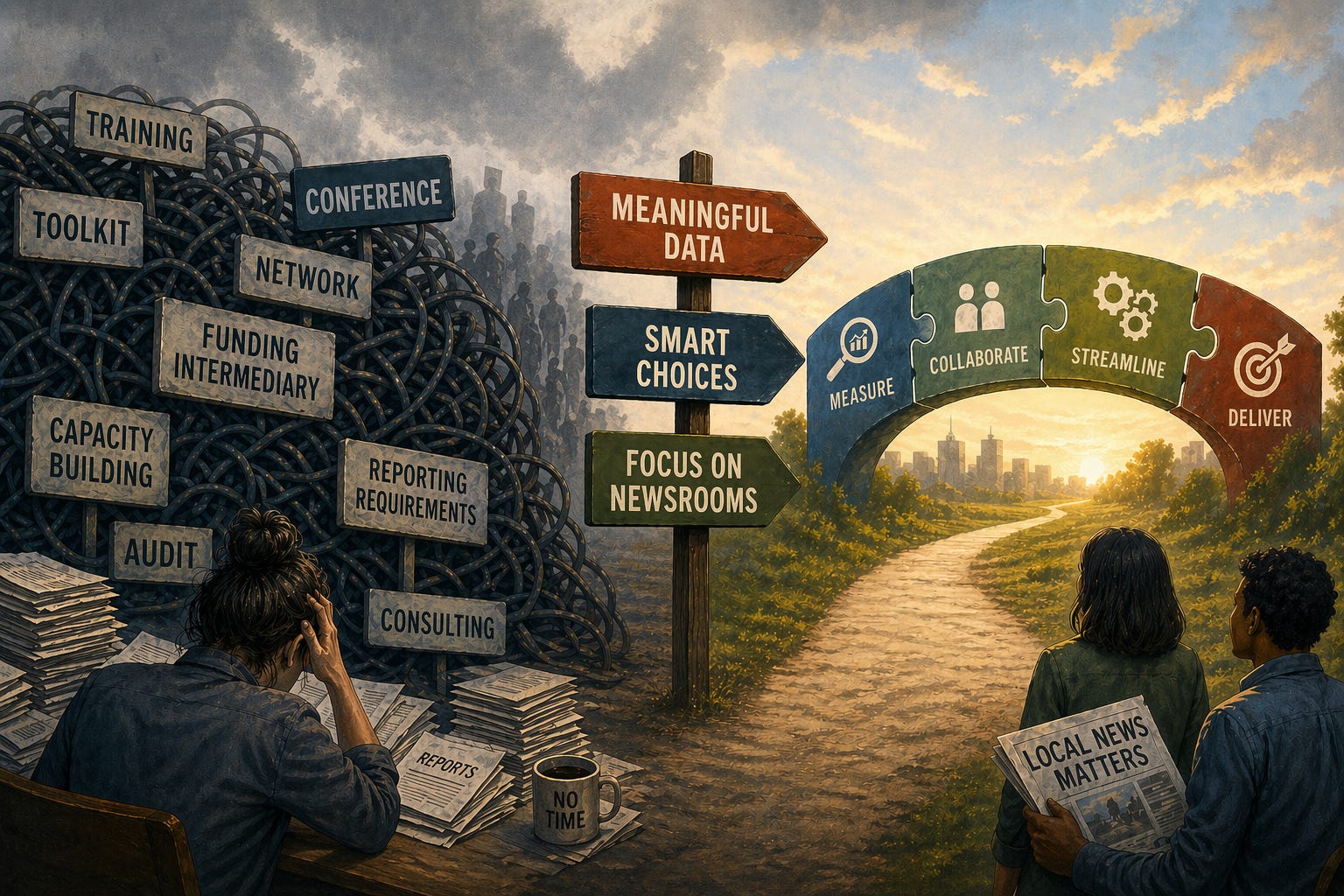
The hard part, of course, comes in deciding which circumstance is which—where competition and overlap is still healthy, and where it is just wasteful. One interesting aspect of this is that in some cases, such as where competing providers offer services the effectiveness of which can be measured quantitatively, the funders paying the bills already have (or could readily demand) access to data which should enable them to recognize who has built the better mousetrap. I hope they will begin to do so, and to act on the results.
Choices to be made
Some people object to funders playing the more heavy-handed role that will probably be necessary if rationalization like this is to take hold. I am not one of them. As I have said before, the very job of program staff at institutional foundations is to make choices, to pick winners (and therefore, unavoidably, losers). That may not be the happiest aspect of such roles, but it is a responsibility that goes along with the many privileges of a well-compensated post giving away other people’s money. It would be important, however, for decisions of this sort to be made purely on the merits, with funders careful to avoid conflicts of interest that may arise, for instance, from board roles or other stakes in various intermediaries.
In some cases, it may make sense for intermediaries to try to get ahead of this emerging trend. With some degree of compelled consolidation looming, mergers may seem more attractive than previously, conferences can perhaps be combined, services streamlined to avoid overlap. All of that, driven by those closest to the work, could be preferable to foundations making choices based on less information.
While combinations are no panacea and don’t always work out, I have long pressed for more mergers among newsrooms, and I have been pleased to see such combinations as Mother Jones and the old Center for Investigative Reporting, or the recent absorption of The Current in Louisiana by Deep South Today. Intermediaries are actually late to this party, but if hard choices about funding and increased activity among them is coming, all of us should take that as a sign of progress.
Second Rough Draft paid subscribers support nonprofit journalism. To receive new posts become a free or paid subscriber