
Solar power is coming to flat balconies
Autumn took over from summer on Sunday, 21 September. But contrary to popular belief, it’s not too late to invest in photovoltaics: it’s not the sun that counts, but the light. For flat dwellers, generating their own electricity often seems out of reach, unless a committed property manager has solar panels installed on the roof. However, there is an alternative: balcony photovoltaic panels.
In Germany, the phenomenon is gaining momentum. According to Leonhard Probst of the Fraunhofer Institute for Solar Energy Research, quoted by AFP last January, 800,000 kits were sold in 2024, ten times more than in 2022. “Many of these small installations are not declared, so the real figure is probably higher,” he adds. In relation to total solar capacity in Germany—almost 100 gigawatts—balcony kits represent between 1.6 and 2.4 GW, or around 2%.
Why is there such a craze across the Rhine? “Germany has many more tenants than Luxembourg, where over 70% of the population own their own home. And the price of electricity is 50% higher. This cost is an incentive to look for solutions to make small savings,” explains Jeannot Behm, head of the ecological department at the town of Esch-sur-Alzette.
On 20 June, the town also launched a pilot project that is unprecedented in the country and the Greater Region: Solar Esch, a solar kit for balconies or terraces, partly paid for by the town.
In Esch, two panels for €250
“In practical terms, the municipality is covering most of the costs as well as most of the technical side,” says alderperson 
In detail, a panel costs €650 excluding VAT. The local authority and the Climate and Energy Fund will each pay €215, Sudstroum will pay a further €75 and the rest—€150—will be paid by the public. For two panels (€950 excluding VAT), the split is €295 for the municipality and the same amount for the Climate and Energy Fund, and €115 for Sudstroum, leaving €250 to the citizen.
A total of €450,000 is being raised to fund 500 installations as part of the pilot phase, scheduled to run until 2027. And the interest is real: “Nearly 64% of Esch residents live in flats, so the potential is enormous,” says an excited Sehovic. “Following the presentation of the project at the town council meeting on 20 June, the town’s information website recorded almost 800 visits in 24 hours. By 15 July, 140 forms had already been submitted. These are certainly raw figures, but the turnout clearly shows that we have launched a long-awaited initiative.”
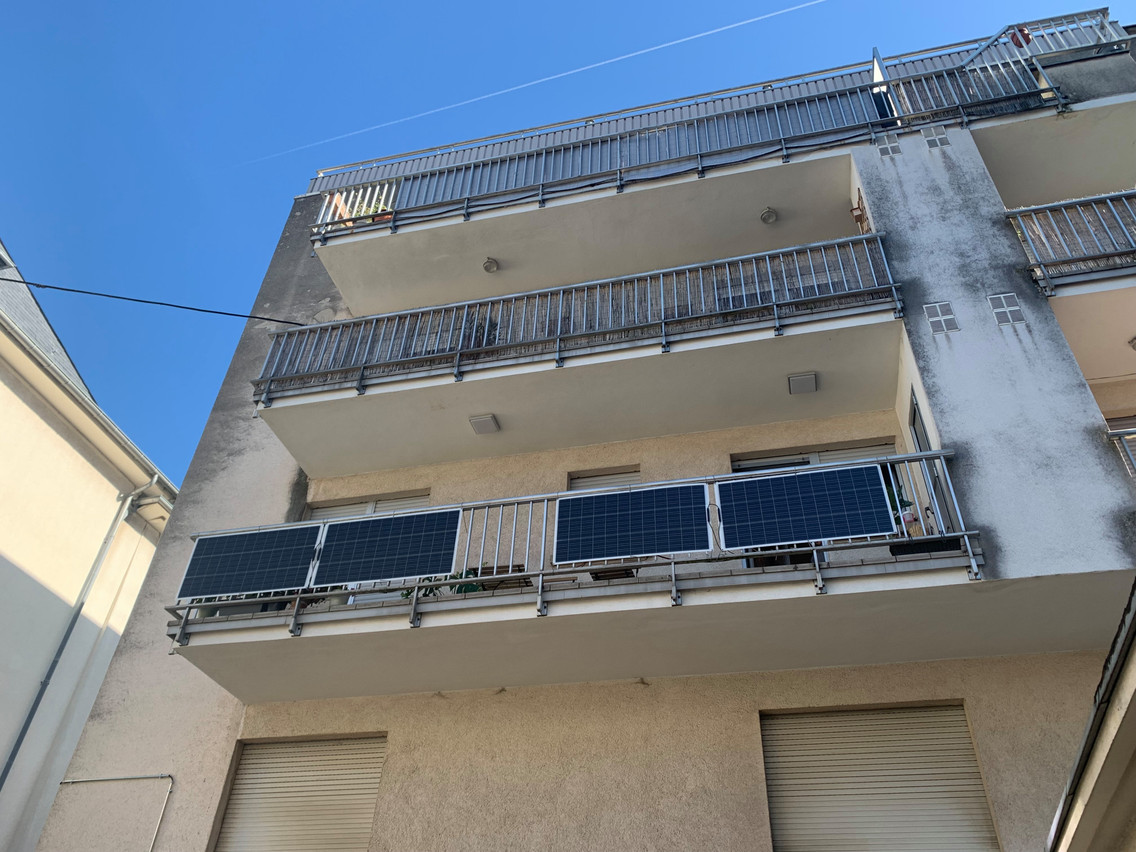
More and more flat dwellers are investing in balcony solar panels, as here in Bonnevoie. (Photo: Ioanna Schimizzi/Paperjam
“The subject exists in Luxembourg: at Klima-Agence, we regularly receive questions about it. But it’s clear that we’re not at the same level as Germany,” notes 
An advantage that needs to be put into perspective, however, says his colleague Nina Weicherding, a senior adviser on sustainable energy transition: “The yield is obviously not the same. Power is limited for this type of installation: the inverter cannot exceed 800 watts. By way of comparison, a standard rooftop photovoltaic installation for a Luxembourg household develops around 6 kilowatt-peak (kWp).
Balcony panels soon to be removed from the Klimabonus
“You obviously can’t charge an electric car or power a heat pump with balcony solar panels,” explains Fenn Faber, director of Klima-Agence. “However, they are sufficient to cover some of our everyday needs: laptops, telephones, washing machines and fridges. This already helps to reduce the bill.”
Concretely, a balcony photovoltaic plant produces electricity thanks to its modules and injects it directly into the domestic grid. Plugged into a standard power socket, it immediately supplies the home. The surplus is fed back into the public grid, but without payment. “It’s a bit of a DIY solution: plug and play that doesn’t require a great deal of technical expertise. You do, however, need to check that your basic consumption is sufficient to absorb the electricity produced,” says Faber. You still need to have an outlet on the balcony, or make a cut in the wall to install one.
Note that Klimabonus state aid exists for this type of installation, provided it is carried out by a professional. The support can cover up to 50% of the costs (excluding VAT), with a maximum of €1,250/kWp for an offer signed on or after 1 October 2024 and an invoice dated up to 31 December 2025. The form must be validated by the installer, says Klima-Agence.
20-30% savings on electricity bills
“However,” Faber continues, “a change of regime is in the pipeline: the next bill will introduce a minimum output of 2 kWp to qualify for subsidies. Balcony installations, even those installed by a professional, will therefore no longer be eligible once the law has been passed. But as the applications remain anecdotal, this shouldn’t have a big impact. Most private individuals install their own kits.”
And what about profitability? “Our research shows a payback in five to six years, which is still interesting,” observes Nina Weicherding, senior consultant in sustainable energy transition.
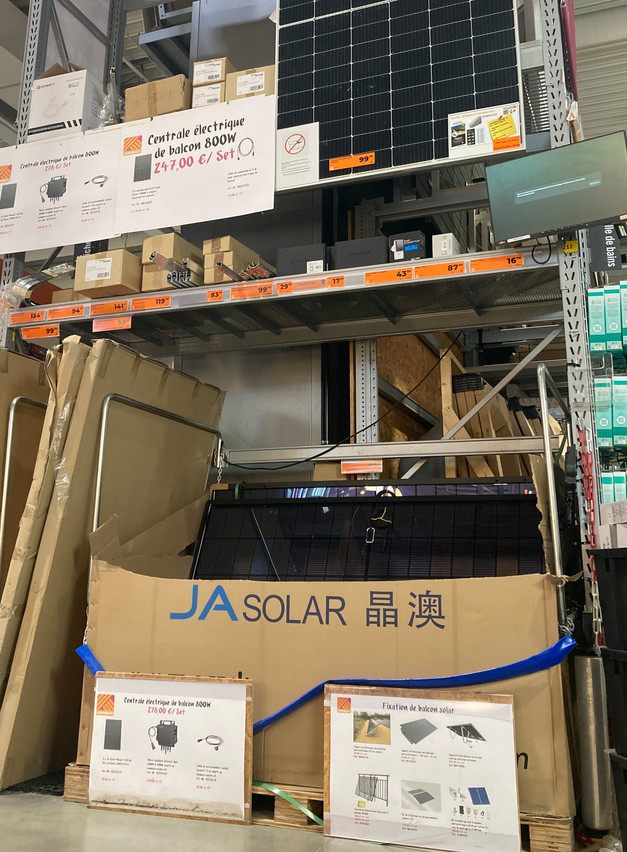
At the Hornbach shop in Bertrange, about four balcony solar panels are sold every day. Photo: Ioanna Schimizzi/Paperjam
At the Hornbach shop in Bertrange, Jordan Izzi, head of the lighting and electrical sector, confirms that there are “an enormous number of requests. At first, it was just a test we ran following the outbreak of war in Ukraine in 2022, but the interest has never waned since. There’s a certain seasonality, because customers think that panels work better in summer, but photovoltaic panels capture light, so they’re useful all year round.” In the last eight weeks, for example, the shop has sold 149 kits, or around four panels a day. Hornbach offers a kit with two photovoltaic panels, a micro-inverter and a connection cable for €278. “We only use CE-certified products because safety is essential,” says Izzi.
Within the Solar Esch project, says Sehovic, “we wanted to go even further and from the start of the project, the aspect of the local or regional economy was important. So we selected solar panels made in Germany, which are produced and assembled in Bitbourg. We also use Luxembourg panels, supplied by Soluxtec, which is the only assembler of photovoltaic panels in Luxembourg.”
For the Solar Esch project, the return on investment is proving to be even quicker than buying the panels yourself. “With two modules installed on a well-facing balcony, you can reduce your annual electricity consumption by 20-30%,” explains Jeannot Behm, head of the environmental department at Esch town council. “At the subsidised price, the installation pays for itself in one to two years. Even in the least favourable scenario—a north-facing position halves the yield—the payback period is no more than two to four years. This is still a very good deal given the price on offer.”
This article was originally published in French.