
Solar Panel Cleaning Market Size, Share And Growth Report 2033
Solar Panel Cleaning Market Size, Share And Growth Report 2033
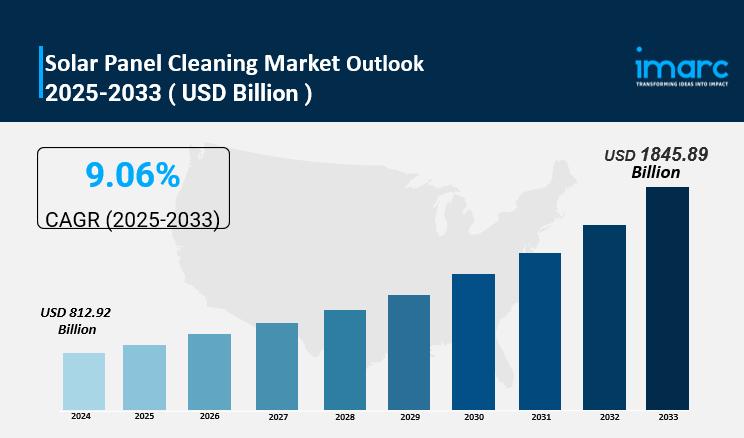
Solar Panel Cleaning Market Size
IMARC Group, a leading market research company, has recently released a report titled “Solar Panel Cleaning Market Size, Share, Trends and Forecast by Product, Material, Distribution Channel, Pricing, End-User, and Region, 2025-2033.” The study provides a detailed analysis of the industry, including the solar panel cleaning market size, share, trends, and growth forecast. The report also includes competitor and regional analysis and highlights the latest advancements in the market.
Solar Panel Cleaning Market Overview
The global solar panel cleaning market size reached USD 812.92 Million in 2024 and is projected to grow to USD 1,845.89 Million by 2033, exhibiting a CAGR of 9.06% during the forecast period of 2025-2033. The market is expanding due to increasing solar energy adoption, environmental concerns, and supportive government policies. Asia-Pacific leads, accounting for 42.6% market share in 2024. Dirty panels reduce efficiency, making cleaning crucial especially in dusty and polluted areas. Innovations such as robotic and dry cleaning methods are becoming important.
Study Assumption Years
● Base Year: 2024
● Historical Year/Period: 2019-2024
● Forecast Year/Period: 2025-2033
Solar Panel Cleaning Market Key Takeaways
● Current Market Size: USD 812.92 Million in 2024
● CAGR: 9.06% during 2025-2033
● Forecast Period: 2025-2033
● Asia-Pacific dominates with over 42.6% market share in 2024 due to large solar energy expansion and favorable conditions.
● United States accounts for 83.60% share of the North American solar panel cleaning market, driven by high clean energy adoption.
● Wet cleaning holds 68.5% market share owing to its effectiveness in removing stubborn residues.
● Manual cleaning remains widely used especially in residential and small commercial sectors due to affordability and flexibility.
● Increasing integration of IoT and robotic systems promotes efficient, water-saving automatic cleaning methods.
Claim Your Free “Solar Panel Cleaning Market” Insights Sample PDF:
https://www.imarcgroup.com/solar-panel-cleaning-market/requestsampleMarket Growth Factors
The growing adoption of renewable energy is a significant driver for the solar panel cleaning market. With more homes, businesses, and industries installing solar systems to reduce fossil fuel dependency, maintaining clean panels becomes essential for optimal performance. According to the International Energy Association, renewable energy usage in heat, power, and transport sectors is expected to rise nearly 60% between 2024 and 2030. Large solar farms demand automated and robotic cleaning to minimize labor costs while ensuring high efficiency. Frequent cleaning is crucial particularly in arid and dusty regions where dirt accumulation quickly reduces panel effectiveness.
Rising integration of Internet of Things (IoT) with solar panels is improving cleaning scheduling and efficiency. IoT sensors monitor dust accumulation, weather conditions, and energy output, enabling cleaning to occur only when necessary, thus extending panel lifespan. Automated robotic cleaners use IoT data to optimize water and energy usage. Large solar farms utilize predictive maintenance to detect cleaning needs early, ensuring maximum reliability. Smart home systems alert homeowners about panel dirtiness, making maintenance easier and cost-effective. IoT also supports waterless and electrostatic cleaning by controlling cleaning cycles precisely.
Increasing electricity demand fuels the market as solar installations expand and routine cleaning becomes mandatory to sustain high energy production. For instance, over 250 million Indian households had the capacity to install 637 GW of rooftop solar power by November 2023. Environmental pollutants reduce panel efficiency, necessitating frequent cleaning. Utility-scale solar farms prioritize automated and robotic cleaning to maintain consistent power generation. Continuous solar infrastructure expansion by governments and private investors further underlines the need for cleaning technologies to optimize power generation and reduce reliance on conventional electricity sources.
Market Segmentation
Analysis by Technology:
● Wet Cleaning: Holds 68.5% market share; removes stubborn dust, dirt, and bird droppings using water and cleaning solutions. Preferred for thorough washing and salt accumulation areas.
● Dry Cleaning: Not explicitly detailed but contrasted with wet cleaning, suggesting lesser water usage.
Analysis by Process:
● Water Based: Common method using water and mild detergents, effective in heavy pollution and coastal regions. Utilizes water-efficient techniques like pressure washing and recycling.
● Electrostatic System: Uses electric charges to repel dust without water or contact, ideal for water-scarce, arid regions.
● Robotic: Gaining popularity; employs brushes, air jets, or microfiber pads to clean autonomously, reducing manual labor and water consumption.
● Others: Not specifically described.
Analysis by Application:
● Industrial and Utility: Large-scale installations needing frequent and specialized cleaning, often in remote dusty regions to maximize output. Automated systems favored.
● Commercial: Not detailed separately; implied between industrial and residential sectors.
● Residential: Smaller scale, less frequent cleaning needs; manual methods preferred.
Analysis by Mode of Operation:
● Manual: Widely used for residential/small commercial setups due to low cost and flexibility. Enables thorough inspection but limited by labor availability.
● Automatic: Includes robotic and automated cleaning systems, increasingly used in large-scale farms for efficacy and cost savings.
Regional Insights
Asia-Pacific holds the leading market position with a 42.6% share in 2024, driven by rapid solar energy expansion in countries like China, India, and Japan. Large solar farms in dusty and arid zones necessitate frequent cleaning.
Government incentives and industrial pollution also fuel demand. Low labor costs favor manual cleaning while growing automation in large farms supports market growth. Water scarcity encourages adoption of dry and water-efficient cleaning technologies.
Recent Developments & News
In 2024, several key developments occurred: IFBOT partnered with LEWEI TRADING (H.K.) LIMITED in September for exclusive distribution of its solar panel cleaning robots in Australia, expanding market presence. In July, IFBOT installed 80 X3 cleaning robots at a 20MW solar farm in Inner Mongolia, emphasizing waterless, eco-friendly technology. June saw IFBOT ally with Milan Utama Sdn. Bhd. in Malaysia for exclusive distribution of PV cleaning robots, enhancing Malaysia’s renewable sector. In April, Airtouch Solar secured a USD 6 Million contract with Adani Green Energy for water-free cleaning robots for Rajasthan, aiming to save 50 million liters of water annually.
Key Players
● Clean Solar Solutions Ltd
● Ecoppia
● Indisolar Products Private Limited
● INTEGRA GLOBAL Co., Ltd.
● Pacific Panel Cleaners, LLC
● Premier Solar Cleaning, LLC.
● Saint-Gobain Advanced Materials Taiwan Co., Ltd.
● Solarwatt
● SunBrush mobil GmbH
● The Solaria Corporation
Ask an Analyst :
https://www.imarcgroup.com/request?type=report&id=13149&flag=CIf you require any specific information that is not covered currently within the scope of the report, we will provide the same as a part of the customization.
About Us
IMARC Group is a global management consulting firm that helps the world’s most ambitious changemakers to create a lasting impact. The company provide a comprehensive suite of market entry and expansion services. IMARC offerings include thorough market assessment, feasibility studies, company incorporation assistance, factory setup support, regulatory approvals and licensing navigation, branding, marketing and sales strategies, competitive landscape and benchmarking analyses, pricing and cost research, and procurement research.
Contact Us
IMARC Group,
134 N 4th St. Brooklyn, NY 11249, USA
Email: sales@imarcgroup.com
Tel No: (D) +91 120 433 0800
United States: +1-201971-6302
This release was published on openPR.