
Solar Cell (Photovoltaic) Module Market Size Set to Hit US$ 109.13 Billion by 2032
Solar Cell (Photovoltaic) Module Market Size Set to Hit US$ 109.13 Billion by 2032
Solar Cell (Photovoltaic) Module Market
Solar Cell (Photovoltaic) Module Market Overview -
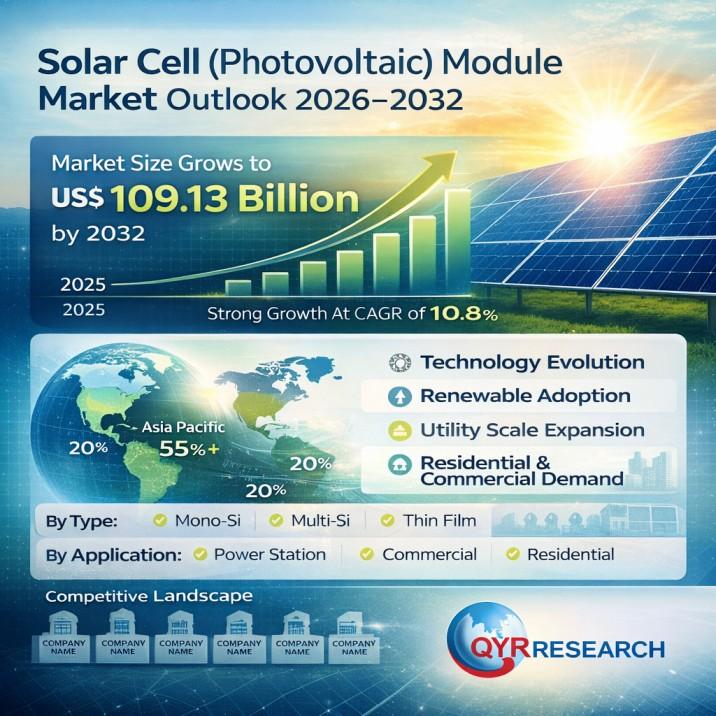
The global Solar Cell (Photovoltaic) Module market is witnessing robust expansion as countries accelerate renewable energy adoption and pursue decarbonization goals. The market was valued at US$ 53.76 billion in 2025 and is projected to reach US$ 109.13 billion by 2032, advancing at a CAGR of 10.8% during the forecast period from 2026 to 2032. Rapid declines in generation costs, supportive policy frameworks, and improvements in module efficiency are reinforcing solar energy as a mainstream power source.
A solar cell, or photovoltaic cell, converts sunlight directly into electricity using semiconductor materials. Purified silicon remains the dominant raw material, though multiple architectures and thin-film approaches coexist. As utilities, corporations, and homeowners seek stable and sustainable energy supply, PV modules are becoming central to future electricity infrastructure.
Get Full PDF Sample Copy of the Report: (Including Full TOC, Tables & Charts):
https://qyresearch.in/request-sample/energy-power-global-solar-cell-photovoltaic-module-market-insights-industry-share-sales-projections-and-demand-outlook-2026-2032Why Purchase This Report?
This report delivers a comprehensive, evidence-based overview of the Solar Cell (Photovoltaic) Module market to support informed strategic planning and investment decisions. It includes free customization options, such as country-level analysis for up to five selected countries and a detailed segment-wise competitive revenue assessment of leading players.
By offering deep insights into market trends, growth drivers, challenges, competitive dynamics, and emerging opportunities, the report equips manufacturers, investors, and decision-makers with actionable intelligence to identify high-growth segments, optimize operations, and maintain a sustainable competitive advantage.
Technology Foundations and Efficiency Trends -
Silicon wafer-based technology has historically represented the overwhelming majority of global shipments, accounting for more than ninety percent of total sales in earlier assessments. Within this segment, mono-crystalline modules have steadily gained share, now representing the leading technology thanks to superior efficiency, longer lifespan, and improved performance in limited spaces.
Manufacturers are investing heavily in cell architecture upgrades such as passivated contacts, larger wafer formats, bifacial generation, and enhanced temperature coefficients. These innovations are pushing energy yield higher while reducing balance-of-system costs. As a result, project developers can achieve better returns even in competitive power markets.
Demand Drivers Across Applications -
Utility-scale PV power stations remain the largest demand center. Governments worldwide are expanding renewable targets, and solar is often the fastest technology to deploy. Large installations benefit from economies of scale, streamlined permitting, and integration with grid modernization programs.
Commercial rooftops form another rapidly growing segment. Businesses are adopting on-site generation to hedge against volatile electricity prices and to meet sustainability commitments demanded by investors and customers. Residential adoption is also expanding as homeowners pair rooftop systems with energy storage and smart management platforms.
Electrification of transport and industry indirectly supports module demand as well. Rising electricity consumption increases the need for new generation capacity, much of which is expected to come from renewables.
Competitive Landscape -
The market is highly dynamic, with strong competition in manufacturing scale, cost control, and technology leadership. Prominent suppliers include JinkoSolar, JA Solar, Canadian Solar, Trina Solar, and LONGi. Shipment rankings have often been led by JinkoSolar, with close competition from JA Solar and Canadian Solar.
Success increasingly depends on vertical integration, access to advanced wafer and cell technology, and global distribution networks. Companies are also differentiating through warranties, financing partnerships, and project development expertise.
Regional Market Dynamics-
Asia Pacific stands as the largest production and export base, supported by extensive manufacturing ecosystems and policy backing. China in particular plays a dominant role in module fabrication and upstream supply. Europe is a major consumption center, driven by climate objectives, high electricity prices, and strong rooftop adoption.
North America continues to expand installations through utility procurement and corporate renewable purchasing. Meanwhile, emerging markets in the Middle East, Africa, and South America are accelerating solar deployment to diversify energy supply and reduce dependence on imported fuels.
Segmentation Insights -
By type, mono-silicon modules lead revenue generation, while multi-silicon and thin-film technologies such as CdTe and CIGS maintain niche positions where specific performance attributes are valued. Application segmentation highlights the dominance of PV power stations, though commercial and residential markets are achieving faster percentage growth rates.
Future Outlook -
The outlook through 2032 remains highly positive. Continued efficiency gains, automation in manufacturing, and maturing supply chains are expected to keep prices competitive. At the same time, integration with storage, digital monitoring, and smart grids will enhance system value.
Solar modules are no longer alternative technologies; they are foundational assets of modern energy strategy. As investment accelerates and innovation continues, the Solar Cell (Photovoltaic) Module market is poised to remain one of the most influential segments in the global transition toward clean and resilient power systems.
Key Benefits for Stakeholders -
✔ Enables executives, policymakers, product managers, and sales leaders to make informed strategic decisions
✔ Provides global, regional, and country-level revenue analysis to assess market share and identify new growth markets
✔ Offers detailed segmentation by type, application, technology, and end-use to support product and financial planning
✔ Helps investors evaluate market scope, risks, and expansion opportunities
✔ Supports competitive benchmarking through in-depth analysis of key players and their strategies
Key Questions Addressed in the Report -
✯ What is the overall market size and projected growth rate across global and regional segments?
✯ How does the market size and growth outlook vary across major countries?
✯ Which region or market sub-segment is anticipated to dominate growth during the forecast period?
✯ What are the primary factors expected to drive market expansion, and what challenges may restrain growth?
✯ Which emerging technologies and market trends are shaping the future landscape?
✯ What are the most significant opportunities available in the market?
✯ Who are the leading manufacturers actively participating in the global market?
✯ Which company currently holds the largest share of the market?
✯ What are the potential growth avenues for new entrants in the global market?
Benefits of purchasing QYResearch report:
Competitive Analysis:
QYResearch provides in-depth Solar Cell (Photovoltaic) Module analysis, including information on key company profiles, new entrants, acquisitions, mergers, large market shear, opportunities, and challenges. These analyses provide clients with a comprehensive understanding of market conditions and competitive dynamics, enabling them to develop effective market strategies and maintain their competitive edge.
Industry Analysis:
QYResearch provides Solar Cell (Photovoltaic) Module comprehensive industry data and trend analysis, including raw material analysis, market application analysis, product type analysis, market demand analysis, market supply analysis, downstream market analysis, and supply chain analysis and trend analysis. These analyses help clients understand the direction of industry development and make informed business decisions.
Market Size:
QYResearch provides Solar Cell (Photovoltaic) Module market size analysis, including capacity, production, sales, production value, price, cost, and profit analysis. This data helps clients understand market size and development potential, and is an important reference for business development.
Request for Pre-Order / Enquiry Link:
https://qyresearch.in/pre-order-inquiry/energy-power-global-solar-cell-photovoltaic-module-market-insights-industry-share-sales-projections-and-demand-outlook-2026-2032Chapter Outline:
Chapter 1: Introduces the report scope of the report, executive summary of different market segments (by region, product type, application, etc), including the market size of each market segment, future development potential, and so on. It offers a high-level view of the current state of the market and its likely evolution in the short to mid-term, and long term.
Chapter 2: key insights, key emerging trends, etc.
Chapter 3: Manufacturers competitive analysis, detailed analysis of Solar Cell (Photovoltaic) Module manufacturers competitive landscape, price, sales and revenue market share, latest development plan, merger, and acquisition information, etc.
Chapter 4: Provides profiles of key players, introducing the basic situation of the main companies in the market in detail, including product sales, revenue, price, gross margin, product introduction, recent development, etc.
Chapter 5 & 6: Sales, revenue of Solar Cell (Photovoltaic) Module in regional level and country level. It provides a quantitative analysis of the market size and development potential of each region and its main countries and introduces the market development, future development prospects, market space, and market size of each country in the world.
Chapter 7: Provides the analysis of various market segments by Type, covering the market size and development potential of each market segment, to help readers find the blue ocean market in different market segments.
Chapter 8: Provides the analysis of various market segments by Application, covering the market size and development potential of each market segment, to help readers find the blue ocean market in different downstream markets.
Chapter 9: Analysis of industrial chain, including the upstream and downstream of the industry.
Chapter 10: The main points and conclusions of the report.
About Us:
QYResearch established as a research firm in 2007 and have since grown into a trusted brand amongst many industries. Over the years, we have consistently worked toward delivering high-quality customized solutions for wide range of clients ranging from ICT to healthcare industries. With over 50,000 satisfied clients, spread over 80 countries, we have sincerely strived to deliver the best analytics through exhaustive research methodologies.
Contact Us:
Arshad Shaha | Marketing Executive
QY Research, INC.
315 Work Avenue, Raheja Woods,
Survey No. 222/1, Plot No. 25, 6th Floor,
Kayani Nagar, Yervada, Pune 411006, Maharashtra
Tel: +91-8669986909
Emails - arshad@qyrindia.com
Web -
https://www.qyresearch.inThis release was published on openPR.