
Siberian river discharge and sediment spreading eastward due to climate change
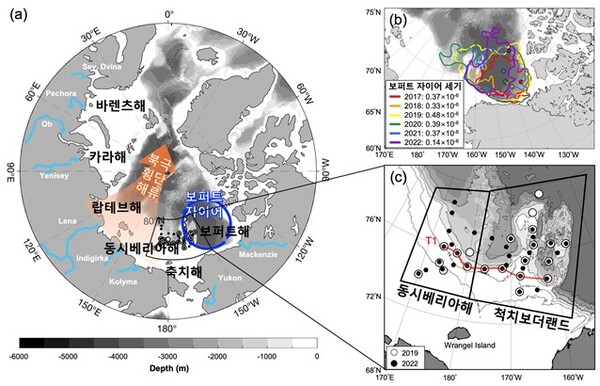
The Korea Polar Research Institute (KOPRI) announced on August 29 that it has confirmed the eastward spread of Siberian river discharge, organic matter, and sediment into the East Siberian Sea as a result of climate change.
The East Siberian Sea is a key passageway for vessels entering the Northern Sea Route from the Pacific. Researchers warned that the increase in land-derived substances in the area could alter the timing of sea ice formation, directly impacting the opening period and navigability of the Arctic shipping route.
Based on comparative analysis of Arctic observation data collected by the icebreaking research vessel Araon, KOPRI found that by 2022, Siberian river water and land-origin materials had expanded some 500 to 600 kilometers farther east compared with 2019, reaching the East Siberian Sea. Consequently, the observed amounts of river discharge and land-derived substances in the area rose by 37% and 29%, respectively.
The research team attributed the phenomenon to the weakening of the Beaufort Gyre—a clockwise ocean current in the Beaufort Sea that normally prevents Siberian river water from spreading eastward. In 2022, strong low-pressure systems developed in the East Siberian Sea, weakening the gyre and pushing surface currents eastward, carrying river water and sediment with them.
“Climate change is rapidly reducing sea ice and altering atmospheric circulation patterns, which could structurally change the pathways of material transport in the Arctic Ocean,” the team noted. “Since the influx of land-origin substances can lead to shifts in marine ecosystems, long-term monitoring and tracking are essential.”
Shin Hyung-chul, President of KOPRI, stressed, “Understanding polar changes is essential in both addressing the climate crisis and seeking new opportunities. Through continuous observation and analysis, we will provide a scientific foundation for anticipating and preparing for the Arctic’s future.”