
Should the news media 'love America'? Here's how.
A few days ago, CBS News declared the five principles of its new mission. One of them was “We love America.” And the statement added, “We make no apologies for saying so.”
No apologies needed, CBS News. But then again, I think we may have a different definition of how journalists can show their patriotism.
No American-flag pins on lapels are necessary. No jingoistic headlines about illegal raids are welcome. And, please, no fawning interviews of people in powerful positions.
Journalists and their news organizations can show their patriotism by doing their jobs of seeking the truth, no matter who it offends. They can serve the public by reporting honestly and deeply on what their government is up to — and why — even if that means they lose access or get sued.
Here’s more of what they can do to show their patriotic love of country the right way:
- Be willing to challenge authority. Almost immediately after getting the job of CBS Evening News anchor, Tony Dokoupil did a soft, lengthy interview with Defense Secretary Pete Hegseth, just after the US illegally took over Venezuela and captured its leader, Nicolas Maduro. “Hegseth answered none of the questions and (Dokoupil) didn’t push back,” was the assessment of Dan Pfeiffer of Pod Save America fame. And author Don Winslow went further, calling it “a clown show.” Dokoupil also embarrassed himself badly in the last few days by claiming in a social media post that he’d outstrip the legendary journalist who once held the anchor’s chair at CBS News: “I can promise you that we’ll be more accountable and more transparent than Cronkite or anyone else of that era.” Maybe get a few weeks under your belt before that kind of thing?
Hold the powerful accountable. So far, I’m not impressed with the mainstream coverage of the Venezuela raid, which seems too focused on the daring “how” and not the legality or the “why.” A New York Times front page headline: “Inside Mission to Stalk Maduro, Learning His Routine and Room.” It described the CIA’s planning and spying on Maduro’s daily movements, describing the mission as “highly successful,” and “virtually flawless,” while more quietly noting “larger questions about the legality and rationale for U.S. actions.”
If CBS News were really interested in “loving America,” then new boss Bari Weiss wouldn’t have spiked the 60 Minutes story about the abuses at an El Salvador prison where Venezuelan migrants have been sent without due process.
In right-wing media, the flag-waving is intense. Even Megyn Kelly, the former Fox host and now podcaster, called the Fox News coverage of the Venezuela raid “like watching Russian propaganda.”
- Do their jobs “without fear or favor.” The endless spate of kowtowing, legal settlements and cozying up by major media organizations that have been detailed here and elsewhere are the opposite of this. The shocking decline of the Washington Post’s editorial section is a case in point. Those who haven’t joined that party, including the Associated Press and the Times, who are fighting the good fight in court, deserve praise; but this attitude should be the norm, not the exception. This gets harder to do all the time when corporate owners exert their will, and when the ownership of news organizations and other media outlets continues to shrink. I wrote about this in the Guardian recently.
- Put reporting over punditry. I really appreciated the immediate interview by the excellent Issac Chotiner of the New Yorker with Oona Hathaway, the president-elect of the American Society of International Law, and a prominent Yale law professor, who is a true expert on this subject. The headline was straightforward: “The Brazen Illegality of Trump’s Venezuela Operation.” And the first question and answer went like this. Chotiner: “What is the legal basis, such as it is, for this action?” Hathaway: “Unfortunately, I don’t think there is a legal basis for what we’re seeing in Venezuela.” She goes on to logically shred the self-defense idea that’s been posited. Read it here.
Of course, if you ask CBS News, they disdain the expertise of “academics and elites” like Hathaway, pledging instead to reflect the ideas of ordinary Americans. This, we’re told, is supposed to help the media regain public trust. I doubt it, having watched this notion fail elsewhere. Plus, academics and elites, such as Hathaway, actually know things; they offer expertise, not just feelings.
One of the reasons I respect ProPublica, the investigative newsroom, so much is the depth of reporting there. Its project on American health care, “Sick in a Hospital Town,” digs beneath of the surface of American braggadocio — we’re No. 1! — to show why, among the world’s richest countries, the U.S. ranks last in terms of health outcomes. Or recall their story from last June about “the intern in charge” — Thomas Fugate, a 22-year-old with no national security experience appointed to run the government’s hub for fighting violent extremism.
These stories take a lot of digging, a lot of reporting and a lot of journalistic elbow grease. They tell us things we didn’t know, they expose wrongdoing, they don’t pull their punches. That’s the role of journalists in a free society. And that’s what I’d call loving America.
American Crisis is a community-supported project where I explore how journalism can help save democracy. Please consider joining us!
Meanwhile, at this critical moment, the lead opinion piece on the Washington Post app on Monday was “This hat should be America’s national dress,” a light-hearted proposal to make the cowboy hat the official garb of the nation. (A staff-written editorial about Venezuela, placed lower, noted the “unknowns in Venezuela. An earlier staff editorial, published Saturday, celebrated “Justice in Venezuela,” calling the raid “one of the boldest moves a president has made in years.)
Readers, here’s a sticky question for you, and I’d value your opinion. You might have heard that the New York Times and the Washington Post found out about the Venezuela raid a few hours before it was scheduled to begin. Both news organizations held off on publishing, at the request of the administration, in order to avoid endangering U.S. troops. I deeply dislike the idea of newsrooms cooperating with the government in this way — especially given Trump’s constant and destructive attacks on the press. At the same time, I think it would have been a very difficult decision to go ahead and publish with only hours to go. If the lead time had been weeks, that would have been a very different kind of decision.
I’ll also ask you if you’re as disturbed as I am by this turn of events, and what it suggests for the future. I’m interested, too, in where you’re getting your news on this, and how you’re making sense of it.
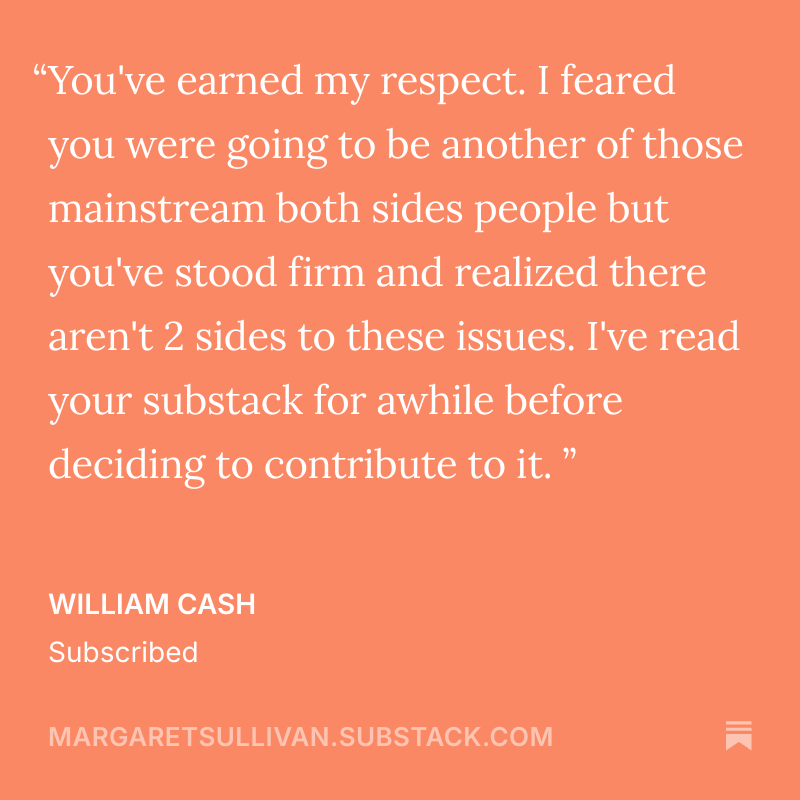
Thanks for your interest and support. Welcome to newcomers to American Crisis —here’s why one reader just became a paid subscriber. And below that, some information about what I’m doing here and why.
My background: I am a Lackawanna, NY native who started my career as a summer intern at the Buffalo News, my hometown daily. After years as a reporter and editor, I was named the paper’s first woman editor in chief in 1999, and ran the 200-person newsroom for almost 13 years. Starting in 2012, I served as the first woman “public editor” of the New York Times — an internal media critic and reader representative — and later was the media columnist for the Washington Post. These days, I write here on Substack, as well as for the Guardian US, and teach an ethics course at Columbia Journalism School. I’ve also written two books and won a few awards, including three for defending First Amendment principles.
The purpose of ‘American Crisis’: My aim is to use this newsletter (it started as a podcast in 2023) to push for the kind of journalism we need for our democracy to function — journalism that is accurate, fair, mission-driven and public-spirited. That means that I point out the media’s flaws and failures when necessary.
What I ask of you: Last fall, I removed the paywall so that everyone could read and comment. I thought it was important in this dire moment and might be helpful. If you are able to subscribe at $50 a year or $8 a month, or upgrade your unpaid subscription, that will help to support this venture — and keep it going for all. Thank you!