
Scott Trust and Guardian management face staff fury over Observer sale
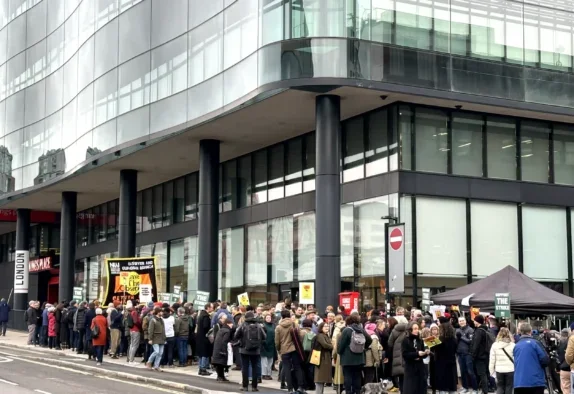
Guardian and Scott Trust leaders faced furious staff this morning as they answered questions about the plan agreed last night to sell The Observer to Tortoise Media.
Numerous staff made impassioned speeches and there were times when Scott Trust chair Ole Jacob Sunde and Guardian editor-in-chief Katharine Viner were openly jeered. Guardian Media Group chair Anna Bateson was also present, as was GMG chair Charles Gurassa who is understood to have read out a prepared statement.
There was standing room only in the morning conference room in the Guardian offices at King’s Place, London with more staff joining via Zoom.
Questions asked of management at the meeting included: Why has the sale been concluded so quickly and why were staff not consulted?
It emerged during the meeting that the Scott Trust is investing £5m in the newly merged Tortoise/Observer business. This brings the total amount of investment which Tortoise says it has to spend on The Observer to £25m.
Anger at the meeting appears to have centred around a sense of betrayal felt by Observer journalists, many of whom strongly identify with The Guardian’s mission of providing liberal journalism for free to the world. Many fear that a paywalled Observer will have a much smaller audience and be very different, and more elite, than the one than they write for now.
Leading Guardian and Observer journalists attending the meeting included science editor Robin McKie, columnist Andrew Rawnsley, investigative reporter Carole Cadwalladr and comment writer Sonia Sodha.
At one point one of the journalists at the meeting said the deal between The Scott Trust and Tortoise Media looked like “an establishment stitch-up”.
They accused the leadership team of “riding roughshod over the Scott Trust values of integrity and honesty” because The Observer’s sale was seen as a closed process involving just one bidder.
One speaker said: “You want The Observer behind a paywall so that it is not a rival to The Guardian.”
The speaker said the process was “damaging for the reputation of The Guardian, you should all be thoroughly ashamed of yourselves” – to which there was applause and cheering.
At one point editor Viner said she had been worried about the fate of a one-day, UK-only, print-only title for some time. This comment was met with shouts and jeers. One person shouted “we’re not print only” and another said: “Our journalism goes out around the world as Guardian journalism.”
At one point a relatively famous and multi-award-winning Guardian journalist asked Scott Trust chair Ole Jacob Sunde if he would call him by his name or if he knew the names of any of the journalists in the room. Sunde admitted that he did not know the journalist’s name.
The journalist responded: “I’ve been here for 34 years… Sonia, Carole… these are quite well-known people – you should know who we are.”
The Scott Trust chair said: “I’vebeen working in media for 30 years, why do you think I have done that? Why do you think I come to London often to chair The Scott Trust. You think that is because I don’t care? Of course I care.
“I’ve spent a large part of my life trying to promote liberal journalism throughout Europe. I’ve done that in Scandinavia, I’ve saved journalists’ jobs in Scandanavia, I’ve tried to do it here. That is why I am here. That is why I am putting a large part of my life into this. The fact I do not know your name should not overshadow the fact that I really care about this.”
The journalist said: “To care about the Guardian and Observer you have to know us, you have to read us, you have to care about us, you have to know our values and to be overseen by someone who doesn’t know any of us…”
At this point Viner intervened and said: “Is it because he is foreign?” This comment was met with loud jeers and comments such as “that’s shameful” and “that’s really out of order”.
In an earlier email to staff the Scott Trust chair said: “We’re confident we have agreed the best possible way forward for staff, readers and the future of both titles. It is a model that will see investment in journalism, enshrines the Scott Trust’s values in the Observer’s future, and protects the Observer and Guardian’s ability to continue to produce trusted, liberal journalism.”
Tortoise Media founder James Harding said in a statement today: “We are honoured and excited at the prospect of working together to renew The Observer, a name that represents the best of liberal, pioneering journalism. We admire its temperament, both tolerant and humane. We love its appetite for the arts and, of course, food.
“We promise its readers we will do all we can to live up to its history as a defender of human dignity and to give it a new lease of life as a powerful, progressive voice in the world.”
The joint Observer/Guardian NUJJ chapel is expected to meet today to decide to continue industrial action.
The post Scott Trust and Guardian management face staff fury over Observer sale appeared first on Press Gazette.
Related Knowledge Center: Climate economics
Climate change is now a driver of the world’s economy. The impact is profound:
- Catastrophic weather events — hurricanes, floods, droughts, high temperatures — are more frequent and more extreme. The cost can be measured in both the initial damage caused and the longer-term impact on the economy.
- Vulnerable communities are increasing climate-related investments, hardening infrastructure and taking other protective measures.
- Investment in carbon capture and storage technologies is increasingly rapidly.
- Governments are making investments and crafting regulations to reduce emissions of carbon dioxide and other greenhouse gases.
On top of all of this is the cost of uncertainty. As the Fourth National Climate Assessment, released in 2018 by the U.S. Global Change Research Program, says, “The assumption that current and future climate conditions will resemble the recent past is no longer valid.”