
Scientists dig 2,600 feet underground to test ancient clay for nuclear waste storage
A team of researchers has initiated a deep drilling project underneath a mountain in Switzerland in order to examine whether certain clay rock formations can safely store radioactive waste for thousands of years.
Led by the GFZ Helmholtz Centre for Geosciences in Germany, the effort is part of an international research initiative called DEBORAH (Deep borehole to resolve the Mont Terri Anticline Hydrogeology).
It aims to test the barrier properties of Opalinus clay (OPA), which formed during the Jurassic Period some 175 million years ago. Found in Southern Germany and Switzerland, it is widely considered a strong candidate for hosting underground nuclear waste repositories.
The team has already finished the first 180 feet (55 meters) of drilling at the Mont Terri underground rock laboratory in Switzerland, a facility that has hosted nuclear waste disposal experiments for three decades.
The researchers reported nearly 100 percent core recovery from the borehole and plan to extend the drill to about 2,626 feet (800 meters) deep.
Probing ancient rock
Located near the town of Saint-Ursanne in the Canton of Jura, the Mont Terri rock laboratory sits inside a mountain in northwestern Switzerland, where a highway tunnel runs about 492 to 656 feet (150 to 200 meters) below the surface.
At the same time, a parallel safety gallery connected to the tunnel serves as the entrance to the underground research facility. The site was established in 1966, and is currently used by 22 partners from nine countries.
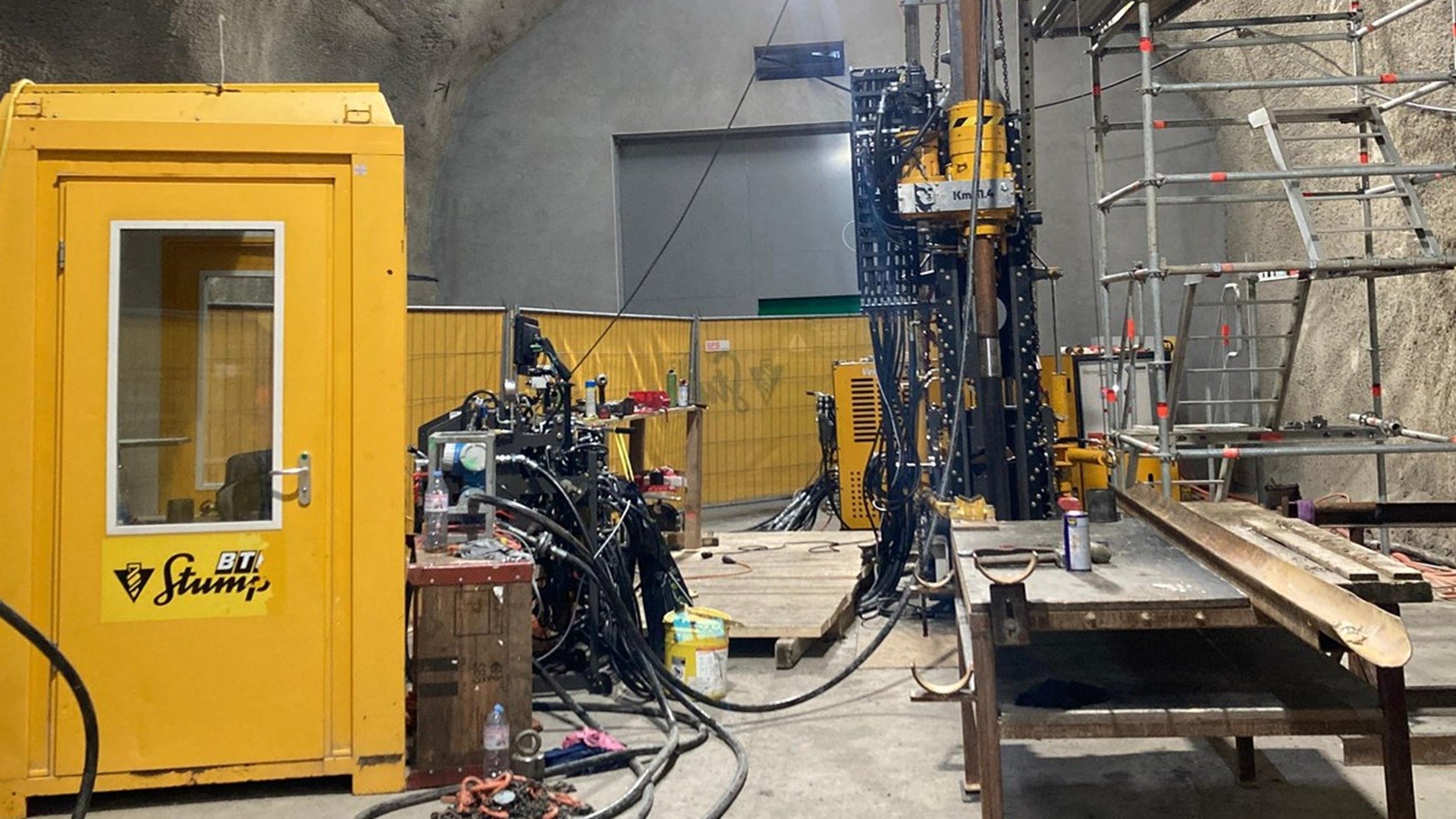
Credit: Felix Kästner, GFZ
For the current project, the team installed a drilling rig roughly 32 feet (10 meters) tall inside the laboratory. It extracts cylindrical cores by cutting a circular groove into the surrounding rock, leaving a narrow central column that is then pulled out in sections.
The samples are being carefully documented and analyzed to understand how the clay and surrounding rock layers interact with underground water systems. This is critical when evaluating long-term geological storage sites for radioactive waste.
Nuclear waste storage
The results could identify suitable rocks for nuclear waste storage in Germany, the UK, and Switzerland. Felix Kästner, PhD, a scientist at GFZ, and coordinator of the DEBORAH project, said that the first drilling section was completed as planned.
“The rapid drilling progress kept the participating scientists constantly busy with core logging and sampling,” Kästner said. “The work is a special experience for everyone involved as part of the cross-partner collaboration.”
The scientists plans to drill to a final depth of about 2,626 feet, and examine not only the Opalinus clay, but also the rock layers located above and below it. This will also help them understand the underground hydrogeological processes.
According to Kästner, the researchers are particularly focused on how water flows through the rock and interacts with the clay barrier. This can influence the long-term stability of nuclear waste repositories.
“The work allows scientists to closely observe the data collection that is essential for later laboratory analyses and computer-based models,” Kästner concluded in a statement. “We are eagerly looking forward to the coming weeks and the next drilling sections.”
Apart from drilling, the researchers are also conducting seismic and gravimetric measurements around the site. This way, they’ll be able to scan the subsurface and gain insight into the structure of the rock layers and underground water systems surrounding the Opalinus clay formation.