
Scientists and Archivists Worry Epic Games’ Control of the 3D Model Market Will ‘Destroy’ Cultural Heritage

This article was produced with support from the Capitol Forum.
Scientists, artists, and archivists are panicking about Epic Games’ deprecating of Sketchfab, the internet’s leading repository for open access 3D models, saying that the uncertain future of the platform under Epic Games’ ownership could break or limit access to hundreds of thousands of free 3D models, severely impacting their role in education, research, and conservation.
“Since its inception, Sketchfab.com, a 3D model-sharing website, has served the invaluable function of hosting and showcasing the vast digitized collections and portfolios of many museums, universities, and artists across the world,” a petition to “keep Sketchfab alive,” says. “Unfortunately, their new owners, Epic Games, intend to destroy it […] This is the virtual equivalent of burning the Library of Alexandria.”
“We have no intention of burning any libraries,” Epic’s vice president and general manager for creator marketplaces Bill Clifford told GamesIndustry.biz. “Change is tough and we’ve tried to be extremely clear and concise in our communications, and I think sometimes it’s easily misinterpreted, especially as you go deeper and deeper into Reddit threads.”
Most people today probably know Epic Games as the developer of Fortnite, but it also makes the incredibly popular Unreal Engine, and runs the Unreal Engine Marketplace, where users can buy and sell 3D models. In recent years Epic Games has consolidated a lot of the competition in this space, acquiring Quixel in 2019, and ArtStation and Sketchfab in 2021. This month, Epic Games started collapsing all these separate markets into a single new marketplace for 3D assets called Fab.
Sketchfab is no longer accepting new seller applications, and has invited existing Sketchfab creators to migrate their models to Fab, which launched last week. Epic Games has also not made clear what the plan for free and open access 3D models on Sketchfab is after 2025, but it says that it will provide those users an alternative solution eventually and plenty of notice on how that transition will work.
The Sketchfab users I talked to have a variety of specific concerns about this transition, but ultimately they are all worried that Fab is a marketplace designed for Epic Games to make a profit on sales, whereas Sketchfab prioritized open access and the ability to share 3D models for free.
“We will continue to support the scientific community, along with anyone else who uses Sketchfab to share free and view-only content including artists, hobbyists, educational institutions, the cultural heritage community and more,” Epic Games spokesperson Jake Jones told 404 Media in an email. “We will not remove the ability to share or download content on Sketchfab until we have a viable alternative.”
Epic Games also responded to a detailed list of concerns from Sketchfab users included in this article. In almost all cases, Epic Games said that the Sketchfab features users worry will break will continue to work, or that Epic Games is working on an alternative solution that will be rolled out to Fab in the future.
Emily Esser, who authored the petition to keep Sketchfab alive, reviewed those answers and was not convinced.
“No matter how much Epic staff may spin it, Fab is an indefensibly flawed product,” she told me in an email. “This was inevitable. Look on any social media page (or my linked compilation) for endless examples. Epic isn’t ‘unifying,’ they’re monopolizing.”
One of the key issues according to the Sketchfab users I talked to is how Fab will handle models under some Creative Commons licenses. At the moment, Sketchfab users can only migrate models under the Creative Commons Attribution license to Fab. This license allows for commercial use as long as the original creator of the model is credited. Other Creative Commons licenses, like CC-BY-NC, which only allows for noncommercial uses of the work, can’t be migrated.
That means that all the 3D models on Sketchfab created as part of scientific or academic research at the moment can’t be migrated to Fab.
For example, Digital Life, a non-profit that aims to preserve the heritage of life on Earth through creating and sharing high-quality and accurate 3D models of living organisms, has shared 152 of those 3D models on Sketchfab, which are used for research, education, and conservation. Duncan Irschick, a professor at UMASS Amherst and the director of Digital Life, told me that the models are used in classrooms, by researchers who want to study animal locomotion, and by conservationists who can print 3D models or create other visual materials to inform the public about endangered species.
“If you look at our 3D Rhino, I think it’s been downloaded 16,000 times, but all those are free,” Irschick told me in an interview. “We can’t sell that Rhino because I’m a scientist, and by law I cannot sell scientific data. I have no issue with people selling 3D content. My issue as a scientist is that [the transition to Fab] would remove me from the platform, and I just couldn’t really disseminate our content very easily.”
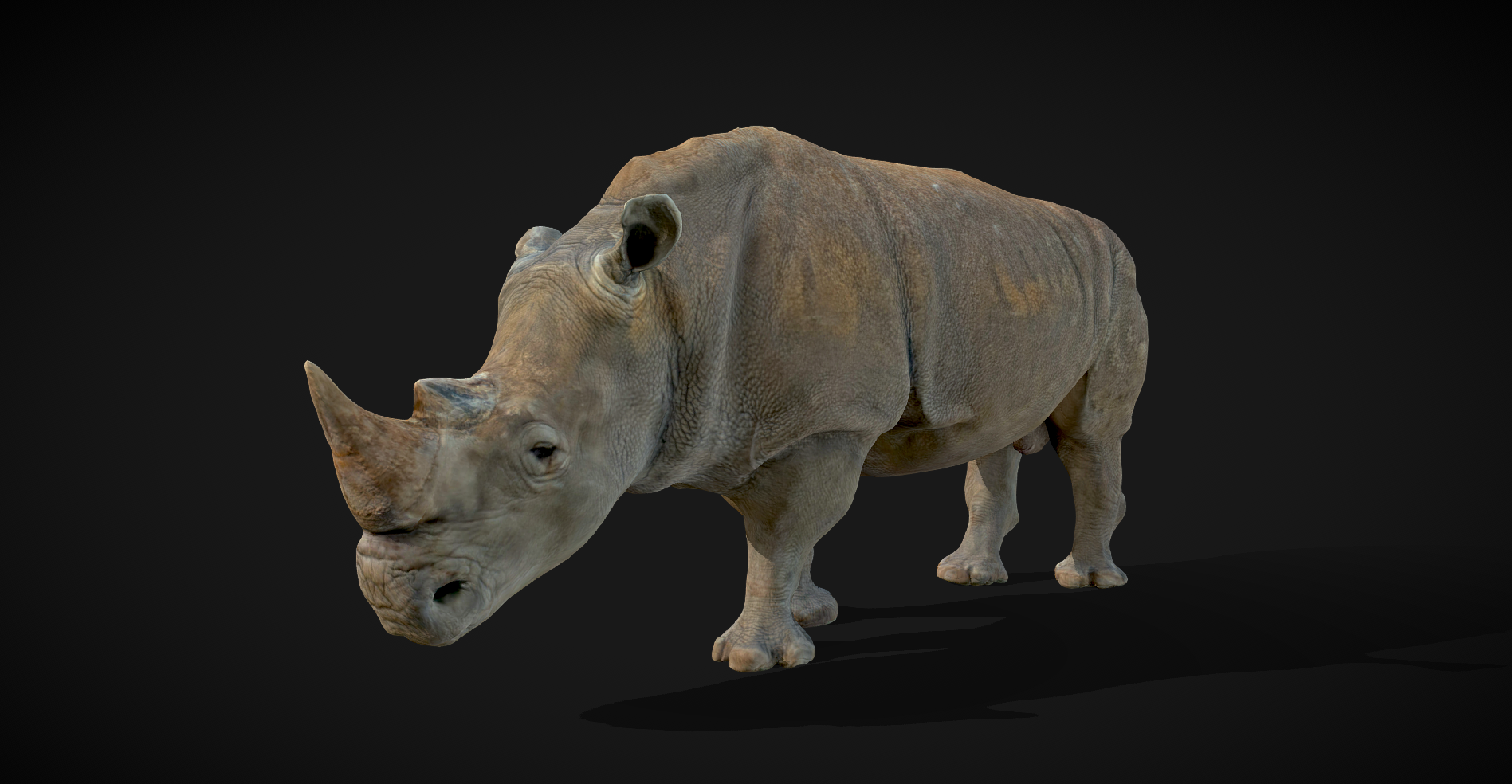
Irschick said that he will send the 3D models manually to people who ask him via email, but that this process is obviously less efficient than just letting users download the models from Sketchfab.
“We will continue to develop Fab into a destination for view-only 3D models, and in 2025, Fab will release a streamlined sign-up process for users who wish to only offer free content for download,” Epic Games told 404 Media. “We also plan to expand support for additional license types on Fab and will update our community when a wider range of licenses become available there.”
Scott Edmunds, the Editor-in-Chief of the academic GigaScience, told me that one of the publication’s goals was pushing the boundaries of how research is communicated by embedding visualization tools readers can interact with in order to better understand the data. GigaScience currently has 277 models in 14 collections on Sketchfab.
“Sketchfab has been a fantastic tool for doing this with all of the 3D imaging data we’ve published—things like microfossils for studying climate change, digitized museum specimens for the visually impaired, 3D printable plants for standardizing drone imaging, and 3D reconstructions of the brains of cave salamanders to better understand their evolution and developmental biology,” Edmunds said.
Edmunds said it’s still unclear how the migration to Fab will pan-out, but that losing access to Sketchfab 3D viewer would be the biggest problem as that’s what GigaScience and other journals use to embed content in their papers (he pointed to Table 1 in this paper as an example).
“Removing this will be detrimental to the scientific record as it will make a whole ecosystem of scientific publications broken and no longer interactive,” Edmunds said. “[This will slow] the movement to more interactive and understandable content that was starting to happen thanks to Sketchfab and other visualization tools coming on the market.”
Epic Games told 404 Media that these embeds will continue to work and that it plans to add embedding and API support to Fab in the future that will function similarly to Sketchfab.
All the Sketchfab users I talked to also pointed to Sketchfab’s “Cultural Heritage” collection as one of the most valuable aspects of the platform that they worry will be lost in the transition to Fab. The collection includes more than 100,000 3D models of works of art and ancient artifacts, many of them scanned by museums and shared under noncommercial licenses. On Fab, the 3D models that can migrate will fall under the “Objects & Decor” category.
In a Google document where Sketchfab users are listing their concerns, trying to make sense of the transition to Fab, and listing potential open source alternative, Thomas Flynn, Sketchfab’s former Cultural Heritage Lead and Community Manager, said “Regardless of the outcome over the coming months/years, I think this is a really good opportunity for the heritage community to find/build/rally around an online 3D storage and display solution that it has more/full control over… while still using Sketchfab/Fab if they want :)”
Pavel Matoušek, who creates photorealistic 3D model scans and manages the Sketchfab accounts of several museums that share 3D models of items in their collections, says that even when Epic Games does eventually explain how Sketchfab users can continue to share these models under licenses that are not currently supported on Fab, that transition will be extremely difficult for the type of institutions he works with.
“Making any change is a very hard and long process for large institutions, especially if it means reuploading thousands of models, changing API links in hundreds of display servers in museums etc,” Matoušek told me. “I knew the platform [Fab] was coming for over a year now and I was very vocal about what’s wrong about it to them, but the answer always was ‘We know it’s not great, but the decisions were already made.’”
Emily Esser, a Sketchfab user and the author of the petition to keep Sketchfab alive, listed other issues with the transition to Fab echoed by other Sketchfab users I’ve talked to. These include the fact that some commonly used file formats that are supported on Sketchfab, like Collada (.dae), can’t currently migrate to Fab, that the lighting on some models breaks during the migration process from Sketchfab to Fab (one Sketchfab user told me “the vast majority of my almost 3900 models on Sketchfab” now appear as dark on Fab), and Fab’s total lack of social features, like likes and comments, which Sketchfab users told me were critical to the platform.
Irschick, for example, said that the social features on Sketchfab made it easier for him to raise funding for the creation of new 3D models.
“When we’re trying to commission new models and raise money to create a [3D model of] a southern black rhino, of which there’s only a couple left, we’ll point to the incredible usage and say, ‘Look how much this model has been used, and look at the comments and look at the emails.’” he said. “The very large community that surrounded the open access stuff in general is a huge benefit.”
Epic Games said the “Collada (.dae) format has not received a significant update for years and is no longer as popular in the industry because it doesn’t support modern features like PBR materials” and that it has no plans to natively support Collada on Fab. However, the company said Fab will automatically convert the to another file format while still allowing users to download the original source file. Regarding lighting breaking in some cases during the migration process, Epic Games said it has “made improvements to the Fab 3D viewer since launch including enhancements to lighting to ensure publishers’ models map back more closely to what’s displayed on Sketchfab’s 3D viewer.”
“We realize some will be disappointed that we can’t bring every feature over from the four marketplaces that we’re unifying, but we will keep working to accommodate our community’s needs,” Epic Games said regarding Sketchfab’s social features not being available on Fab.
Again, while the Sketchfab users I talked to pointed to concrete issues they’re experiencing currently, a lot of the panic in the community is about an uncertain future and the fact that a piece of internet infrastructure they thought they could always rely on has changed ownership and is now part of a much larger effort to consolidate and more efficiently monetize the 3D asset marketplace, of which they are a small and inherently unprofitable part.
One of the most interesting projects on Sketchfab I came across while reporting this story is Windmill Preservation Project. It’s the personal project of Saulius Zaura, who in 2020 began using drones to create photogrammetry scans of old, abandoned windmills in Lithuania, which once had over 1,000 windmills. When one of the windmills he created a 3D model of collapsed, he realized that he had an opportunity to capture a small part of history before it disappears.
“I realized that many of them [windmills] could collapse at any time and felt responsible to not delay the project,” he wrote in 2022.
Creating 3D models of the windmills and hosting them on Sketchfab seemed like a very resilient way to preserve history, but the uncertainty around the transition to Fab shows that’s not necessarily the case.
“My experience with Sketchfab and Epic Games highlighted that digitized heritage can be just as vulnerable,” he told me. “While physical heritage decays gradually, in the digital world, it can simply be… switched off . That’s the biggest concern now when doing any long term planning.”
Related Knowledge Center: ENERGY BASICS: nuclear
Nuclear energy provides almost 20 percent of the U.S. electricity supply. Advocates have called for an expanded role for nuclear as an emissions-free fuel source. But the economics of building new reactors are daunting. In addition, lingering safety concerns are an institutionalized part of the calculation of nuclear regulation, and highly radioactive nuclear waste remains a can that public officials have been inclined to kick down the road. The Energy Information Administration projects a sharp decline in nuclear power generation over the next decade, as new nuclear plants — two are planned — are more than offset by anticipated retirements of several operating reactors.